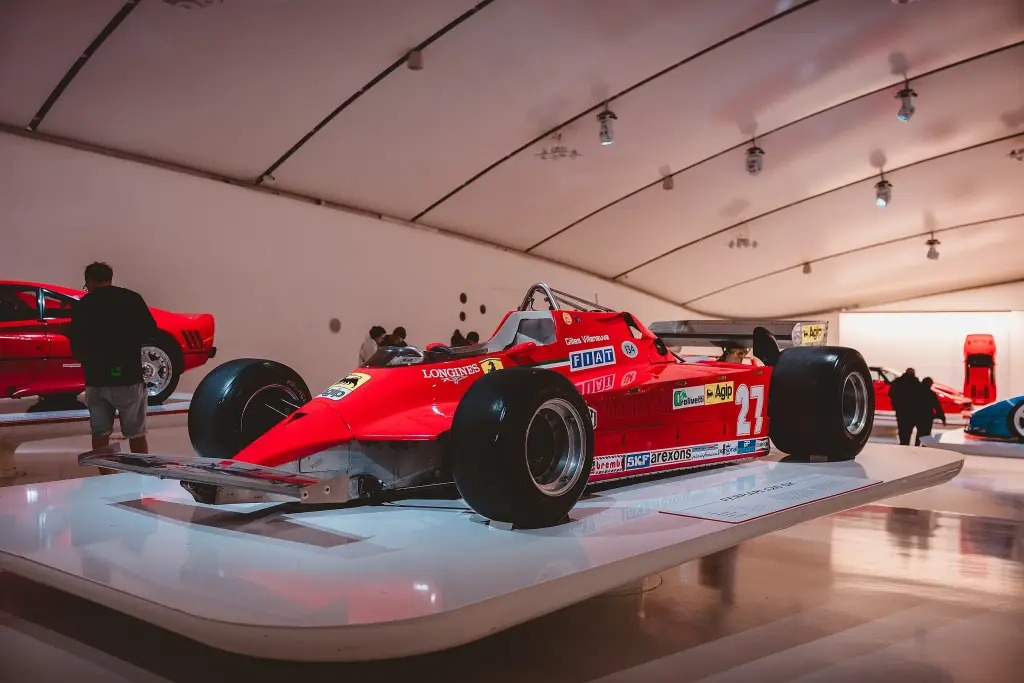
The Ferrari 126C is the car with which Ferrari raced in Formula One from 1981 through 1984. It was the team’s first attempt at a turbocharged Formula One car, designed by Mauro Forghieri and Harvey Postlethwaite, with Nicola Materazzi as engine chief engineer.
Ferrari 126C at a glance
| Seasons | 1981–1984 |
|---|---|
| Type | Formula One car, first Ferrari turbo |
| Designers | Mauro Forghieri, Harvey Postlethwaite |
| Engine chief | Nicola Materazzi |
| Engine | 1.5-litre turbocharged V6 |
| Supercharging | twin KKK turbochargers (126CK) |
| Power, qualifying | about 600 bhp (447 kW) |
| Power, race trim | about 550 bhp (410 kW) |
| Alternative engine | Comprex pressure-wave supercharger (126CX) |
| Replaced | Ferrari 312T series |
| Drivers | Gilles Villeneuve, Didier Pironi |
| Notable results | Villeneuve wins at Monaco and Spain in 1981 |
based on one source (English Wikipedia).
History of the Ferrari 126C
The 126C was designed to replace the highly successful but obsolete 312T series that Ferrari had used since 1975. The basic chassis was almost identical to the previous car, but the smaller and narrower forced-induction V6 suited the ground-effect aerodynamics then needed to be competitive: the old car’s wide 180° V12 obstructed the airflow required to generate efficient ground effect. Overall, the new package was simply better.
Comprex versus turbo
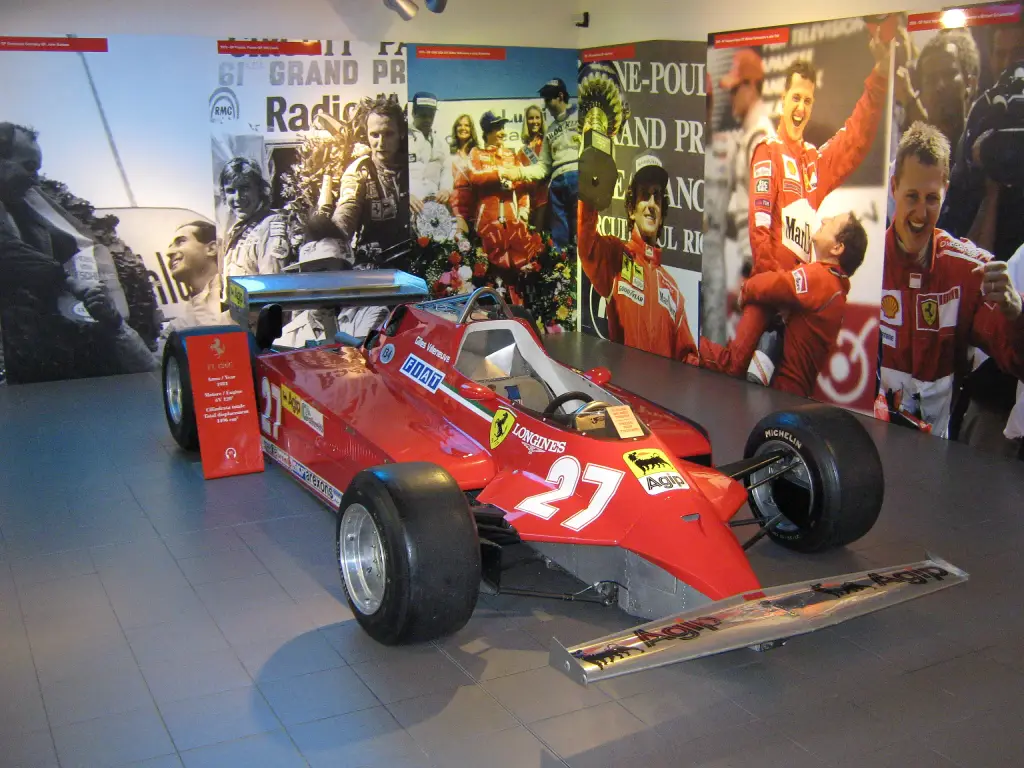
During engine development Ferrari experimented with a Comprex pressure-wave supercharger supplied by a Swiss company. That version was first called 126BBC, from Brown Boveri Comprex, and later 126CX. Drivers praised it for behaving like a naturally aspirated engine with an extended power range, which eliminated the notorious turbo lag. But the system was tall in the car and could mix exhaust and intake gases, so the team chose twin KKK turbochargers instead: about 600 bhp in qualifying trim, detuned to 550 bhp for races. The turbocharged car was called 126CK. Enzo Ferrari had hired Materazzi in December 1979 specifically for his turbocharging experience with the Lancia Stratos Group 5 silhouette cars, to match the know-how Renault had built up. Materazzi saw the advantages of the Comprex but also its difficulties, and prepared a second iteration with two smaller Comprex units driven by a hydraulic clutch instead of a belt; it was not used because the turbocharger was simpler and worth pursuing.
Handling: “a big red Cadillac”
The 126CK was first tested during the 1980 Italian Grand Prix and proved far faster than the 312T5 then in use. Gilles Villeneuve preferred it, though he had reservations about the handling. Early unreliability of the turbo engine ruined his 1981 championship hopes, but he scored back-to-back victories in Monaco and Spain and several podium places. Because of the problematic handling the car was at its best on fast tracks with long straights such as Hockenheim, Monza and Buenos Aires. Villeneuve called it “a big red Cadillac”. According to his team-mate Didier Pironi and Postlethwaite, who joined Ferrari well into 1981, the cause was not the chassis but the aerodynamics: Postlethwaite said the 126CK “had a quarter of the downforce that the Williams or Brabham had that year”. The lack of downforce, combined with hard suspension and an engine with massive turbo lag and a steep power curve, made the car slide into corners and then snap back, overloading its tyres and subjecting drivers to higher g-forces than in a Williams FW07 or Brabham BT49.
1982: the 126C2
Postlethwaite’s arrival led to a total overhaul for 1982. The turbo engine was further developed and reliability found, while an all-new chassis, suspension and bodywork were designed around Ferrari’s first genuine full monocoque, built with honeycomb aluminium panels. That made it more like the British specialist cars than any Ferrari F1 design since 1962. Smaller, nimbler and with vastly improved aerodynamics, the 126C2 handled far better than its predecessor, although the weight of the turbocharged engine still made it slower through corners than its rivals. Villeneuve and Pironi posted record testing times with it.
Design and features
- First Ferrari turbo F1 car: a 1.5-litre forced-induction V6 replacing the naturally aspirated flat-12 of the 312T series.
- Twin KKK turbochargers: about 600 bhp in qualifying, 550 bhp in race trim — the most powerful engine of 1981.
- Ground-effect bodywork: the narrow V6 left room for the underfloor tunnels the wide V12 had blocked.
- Comprex experiment: the 126CX pressure-wave supercharger removed turbo lag but was too tall and was dropped.
- First monocoque: the 1982 126C2 used a honeycomb aluminium monocoque, a first for a Ferrari F1 car.
Ferrari 126C versions
- 126CX (1981): experimental Comprex pressure-wave supercharged version, also known as 126BBC.
- 126CK (1981): the twin-KKK-turbo car that raced, winning in Monaco and Spain.
- 126C2 (1982): new honeycomb monocoque, revised suspension and bodywork, much improved aerodynamics.
The 126C replaced the V12-powered 312T and came before the F310 of the 1990s. Its drivers included Gilles Villeneuve; other Maranello racing cars are in the Ferrari collection.
Video: Gilles Villeneuve prova Ferrari 126 C2 on board (audio)
Video by alberto arcudi on YouTube.
Sources
- Ferrari 126C, English Wikipedia: design, Comprex, power figures, 1981–1982 seasons