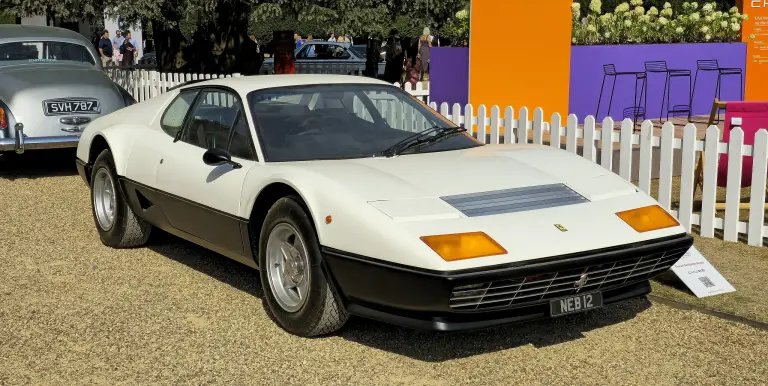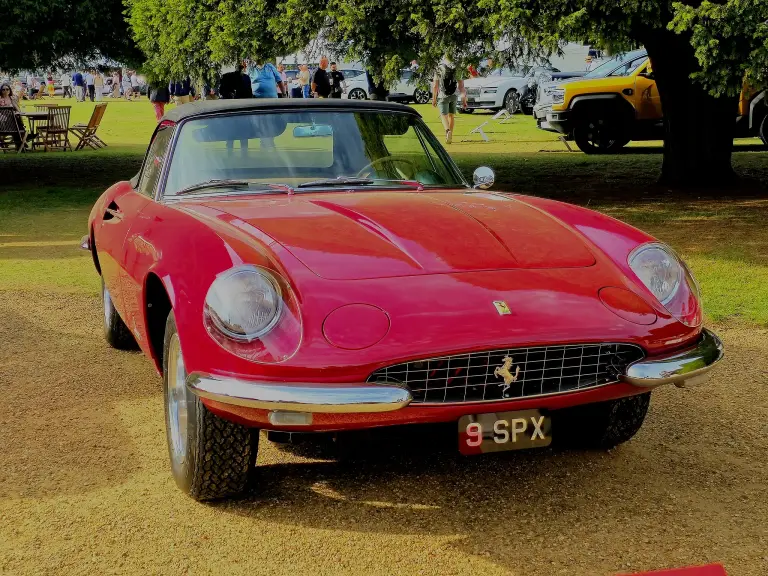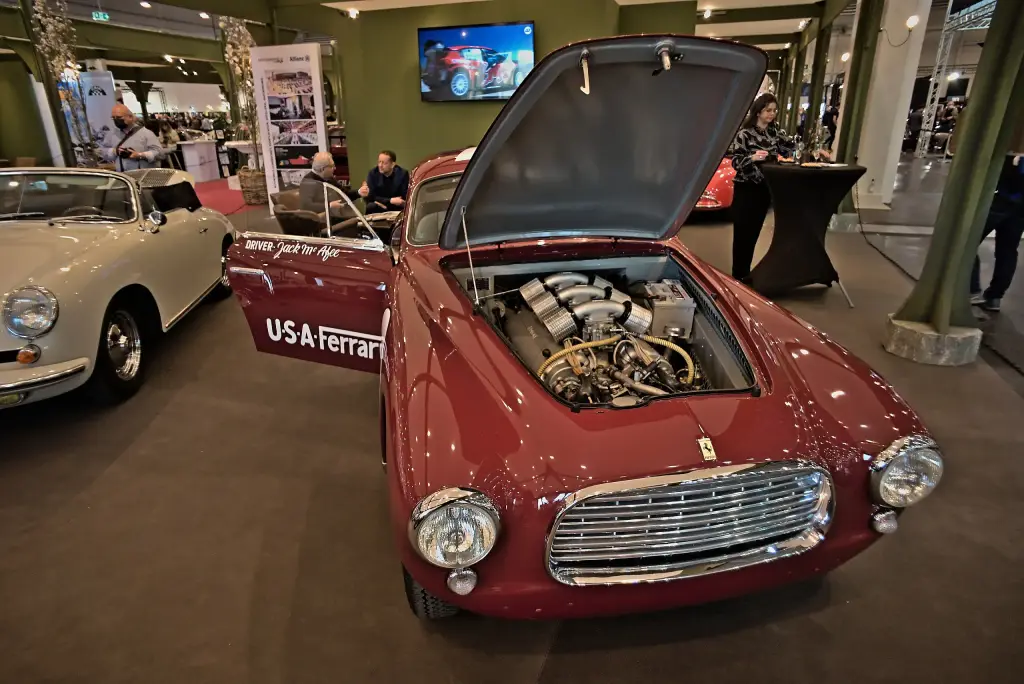
Ferrari America is a series of flagship grand touring models built mainly for the North American market in the 1950s and 1960s. They used large V12 engines and often carried custom bodywork by Italy’s famous coachbuilders.
Ferrari America at a glance
| Production | 1950–1960s |
|---|---|
| Market | North America |
| Layout | front engine, rear-wheel drive, live rear axle |
| Steering | worm and sector |
| 340 America | 1950–1952, Lampredi V12, 220 PS, 23 built |
| 342 America | six road cars, detuned to 200 hp |
| 375 America | 1953–1954, 4,522 cc, 300 PS, 12 cars |
| 410 Superamerica | 1955–1959, 4,963 cc, 340 PS, 35 built |
| 400 Superamerica | 1959, 3,967 cc, 340 PS, 47 built |
| Body styles | custom coupés, cabriolets and spiders |
based on one source (English Wikipedia); the video attached to the old records shows a 2015 F60 America, a different model, so it is not used here.
History of the Ferrari America
All America models were front-engined and rear-wheel-drive, used a live rear axle and had worm-and-sector steering. Two models, the 410 and the 400, were called Superamerica, while the final model, the 500, was called Superfast; the series also includes the 365 California.
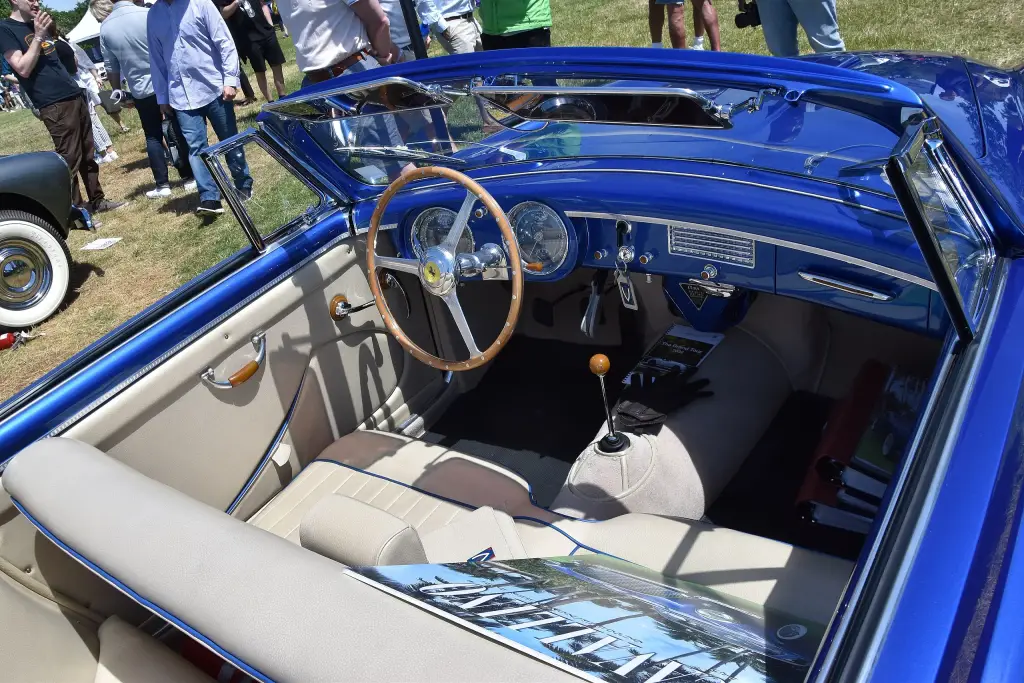
340 and 342 America
The first America cars were the 340s, produced between 1950 and 1952 with the new Lampredi V12 developed for Formula One and rated at 220 PS. Originally 23 were built: 11 by Vignale, eight by Touring and four by Ghia, with Giovanni Michelotti doing the design work for Vignale. The first two cars were converted from the 275 S, and in 1951 a 340 America Vignale Berlinetta won the Mille Miglia driven by Luigi Villoresi, while three Touring barchettas entered that year did not finish. The 340 was succeeded by the 375 America. Only six road-going 342 Americas were made: a Vignale Cabriolet by Michelotti, two Pinin Farina Cabriolets and three Pinin Farina Coupés, using the same Lampredi engine with a different air filter arrangement and detuned to 200 hp. The last, a Pinin Farina Cabriolet presented at the 1953 New York show, was upgraded to a 4.5-litre engine. The 340 and 342 used even chassis numbers like the racing cars, while the 375 and later used odd numbers.
375 America
The 375 America was introduced in 1953, with a Pinin Farina body shown at that year’s Paris Salon. It used a new 4,522 cc “long block” Lampredi V12 rated at 300 PS at 6,300 rpm with three Weber carburettors, for a claimed 0–60 mph in under seven seconds and a top speed of almost 160 mph. Built only from late 1953 through 1954, it was expensive and exclusive: 12 cars were made, ten original 375s and two 250 Europas converted to 375 specification. Most wore three- or five-window Pinin Farina coupé bodies, with about three coupés and a convertible from Vignale.
410 and 400 Superamerica
The 410 Superamerica arrived in 1955 with an engine based on the single-plug 410 S unit, enlarged to 4,963 cc and rated at 340 PS with three Weber 40DCF carburettors. It had a new chassis with independent coil-spring front suspension and was the first Ferrari road car with a five-speed gearbox; its listed top speed of 262 km/h was recognised by the Guinness Book of Records as the world’s fastest production car. In 1957 Weber 46DCF3 carburettors raised output to 360 PS for the Series III, the final development of the long-block Lampredi V12. Each 410 had custom bodywork, mostly by Pinin Farina, and at $16,800 it cost more than twice as much as a Mercedes-Benz 300 SL Gullwing; only 35 were built before production ended in 1959. The 400 Superamerica debuted in 1959 with the smaller 3,967 cc Colombo engine, still 340 PS at 7,000 rpm, four-wheel disc brakes and custom Pinin Farina bodies; 47 were built in two series.
Design and features
- Big V12 engines: from the 4.5-litre Lampredi to the 4,963 cc unit of the 410 Superamerica.
- Custom coachwork: bodies by Vignale, Touring, Ghia and mostly Pinin Farina.
- American focus: built for North American buyers, with many cars sold through Luigi Chinetti.
- Record holder: the 410 Superamerica was listed as the world’s fastest production car.
- Rare and costly: 23 of the 340, 12 of the 375, 35 of the 410 and 47 of the 400.
Ferrari America versions
- 340 America (1950–1952): 220 PS, 23 built.
- 342 America: six road cars, detuned to 200 hp.
- 375 America (1953–1954): 4,522 cc, 300 PS, 12 cars.
- 410 Superamerica (1955–1959): 4,963 cc, 340–360 PS, 35 built.
- 400 Superamerica (1959): 3,967 cc, 340 PS, 47 built.
- 500 Superfast: the final model of the line.
The America series sat above the 250 series and shares its 4.4-litre development with the Ferrari 365. More cars are in the Ferrari collection.
Sources
- Ferrari America, English Wikipedia: 340, 342, 375, 410 and 400 Superamerica