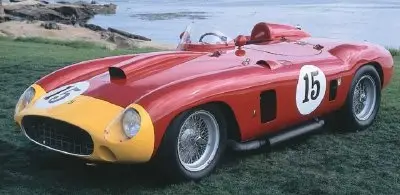
The Ferrari 290 MM is a sports racing car built in 1956 for the Mille Miglia, as successor to the 860 Monza. Four cars were made, and one of them won the 1956 Mille Miglia outright.
Ferrari 290 MM at a glance
| Production | 1956 |
|---|---|
| Built | four cars |
| Purpose | 1956 Mille Miglia and World Sports Car Championship |
| Predecessor | Ferrari 860 Monza |
| Engine | 3,490 cc (3.5 L) 60° Jano V12 |
| Valve gear | four distributors, two spark plugs per cylinder |
| Power | 320 PS (235 kW) at 7,200 rpm |
| Top speed | 280 km/h |
| Chassis | Tipo 520 spaceframe, two large oval tubes |
| Suspension | double wishbones front, de Dion axle rear |
| Body | Scaglietti, with headrest bump |
| Mille Miglia 1956 | winner (Castellotti), fourth (Fangio) |
based on one source (English Wikipedia); no free photographs of this model were found, so the previous cover is kept.
History of the Ferrari 290 MM
Ferrari built the 290 MM to answer Mercedes-Benz, which in 1955 had won the World Sports Car Championship, the RAC Tourist Trophy and the Targa Florio. The biggest change from its four-cylinder predecessors was the engine: a new 60° V12 designed by Vittorio Jano, who had joined Ferrari in 1955 after the departure of Aurelio Lampredi, working with Andrea Fraschetti and Vittorio Bellentani. It had four distributors, two spark plugs per cylinder, uprated cylinder heads, a 9:1 compression ratio and dry-sump lubrication, and was based on the 4.5-litre engine used in Ferrari’s Grand Prix cars.
Engine and chassis
Displacement was 3,490 cc, with a maximum output of 320 PS at 7,200 rpm and a claimed top speed of 280 km/h. The chassis, Tipo 520, was shared with the 860 Monza and evolved from the Tipo 510 used by Ferrari’s four-cylinder racers in 1955: two large oval tubes stiffened by smaller-diameter tubes, Ferrari’s first attempt at a spaceframe. Front suspension was by double wishbones, the rear used a de Dion axle. Carrozzeria Scaglietti designed the body and incorporated a headrest bump into its aerodynamic shape, a feature that became characteristic of Ferrari racing cars through the 1950s and 1960s.
Racing career
Ferrari entered five cars for the 1956 Mille Miglia: two 290 MMs, two 860 Monzas and a single 250 GT SWB. Eugenio Castellotti won the race in a 290 MM, while another, driven by Juan Manuel Fangio, finished fourth. Phil Hill and Maurice Trintignant won the Swedish Grand Prix that year, giving Ferrari overall victory in the 1956 World Sportscar Championship. In 1957 a 290 MM — converted from an 860 Monza — won the 1000 km Buenos Aires with Wolfgang von Trips, Alfonso de Portago and Eugenio Castellotti sharing the driving.
Design and features
- Jano V12: Ferrari’s new 3.5-litre engine with four distributors and twin spark plugs per cylinder.
- First spaceframe: the Tipo 520 chassis with oval main tubes was Ferrari’s first spaceframe design.
- Headrest bump: a Scaglietti aerodynamic detail that spread across Ferrari’s racing cars.
- Mille Miglia winner: Castellotti’s victory in 1956 was the car’s defining result.
Ferrari 290 MM versions
- 290 MM (1956): four cars built for the works team.
- 290 MM converted from 860 Monza: the car that won the 1957 1000 km Buenos Aires.
The 290 MM preceded the V12 sports racers of the 250 series and the later 330 P prototypes. More cars are in the Ferrari collection.
Sources
- Ferrari 290 MM, English Wikipedia: engine, chassis, racing history