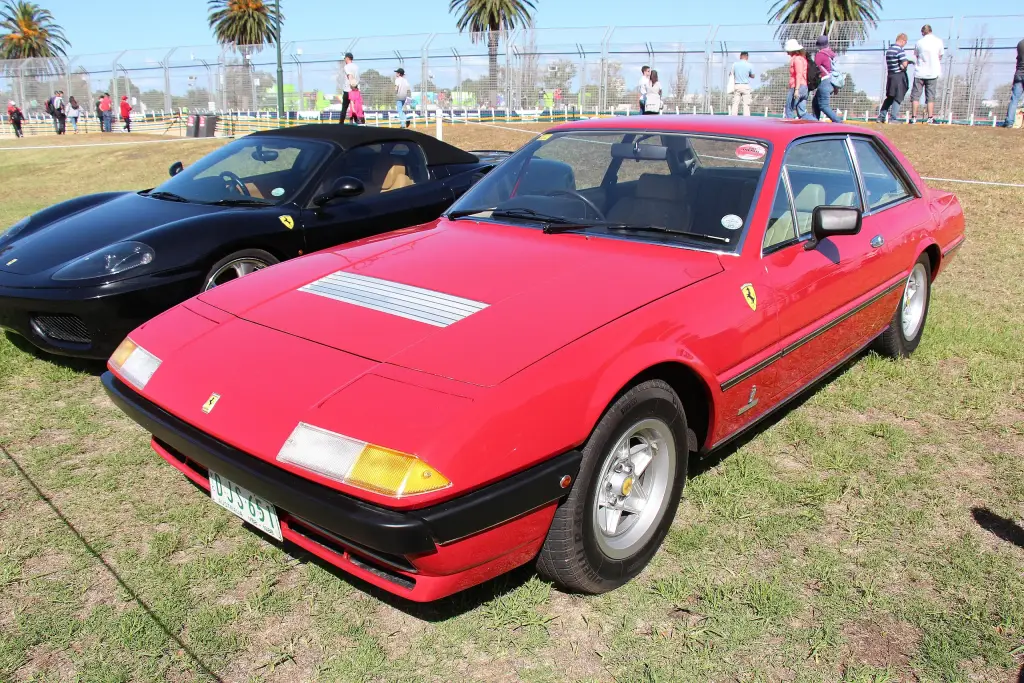
The Ferrari 365 GT4 2+2, Ferrari 400 and Ferrari 412 are a series of four-seater grand tourers built between 1972 and 1989. The three cars are closely related, the name changes reflecting engine changes and styling revisions.
Ferrari 400 at a glance
| Production | 1972–1989 |
|---|---|
| Type | F101, front-engined V12, rear-wheel drive |
| 365 GT4 2+2 engine | 4,390 cc V12, 340 PS at 6,200 rpm |
| 365 GT4 2+2 gearbox | five-speed manual |
| 400 engine | 4,823 cc V12, 340 PS |
| 400 i power | 310 PS (315 PS after the 1982 update) |
| 412 engine | 4,943 cc V12 |
| Transmissions | five-speed manual or GM THM400 three-speed automatic |
| Wheelbase | 2,700 mm |
| 365 GT4 2+2 built | 524 including three prototypes |
| 400 built | 502 (355 Automatics, 147 GTs) |
| 400 i built | 1,305 (883 Automatics, 422 GTs) |
based on one source (English Wikipedia).
History of the Ferrari 400
The series began in 1972, a year after the 365 GTC/4, when a new 2+2 debuted at the Paris Motor Show: the 365 GT4 2+2. Its name referred to the single-cylinder displacement of 365 cc, four overhead camshafts and the 2+2 seating. Most of the mechanicals, including the 4,390 cc V12 with six side-draft Weber 38 DCOE carburettors producing 340 PS, came from its predecessor. The gearbox was a five-speed all-synchromesh manual, five-spoke alloy wheels sat on Rudge knock-off hubs with Borrani wires optional, and standard equipment included leather, electric windows and air conditioning. Ferrari built 524, including three prototypes.
Design and chassis
Ferrari turned again to Leonardo Fioravanti at Pininfarina, whose three-box design was a clear departure from the fastback 365 GTC/4; it followed the 365 GTB/4 Daytona as the second Ferrari with the characteristic swage line dividing the body into upper and lower halves. The tubular steel chassis came from the GTC/4 but the wheelbase grew 200 mm to 2,700 mm. Bodies were steel with a fibreglass floor, built by Pininfarina in Turin and shipped finished to Modena for assembly. Suspension used double wishbones, coil springs coaxial with the dampers and anti-roll bars all round, with hydraulic self-levelling at the rear. The Tipo F101 V12 had an alloy head and block, four overhead cams, 24 valves and wet-sump lubrication, and drove through a shaft to a limited-slip differential. Steering was servo-assisted and brakes were discs all round. Coachbuilders such as Pavesi and Straman offered convertible conversions, and Switzerland’s Felber showed a shooting brake on 400 GT basis, the Croisette, at the 1981 Geneva show.
400, 400 i and 412
At the 1976 Paris Motor Show Ferrari unveiled the 400 in two forms: the 400 Automatic with a GM THM400 three-speed automatic — the first Ferrari with an automatic transmission — and the 400 GT with a five-speed manual. The V12 was stroked to 4,823 cc with six Weber 38 DCOE carburettors and stayed at 340 PS, for 0–60 mph in 7.1 seconds. Changes included five-stud wheels replacing the knock-offs, a revised interior, a front spoiler lip and double instead of triple tail lights; 502 were built, 355 Automatics and 147 GTs. Fuel injection arrived in 1979 with the 400 i: Bosch K-Jetronic cut power to 310 PS but greatly improved emissions, enough to meet US standards, and top speed was 240 km/h. Late in 1982 new camshaft profiles and exhaust headers raised output to 315 PS, with a revised interior, a narrower grille, body-colour bonnet vents and tail panel, and lower-profile Michelin TRX tyres on metric wheels. Ferrari built 1,305 of the 400 i, 883 Automatics and 422 GTs.
The 412 of April 1985 (chassis Tipo F101 EL) took the engine out by 1 mm to 4,943 cc, hence the new name, and ran until 1989, bringing to an end Ferrari’s longest-ever production series. Although the automatic option might suggest an American-market design, no version was officially imported to the United States: Enzo Ferrari believed that new environmental and safety rules and a 55 mph national speed limit meant the eight-cylinder cars would suffice there. Many nevertheless arrived as grey imports.
Design and features
- Longest-running Ferrari: the same basic design stayed in production from 1972 to 1989.
- First automatic Ferrari: the 400 Automatic used a GM THM400 three-speed.
- Fioravanti styling: a three-box shape with the swage line first seen on the Daytona.
- Self-levelling rear suspension: double wishbones and anti-roll bars at both ends.
- Fuel injection: the 400 i cleaned up emissions at the cost of some power.
Ferrari 400 versions
- 365 GT4 2+2 (1972–1976): 4,390 cc, five-speed manual, 524 built.
- 400 Automatic (1976–1979): first Ferrari automatic, 355 built.
- 400 GT (1976–1979): five-speed manual, 147 built.
- 400 i (1979–1985): fuel injection, 1,305 built.
- 412 (1985–1989): 4,943 cc engine, the last of the line.
The series followed the Ferrari 365 and was replaced by the Ferrari 456, the next front-engined V12 four-seater.
Video: Ferrari 365 GT/4 2+2 V12 sound!! 1080p HD
Video by Gumbal on YouTube.
Sources
- Ferrari 365 GT4 2+2, 400 and 412, English Wikipedia: design, chassis, models, production numbers