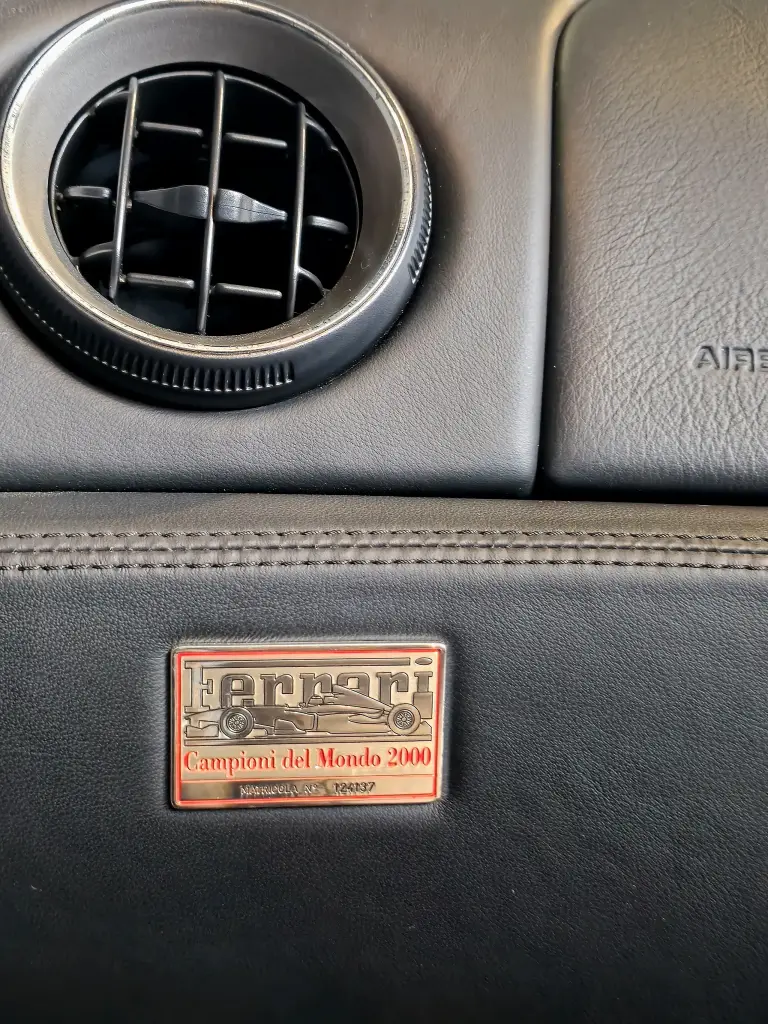
The Ferrari 550 Maranello is a front-engined V12 two-seat grand tourer built from 1996 to 2002. It marked Ferrari’s return to a front-engine, rear-wheel-drive layout for its two-seater 12-cylinder model, 23 years after the 365 GTB/4 Daytona.
Ferrari 550 Maranello at a glance
| Production | 1996–2002 |
|---|---|
| Type | F133 |
| Layout | front engine, rear transaxle, rear-wheel drive |
| Engine | 5,474 cc 65° V12, F133 A |
| Power | 485 PS (357 kW; 478 hp) at 7,000 rpm |
| Torque | 568 N·m at 5,000 rpm |
| Bore × stroke | 88 × 75 mm |
| Gearbox | six-speed transaxle with limited-slip differential |
| Chassis | tubular steel space frame, aluminium body |
| Top speed | 320 km/h |
| Barchetta built | 448 |
| 550 built in total | 3,083 (1996–2001) |
based on one source (English Wikipedia). This article also covers the 575M Maranello and 575 Superamerica records that redirect here.
History of the Ferrari 550 Maranello
Since 1973, when the front-engined 365 GTB/4 Daytona gave way to the mid-engined Berlinetta Boxer, Ferrari’s top 12-cylinder two-seater had used a mid-mounted flat engine; the Boxer became the Testarossa, whose final evolution was the 1994 F512 M. Under Luca Cordero di Montezemolo, who took office in 1991, the F512 M’s replacement was developed as a traditional front-engined V12 grand tourer. After 30 months of development the 550 Maranello was unveiled in July 1996 at the Nürburgring circuit. Its name referred to the 5.5 litres of engine displacement and to the town of Maranello.
Design and chassis
Pininfarina carried out both exterior and interior design. The exterior is credited to Elvio D’Aprile under the supervision of Lorenzo Ramaciotti and was created between 1993 and 1996, with the interior penned by Goran Popović. Frame and main engine components were shared with the 2+2 Ferrari 456, though the 550’s 2,500 mm wheelbase was 100 mm shorter. The chassis is a tubular steel space frame to which aluminium body panels were soldered, and the Pininfarina body had a drag coefficient of 0.33. The engine sits almost behind the front axle, with the six-speed gearbox at the rear axle together with the limited-slip differential. Suspension is double wishbone with coaxial coil spring and damper units at all four corners and anti-roll bars at both ends; steering is rack and pinion with variable power assistance. Ventilated discs measure 330 mm at the front and 310 mm at the rear, and the 18-inch wheels are magnesium alloy. Electronic aids included two-level anti-slip regulation and four-way ABS.
Engine
The F133 A is a naturally aspirated 65° V12 with four valves per cylinder, dual overhead camshafts and a variable-length intake manifold. Displacing 5,474 cc with an 88 mm bore and 75 mm stroke, it produced 485 PS at 7,000 rpm and 568 N·m at 5,000 rpm, enough for a claimed top speed of 320 km/h.
Barchetta and the 575M
In 2000 Ferrari introduced the 550 Barchetta Pininfarina, a limited-production roadster of which just 448 examples were made; its F133 C engine offered the same output. In 2002 the 550 was replaced by the 575M Maranello, an all-round improved rather than all-new version fitted with a larger 5.75-litre version of the F133 engine. In total 3,083 units of the 550 Maranello were produced between 1996 and 2001.
Design and features
- Front-engine return: the first front-engined V12 two-seater Ferrari since the Daytona of 1973.
- Rear transaxle: six-speed gearbox and limited-slip differential at the back for balance.
- 5.5-litre V12: 485 PS and 568 N·m, with a variable-length intake manifold.
- Space frame body: tubular steel frame with soldered aluminium panels and a 0.33 drag coefficient.
- 550 Barchetta: an open limited edition of 448 cars.
Ferrari 550 Maranello versions
- 550 Maranello (1996–2002): the coupé, 3,083 built.
- 550 Barchetta Pininfarina (2000): roadster limited to 448 examples.
- 575M Maranello (2002): updated successor with a 5.75-litre engine.
The 550 shared its frame with the Ferrari 456 and was followed by the Ferrari 599 GTB Fiorano. More cars are in the Ferrari collection.
Sources
- Ferrari 550, English Wikipedia: history, chassis, engine, Barchetta, production