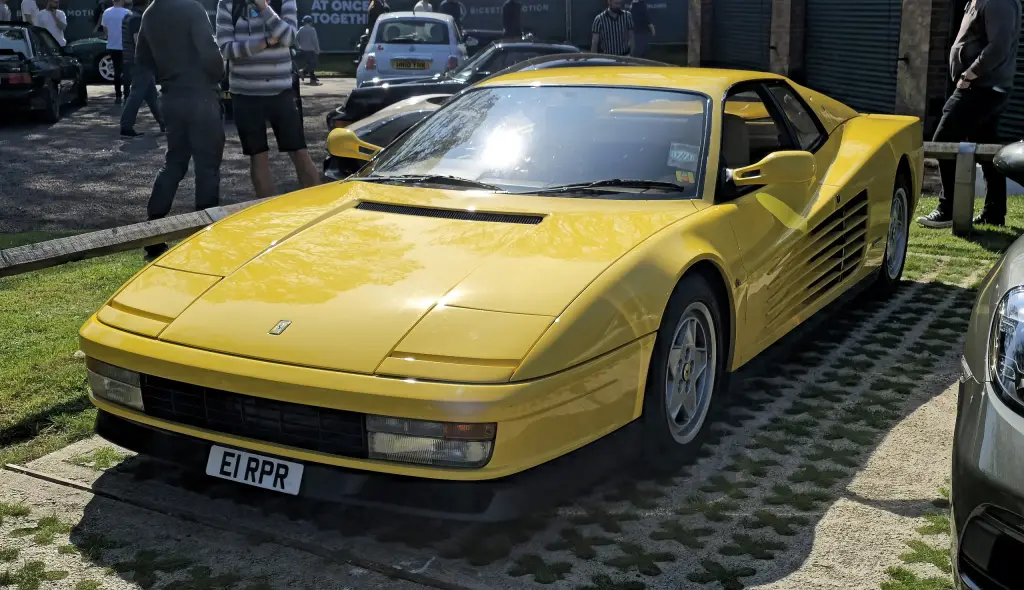
The Ferrari Testarossa is a 12-cylinder mid-engine sports car that went into production in 1984 as the successor to the Berlinetta Boxer. Including the later 512 TR and F512 M revisions, almost 10,000 cars were built, making it one of the most mass-produced Ferraris of its time.
Ferrari Testarossa at a glance
| Production | 1984–1991 (512 TR and F512 M to 1996) |
|---|---|
| Type | F110 |
| Premiere | 1984 Paris Auto Show |
| Engine | flat-12, four-valve heads with red cam covers |
| Power | 390 PS at 6,300 rpm |
| Torque | 490 N·m at 4,500 rpm |
| Gearbox | rear-mounted five-speed manual |
| Weight distribution | 40 per cent front, 60 per cent rear |
| Width | 1,976 mm |
| Wheelbase | 2,550 mm |
| Drag coefficient | 0.36 |
| Versions | Testarossa, 512 TR, F512 M |
based on one source (English Wikipedia); the video attached to the old record is no longer available, so the article has none.
History of the Ferrari Testarossa
The Testarossa traces its roots to the faults of the 1981 512 BBi: a cabin that grew increasingly hot because coolant plumbing ran between the front-mounted radiator and the mid-mounted engine, and a lack of luggage space. To fix both, the Testarossa was designed larger than its predecessor: at 1,976 mm wide it was half a foot wider than the Boxer, and the wheelbase grew about 64 mm to 2,550 mm, accommodating luggage in a carpeted compartment under the forward-opening front lid, with extra storage behind the seats. The roofline was half an inch taller for headroom.
Design
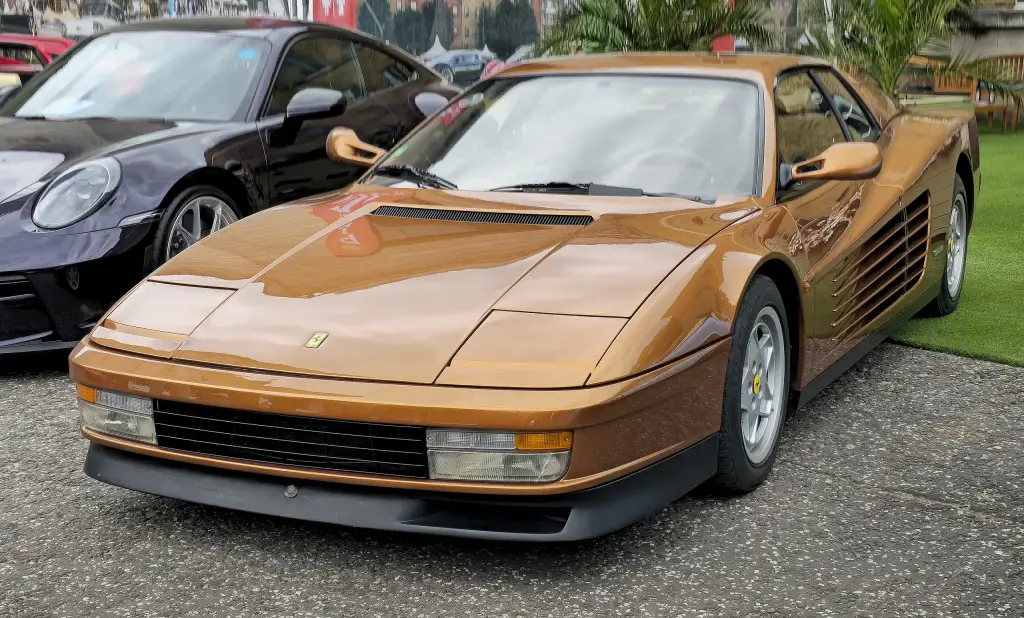
The design came from Pininfarina, from a team led by Leonardo Fioravanti and made up of Ian Cameron, Guido Campoli, Diego Ottina and Emanuele Nicosia. The original idea was Nicosia’s, with Fioravanti setting the layout using his aerodynamic training. The designers first tried to minimise the side intakes, which could not be left open because of American safety legislation, then decided to turn them into a statement of style — the strakes, sometimes called cheese graters, that became emblematic of the late 1980s. They also made the car wider at the rear than at the front, improving stability. Unlike the Boxer, the Testarossa had twin side radiators near the engine instead of one at the front, which removed much of the piping and gave a cooler cabin; the car did not need a rear spoiler, and its drag coefficient of 0.36 was significantly lower than the Lamborghini Countach’s 0.42.
Mechanicals
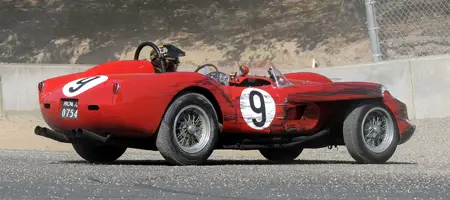
The name pays homage to the 1957 World Sportscar Championship-winning 250 Testa Rossa; Testa Rossa, literally “red head”, refers to the red-painted cam covers of both cars’ 12-cylinder engines, and the Testarossa’s four-valve heads were finished in red. Like its predecessor it used double wishbone suspension front and rear, with 10-inch-wide alloy rear wheels for traction, and its drivetrain evolved from the 512 BBi’s with near-identical displacement and compression ratio. Engine output was 390 PS at 6,300 rpm and 490 N·m at 4,500 rpm.
512 TR and F512 M
The original Testarossa was re-engineered for 1992 and introduced as the 512 TR at the Los Angeles Auto Show, effectively a completely new car with a weight distribution improved to 41 per cent front and 59 per cent rear. Another variant, the F512 M, appeared at the 1994 Paris Auto Show; it dropped the TR initials and added M for modificata, the final version of the line, with a 42:58 weight distribution. The F512 M was Ferrari’s last vehicle with the flat-12 engine.
Design and features
- Side strakes: the “cheese grater” intakes that became the car’s signature.
- Side radiators: twin coolers at the rear instead of one at the front, giving a cooler cabin.
- Bigger than the Boxer: 1,976 mm wide and a 2,550 mm wheelbase, with proper luggage space.
- Red-headed flat-12: four-valve heads with red cam covers, 390 PS.
- Last flat-12: the F512 M of 1996 closed the line.
Ferrari Testarossa versions
- Testarossa (1984–1991): the original car.
- 512 TR (1992–1994): re-engineered version with better weight distribution.
- F512 M (1994–1996): final version and Ferrari’s last flat-12.
The Testarossa replaced the Ferrari Berlinetta Boxer, and its design fed the Ferrari Mythos concept. The Ferrari 348 borrowed its styling themes.
Sources
- Ferrari Testarossa, English Wikipedia: development, design, engine, 512 TR and F512 M