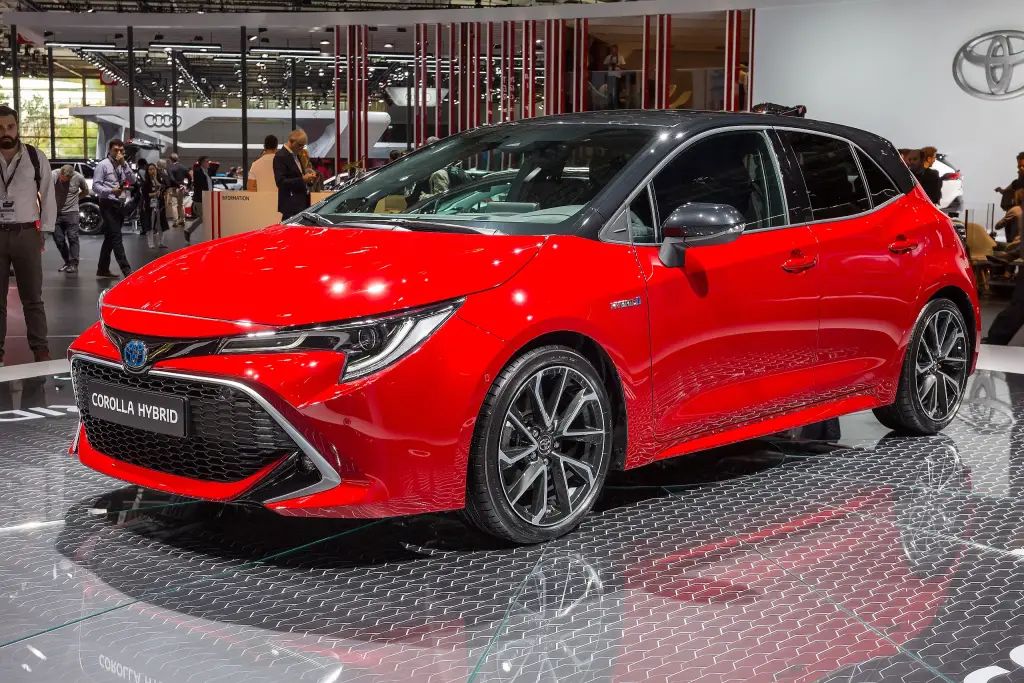
The Toyota Corolla is a series of compact cars sold worldwide since 1966. Since 1997 it has been the best-selling automobile nameplate of all time, overtaking the Volkswagen Beetle, and Toyota passed 50 million Corollas over twelve generations in 2021 and more than 54 million by early 2026.
Toyota Corolla at a glance
| Maker | Toyota |
|---|---|
| Production | Since November 1966 |
| Generations | Twelve |
| Class | Compact car, formerly subcompact |
| Name | Latin for “small crown” |
| First engine | 1.1-litre K pushrod |
| Drive | Rear-wheel drive early, front-wheel drive later |
| Sold through | Toyota Corolla Store, Japan |
| Japanese twin | Toyota Sprinter until 2000 |
| Sales | Over 54 million by early 2026 |
Based on one source: the English Wikipedia article on the Toyota Corolla.
History of the Toyota Corolla
First generation (E10; 1966)
The Corolla was unveiled at the 1966 Tokyo Motor Show and went on sale in November that year with a new 1,100 cc K pushrod engine. It was the second car sold at Toyota Corolla Store, after the smaller Publica, and in 1968 the fastback Corolla Sprinter was added, exclusive to Toyota Auto Store. The name comes from the Latin for small crown, continuing Toyota’s royal naming theme after the Crown and Corona, and the car has always been sold through Corolla Store in Japan.
E20 to E80 (1970–1987)
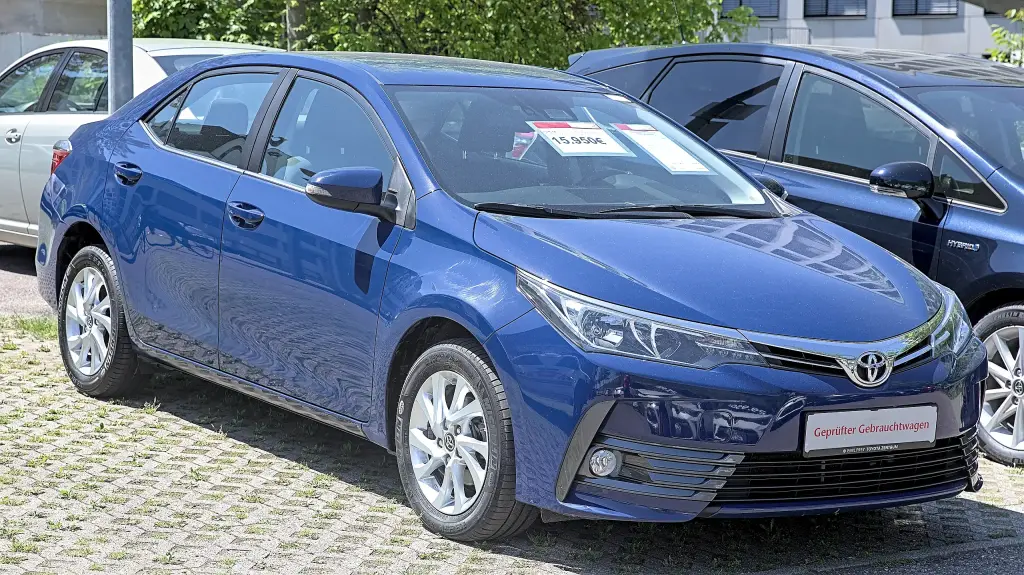
The second generation of May 1970 used a rounder body and separated the Corolla and Sprinter names, which until then had been two treatments of the same car. The 1400 cc T and 1600 cc 2T engines joined the range in September 1970, and in March 1972 the twin-cam 2T engine created the Corolla Levin and Sprinter Trueno. The third generation of April 1974 was larger and heavier and added a two-door liftback. A square-edged restyle followed in March 1979 with the E70, which was the last to use the K and T engines and the first to offer fuel injection in Japan. The E80 of May 1983 brought a sloping bonnet, the 1.8-litre 1C diesel and new hatchback and liftback bodies, and from 1985 rebadged E80 Sprinters were sold in America as the Chevrolet Nova.
A global car
Later generations moved the Corolla to front-wheel drive and made it one of the most widely produced cars in the world, assembled in Japan, Brazil, Canada, China, Pakistan, South Africa, Taiwan, Thailand, Vietnam, Turkey and the United Kingdom among others, and previously in Australia, India, Indonesia, Malaysia, New Zealand, the Philippines and Venezuela. It was built at NUMMI in California until March 2010 and from late 2011 in Mississippi. From 2006 to 2018 the hatchback version was sold in Europe and Japan as the Toyota Auris, a name that was dropped when the E210 generation returned to the Corolla badge. The Corolla’s traditional rivals have been the Nissan Sunny, Honda Civic, Mitsubishi Lancer and Subaru Leone.
Design and features
- Best-seller: the best-selling car nameplate of all time, with over 54 million sold.
- Twelve generations: continuous development since 1966.
- Royal name: corolla means small crown, after the Crown and Corona.
- Global production: built on every continent except Africa’s south and Antarctica, in dozens of plants.
Toyota Corolla versions
- E10 (1966): the original 1.1-litre car.
- E20 (1970): T and 2T engines, and the first Levin and Trueno.
- E30 (1974): larger body and a two-door liftback.
- E70 (1979): square-edged design and optional fuel injection.
- E80 (1983): diesel engine and new hatchback and liftback bodies.
- Auris (2006–2018): the hatchback version under a separate name.
The Corolla family includes the E90 and E120 generations, the Sprinter twin and the Auris hatchback. More cars are in the Toyota collection.
Sources
- Toyota Corolla, English Wikipedia: history, generations, production