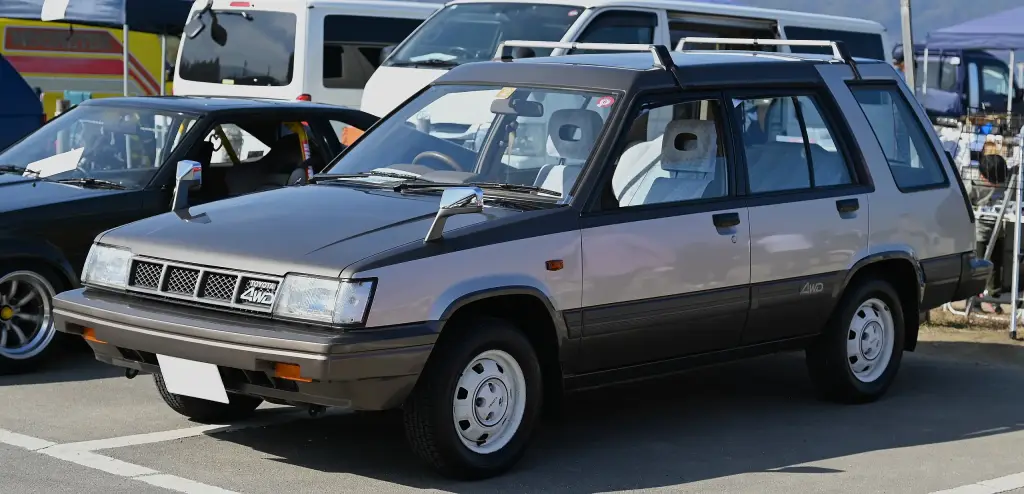
The Toyota Sprinter Carib was a front-engined, four-wheel-drive station wagon produced under the Sprinter name from 1982 to 2002. The first generation was based on the second-generation Tercel and exported as the Tercel 4WD wagon, while the last two generations used Corolla and Sprinter wagon bodies and were sold abroad as Corolla wagons.
Toyota Sprinter Carib at a glance
| Maker | Toyota |
|---|---|
| Production | August 1982 – 2002 |
| Class | Four-wheel-drive station wagon |
| First generation | AL25G, Tercel-based |
| Second generation | AE95G, Corolla E90-based |
| Engines | 1.5-litre, later 1.6-litre fours |
| Gearbox | Six-speed manual with extra-low, or three-speed automatic |
| Four-wheel drive | Part-time, then full-time with a centre differential lock |
| Export names | Tercel 4WD wagon, Corolla All-Trac, Corolla 4WD wagon |
| Name | From the caribou |
Based on one source: the English Wikipedia article on the Toyota Sprinter Carib.
History of the Toyota Sprinter Carib
First generation (AL25G; 1982)
The Sprinter Carib arrived in Japan in August 1982 and was exported soon after as the Tercel 4WD wagon; it had been previewed as the RV-5 concept at the Tokyo Motor Show in October 1981. It was Toyota’s answer to the growing demand for four-wheel-drive recreational wagons, a segment Subaru had led since 1972 with the Leone. The body came in two flavours: a vertical grille with long bumpers for Japan and North America, and a version with the Japanese Corolla II’s grille and bumper for Europe and Australasia. It used a 1.5-litre engine and a six-speed manual: five normal gears plus an extra-low ratio of 4.71:1, giving a 17.5:1 final drive for extracting the car from trouble, usable only in four-wheel drive and at very low speed. A three-speed automatic arrived in October 1983. Better-equipped cars had an inclinometer above the radio, shared with the Land Cruiser J70. The drivetrain was built from existing parts: the Tercel’s engine, transaxle and front drive, the E70 Corolla’s coil-sprung live rear axle and propshaft, and a transfer case built into the gearbox as the only major new part.
Four-wheel drive and updates
The system offered front-wheel drive, four-wheel drive and, on manual cars, the extra-low gear. Because there was no centre differential, four-wheel drive could only be used on loose or slippery surfaces, or the drivetrain would wear. In August 1984 the top manual model gained a twin-Venturi 3A-SU engine, the interior was refreshed and manual cars adopted a button for four-wheel drive instead of a lever; for 1985 the gearbox changed, the extra-low gear was lowered to 4.871 and the final drive went from 3.727 to 4.100 for better acceleration and traction. Toyota’s TEMS suspension was added in Japan in May 1987, along with a new grille.
Second generation and the end
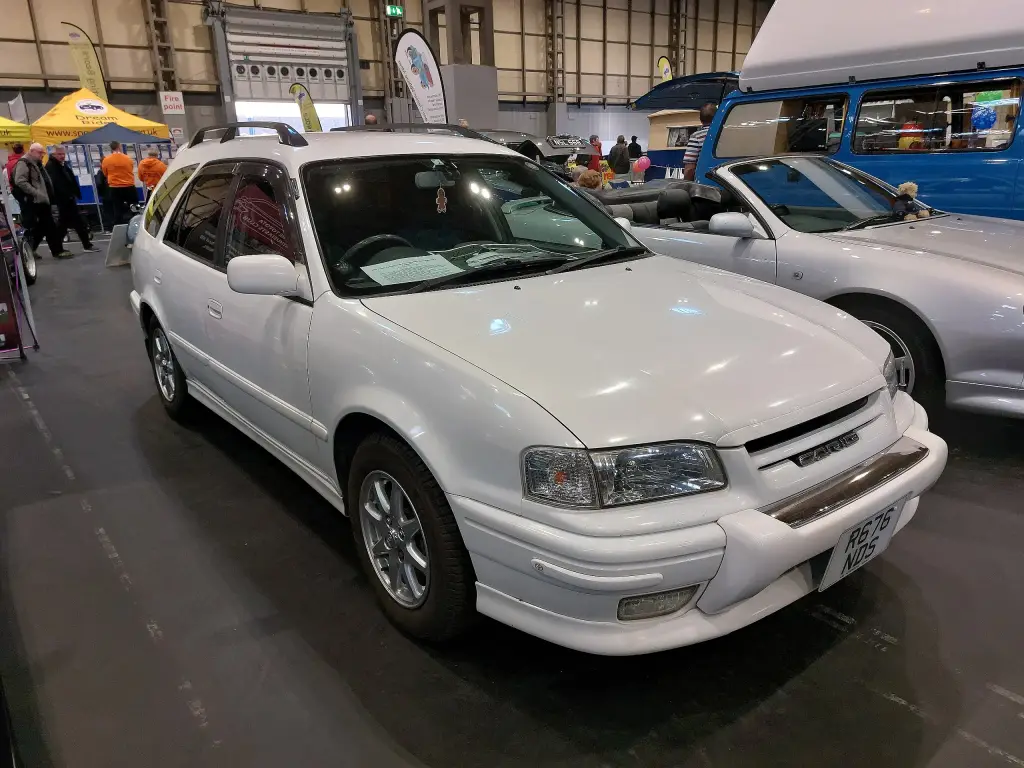
The second-generation Carib, the AE95G, was launched in February 1988 and exported as the Corolla 4WD wagon, the Corolla Tercel 4WD in parts of Europe and the Corolla All-Trac in North America. It used the E90 Corolla and Sprinter wagon shell with a rear end echoing the previous car, and the four-wheel drive became full-time with a centre differential lock operated by a button: locked, it split power 50/50; unlocked, most torque went to the front. The engine became a transverse 1.6-litre 16-valve four, carburetted or fuel-injected depending on market, with a five-speed manual or four-speed automatic. Some Japanese models had a height control switch that raised the body by 30 mm and returned it automatically above 80 km/h. An August 1990 update brought a new bumper, grille, wheels and a revised 4A-FHE engine for Japan, and the line continued to 2002.
Design and features
- Extra-low gear: a 4.71:1 ratio giving a 17.5:1 final drive for slow off-road work.
- Inclinometer: a tilt gauge shared with the Land Cruiser J70.
- Part-time to full-time: four-wheel drive evolved with a centre differential lock.
- Height control: some Japanese cars could raise the body by 30 mm.
Toyota Sprinter Carib versions
- AL25G (1982): first generation with a 1.5-litre engine and six-speed manual.
- 1984 update: 3A-SU engine and button-operated four-wheel drive.
- AE95G (1988): second generation with full-time four-wheel drive.
- Corolla All-Trac: the North American name for the second generation.
- 1990 update: new front end and 4A-FHE engine for Japan.
The Carib was the wagon member of the Sprinter and Corolla E90 families, and its first generation was based on the Tercel. More cars are in the Toyota collection.
Sources
- Toyota Sprinter Carib, English Wikipedia: generations, four-wheel drive, exports