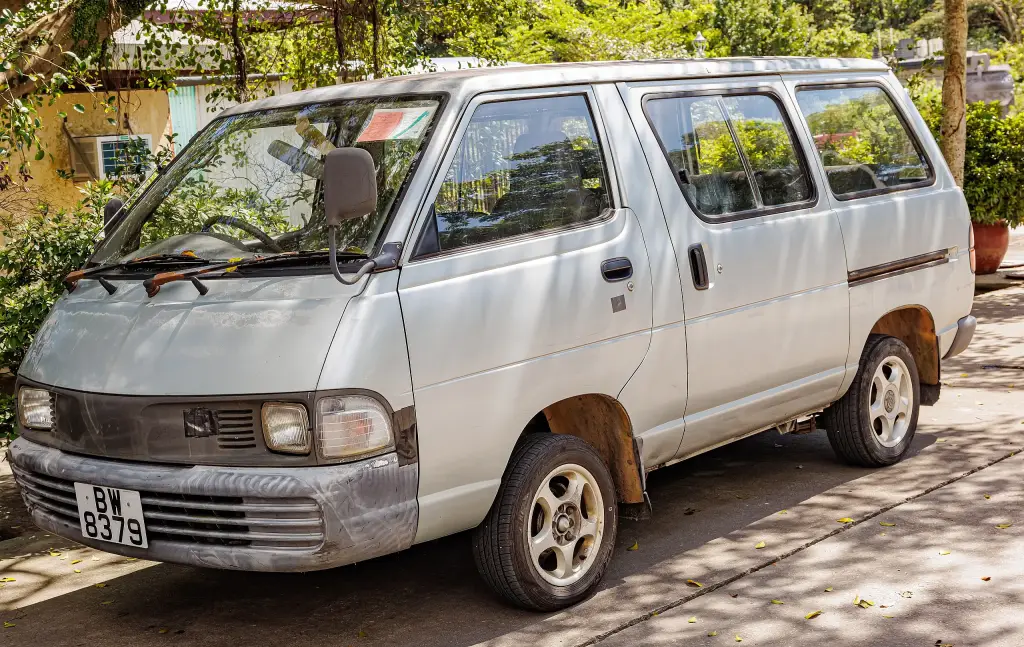
The Toyota LiteAce and TownAce are a line of light commercial and passenger vans built since 1970. The LiteAce began as a light-duty truck sized between the small MiniAce and the larger HiAce, and its larger TownAce relation eventually merged with it into one model line.
Toyota LiteAce at a glance
| Maker | Toyota, developed by Toyota Auto Body |
|---|---|
| Production | Since November 1970 |
| Class | Light truck and van |
| Layout | Cab-over engine, later semi-cab-over |
| First model | M10 truck with the 1,166 cc 3K engine |
| Payload | 750 kg with a three-seat bench |
| Van added | February 1971 |
| TownAce | Larger van from October 1976 |
| Sold through | Toyota Auto Store (LiteAce), Corolla Store (TownAce) |
| Names | LiteAce, TownAce, Spacia, MasterAce Surf, Daihatsu Delta |
Based on one source: the English Wikipedia article on the Toyota LiteAce.
History of the Toyota LiteAce
First generation (M10; 1970)
The LiteAce was developed by Toyota Auto Body and released in November 1970 as a larger, more upmarket line above the 1967 MiniAce. It filled the gap between the MiniAce and the HiAce while staying within Japanese size and engine regulations, so buyers avoided the extra taxes that came with the larger HiAce. It followed the growing popularity of affordable cab-over trucks able to carry up to 1,000 kg: the LiteAce truck offered 750 kg with a three-seat front bench and a high- or low-deck bed, against the MiniAce’s 500 kg. A one-box van and wagon arrived in February 1971 with a single kerbside sliding door and seating for three, six or nine; a five-door twin-sliding-door version and a high-roof wagon came in September 1973. The nine-seater was dropped in 1975 for emissions reasons. In February 1978 the 1,166 cc 3K engine gave way to a 1,290 cc 4K-J, with a small facelift.
TownAce and the M20
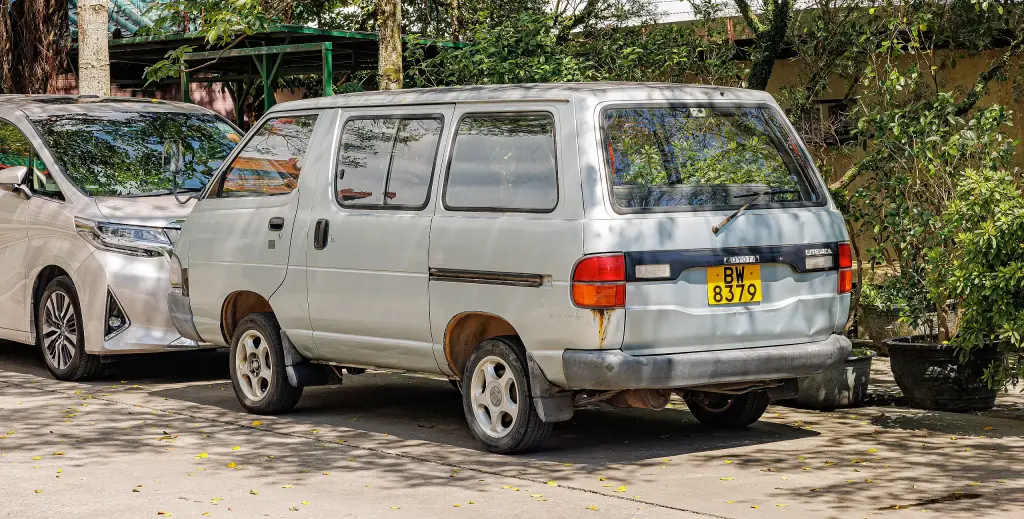
The larger TownAce (R10) was released in October 1976, heavily based on the M10 LiteAce. The second-generation LiteAce van, wagon and truck arrived in October 1979 and was widely exported for the first time: the wagon seated up to eight in a 2/3/3 layout with fully reclining second and third rows, and options included dual-zone air conditioning, a four-speaker audio system, aluminium wheels and, on the high-roof GXL, a moonroof. Trucks gained a “just low” version with 10-inch double rear tyres and 13-inch front wheels to lower the bed. The 1,290 cc 4K-J produced 69 PS, while the wagon used a 1,770 cc 13T-U of 92 PS; a three-speed automatic and five-speed manual became optional in December 1980, along with a flagship FXV grade and swivelling second-row seats.
One line, many names
The two model lines existed separately until 1982, when TownAce trucks became rebadged LiteAce trucks; in 1992 LiteAce vans became rebadged TownAce vans, uniting the ranges. In Japan the LiteAce was sold at Toyota Auto Store and the TownAce at Corolla Store. Both were widely exported to Africa, Asia and Australia, and some versions were sold in Japan as Daihatsu Delta models, from the Delta 750 based on the LiteAce truck to the Delta Wide based on the TownAce van. The Spacia, a high-roof TownAce wagon, later became a name in its own right.
Design and features
- Tax-friendly size: kept within Japanese regulations to avoid the HiAce’s extra taxes.
- 750 kg payload: the original truck carried more than the MiniAce.
- TownAce: the larger relation that eventually merged with the LiteAce.
- Many badges: also sold as the Daihatsu Delta and the Spacia.
Toyota LiteAce versions
- M10 truck (1970): the first LiteAce, with the 3K engine.
- M10 van (1971): one-box van and wagon with up to nine seats.
- TownAce (1976): larger van based on the LiteAce.
- M20 (1979): second generation, widely exported.
- Spacia: high-roof TownAce wagon.
- Daihatsu Delta: rebadged versions sold in Japan.
The LiteAce sits between the HiAce and the smaller ToyoAce, and its passenger versions were sold alongside the Granvia. More cars are in the Toyota collection.
Sources
- Toyota LiteAce, English Wikipedia: generations, specifications, names