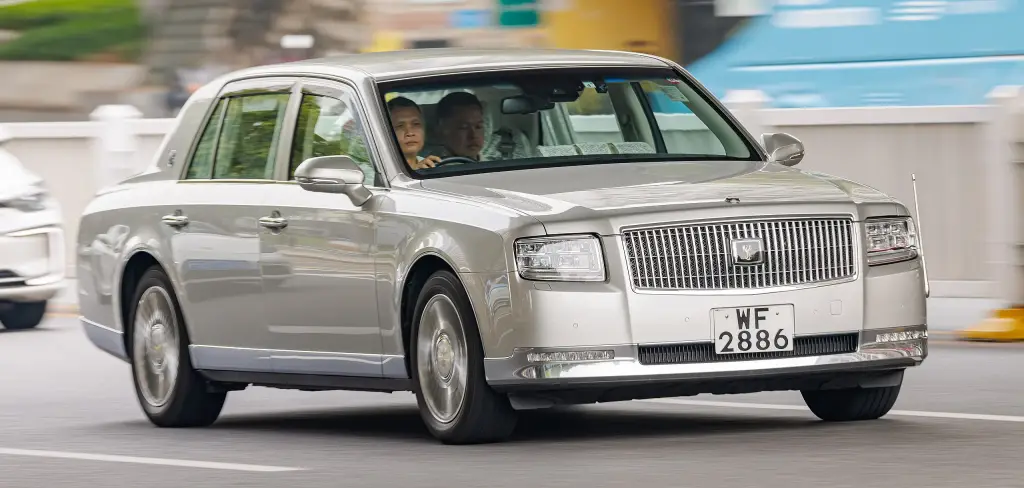
The Toyota Century is a full-size luxury car and limousine produced mainly for Japan since 1967 and serving as Toyota’s domestic flagship. It takes its name from the hundredth birthday of Sakichi Toyoda, the founder of Toyota Industries, and is used by the Imperial House of Japan, the Prime Minister, senior officials and business leaders.
Toyota Century at a glance
| Maker | Toyota |
|---|---|
| Production | Since 1967 |
| Market | Mainly Japan |
| Class | Full-size luxury car and limousine |
| First generation | G20/G30/G40, 1967–1997 |
| Engines | 3.0-, 3.4- and 4.0-litre V8; V12 from 1997 |
| Badge | Golden phoenix, not the Toyota oval |
| Sold through | Selected Toyota Store dealers |
| Limousine | From October 1989 |
| Name | Sakichi Toyoda’s 100th birthday |
Based on one source: the English Wikipedia article on the Toyota Century.
History of the Toyota Century
First generation (G20/G30/G40; 1967)
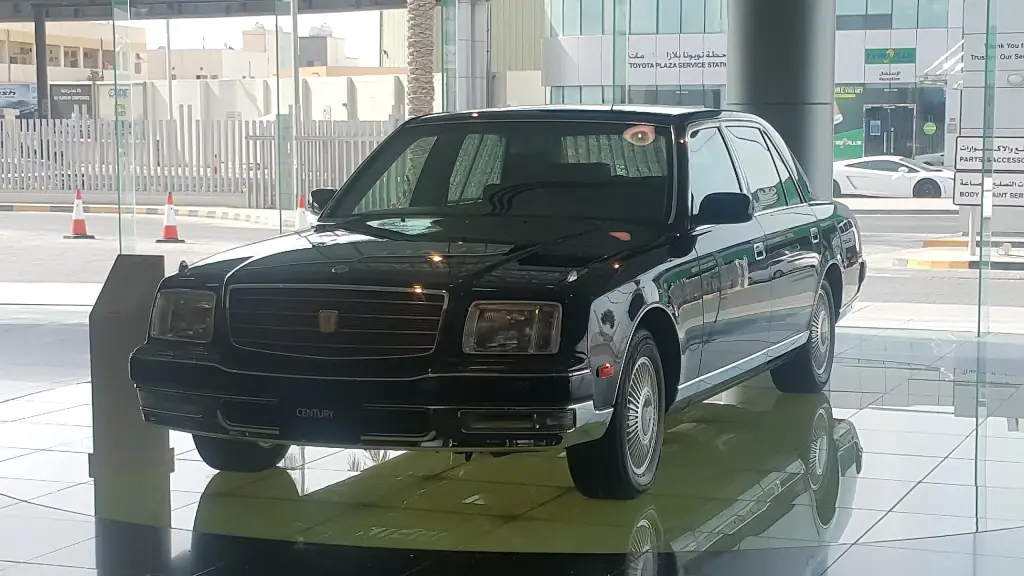
The original Century was based on the 1964 Crown Eight and its 2.6-litre V8, and appeared almost two years after the Nissan President. It used an upgraded 3.0-litre 3V V8, replaced in April 1973 by the 3.4-litre 4V and then by the 4V-U with Toyota’s TTC emission control. Only column shifters were offered at first, with a manual as the base option, until the manually shifted versions were dropped in 1973 and 1974. Fuel injection arrived in November 1978 with the 4V-EU, and in November 1982 the engine changed to the 4.0-litre 5V-EU along with a major facelift. The car used trailing-arm suspension with airbag support springs, electric door latches and, from 1971, automatic climate control. Apart from cosmetic changes and engine upgrades, the design stayed largely untouched for thirty years.
The limousine and the bubble years
During Japan’s bubble economy Century sales doubled, from 1,027 cars in 1985 to 2,117 in 1989. In October 1989 Toyota added the Century Limousine, 650 mm longer at 5,770 mm with a 3,510 mm wheelbase, a padded vinyl roof, an opera window in the centre pillar and 150 mm wider rear doors; annual production of 60 was planned. A September 1987 update replaced the three-speed hydraulic automatic with a four-speed electronic unit and added a floor-shifted D-type with front bucket seats.
V12 and hybrid
The second generation, from 1997, was the only Century with a Toyota-designed V12, an engine made for this car alone. In 2018 the model returned to a V8, this time with hybrid assistance. The Century is not sold at Lexus dealers in Japan, only at specific Toyota Store locations, and it never carries the Toyota oval: its badge is a golden phoenix, the Hō’ō of East Asian mythology associated with the Imperial House. A black Century is an icon of conservative success in Asia, which is why its exterior has changed so little. The nameplate added an SUV body style in 2023 and became a separate brand in 2025.
Design and features
- Phoenix badge: a golden Hō’ō instead of the Toyota oval.
- V8, then V12: the 1997 generation used a V12 built only for the Century.
- Coachwork continuity: the same formal shape was kept for three decades.
- Official use: a favourite of the Imperial Household and the Prime Minister.
Toyota Century versions
- 3.0-litre V8 (1967): the original Century, based on the Crown Eight.
- 3.4-litre V8 (1973): larger engine, later with fuel injection in 1978.
- 4.0-litre V8 (1982): 5V-EU engine and a major facelift.
- D-type (1987): floor shifter and front bucket seats.
- Century Limousine (1989): 5,770 mm long, with a vinyl roof and opera window.
- V12 generation (1997): the only Century with twelve cylinders.
The Century is Toyota’s Japanese flagship above the Crown and alongside the Celsior. More cars are in the Toyota collection.
Sources
- Toyota Century, English Wikipedia: history, engines, limousine