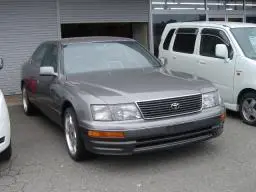
The Toyota Celsior was the Japanese-market version of the Lexus LS 400 and LS 430, sold from 1989 until the Lexus marque arrived in Japan in 2006. It was the visible result of the F1 — Flagship One — project, a secret programme that cost Toyota more than a billion dollars.
Toyota Celsior at a glance
| Maker | Toyota |
|---|---|
| Production | 1989–2006 |
| Market | Japan |
| Class | Full-size luxury saloon |
| Project | F1, begun in 1983 |
| First generation | XF10, from 1989 |
| Engine | 4.0-litre 1UZ-FE V8, 245 PS |
| Gearbox | Four-speed automatic with ECT-i |
| Suspension | Double wishbones, optional air suspension |
| Built in | Tahara, Aichi |
| Name | From the Latin celsus, “lofty” |
The Celsior is the Japanese-market Lexus LS and is described in the English Wikipedia article on the LS; this page uses the first-generation and naming sections only. No free photograph of a Celsior was available, so the record keeps its existing cover.
History of the Toyota Celsior
The F1 project
In August 1983 Toyota chairman Eiji Toyoda started the F1 project, a clandestine effort to build a world-class luxury saloon for international markets. It had no fixed budget or deadline and used no existing Toyota platform or parts. Chief engineer Ichiro Suzuki aimed to beat American and European flagships in aerodynamics, quietness, top speed and fuel efficiency. About 60 designers, 1,400 engineers in 24 teams, 2,300 technicians and 200 support staff built roughly 450 prototypes and 900 engine prototypes and covered 2.7 million kilometres of testing. Designers evaluated 24 kinds of wood and many leathers over two years before choosing the interior trim, and the final design was frozen in May 1987 after development costs of more than US$1 billion.
The car
The LS 400 debuted in January 1989 at the Detroit auto show, and production began on 15 May 1989 at Tahara. The Celsior was the Japanese-badged version of the same car, with the 4.0-litre 1UZ-FE 32-valve V8 of 245 PS and 350 N·m, a four-speed automatic with electronically controlled shifts, double-wishbone suspension with high-mounted upper arms and optional air suspension. It reached 100 km/h in 8.5 seconds and 250 km/h, with a drag coefficient of 0.29 and a cabin measured at 58 dB at 100 km/h — quieter than a BMW 735i or Mercedes-Benz 420 SE.
Celsior and LS
Production was limited to about 50,000 cars a year to protect quality, with 40,000 for the United States, 8,000 for Japan and only about 2,000 for the rest of the world. In Japan the same car carried the Celsior name, which comes from the Latin celsus, meaning lofty or elevated. The Celsior continued through the LS 400 and LS 430 generations until 2006, when Lexus was introduced in Japan and the domestic car took the Lexus badge like everywhere else.
Design and features
- F1 programme: a secret, budget-free project to build a world-class luxury saloon.
- 1UZ-FE V8: a new 4.0-litre 32-valve engine of 245 PS.
- Quiet cabin: 58 dB at 100 km/h, better than its German rivals.
- Double wishbones: high-mounted upper arms, with optional air suspension.
- Aerodynamics: a drag coefficient of 0.29 for a conventional saloon.
Toyota Celsior versions
- XF10 Celsior (1989): the first generation, matching the LS 400.
- Second generation (1994): the LS 400 update.
- Third generation (2000): the LS 430 era.
- Lexus LS (2006): the Celsior name ended when Lexus arrived in Japan.
The Celsior was Toyota’s flagship above the Crown and Century, and it shared its market with the Aristo. More cars are in the Toyota collection.
Sources
- Lexus LS, English Wikipedia: F1 project, engineering, generations