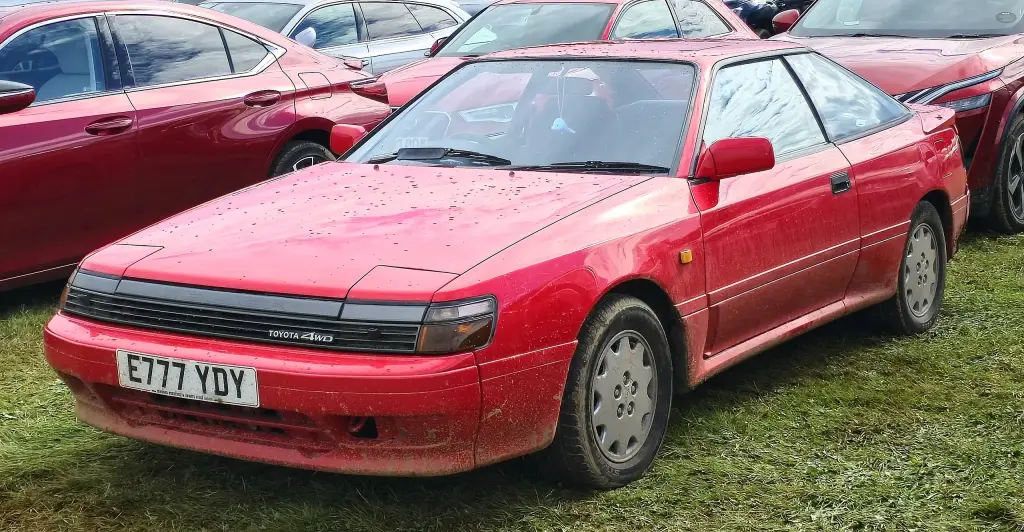
The Toyota Celica GT-Four is a high-performance sports car and a variation of the Celica Liftback, produced from 1986 to 1999 with a turbocharged 3S-GTE engine and full-time all-wheel drive. It was created to compete in the World Rally Championship, whose rules required a manufacturer to build road-going versions in sufficient numbers; such cars are called homologation specials.
Toyota Celica GT-Four at a glance
| Produced | 1986 to 1999 |
|---|---|
| Generations | ST165 (1986–1989), ST185 (1989–1993), ST205 (1994–1999) |
| Engine | turbocharged 3S-GTE, with full-time all-wheel drive |
| ST165 output | 182 to 190 hp and 249 N·m, depending on market |
| ST185 (Japan) | 225 PS (165 kW) and 304 N·m |
| Built at | Tahara plant, Aichi, Japan; rally cars prepared by Toyota Team Europe in Cologne |
| WRC debut, ST165 | 1988 Tour de Corse; first win 1989 Rally Australia |
| WRC debut, ST185 | 1992 Rallye Monte-Carlo; first win 1992 Safari Rally, one of four wins that year |
| US name | All-Trac Turbo |
History of the Toyota Celica GT-Four
The Celica GT-Four concept started with a convertible prototype shown at the 1985 Tokyo Motor Show with the theme “Open Air 4WD Sport”. The convertible was never built, but the idea went into the liftback, which started production in October 1986. The GT-Four introduced Toyota’s first performance drivetrain that powered all four wheels. Although the engine and gearbox sat across the car, hollow splined shafts let the system deliver power to a centre differential, so the torque split could range from fully front to fully rear. A viscous coupling held the split steady at 50:50.
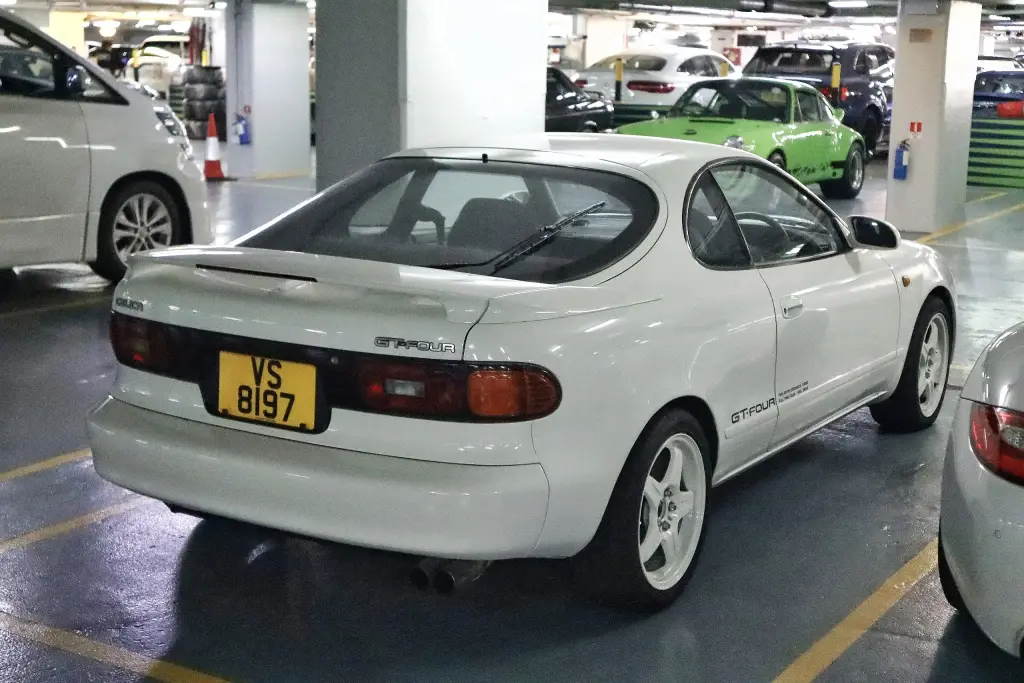
The Celica GT-Four came in three generations. The ST165, built from October 1986 to August 1989, was the only one with the first version of the 3S-GTE engine. It was updated in October 1987, when the manually lockable centre differential became a viscous-coupling limited-slip type. When it was launched in the UK in March 1988 it was the first car sold there designed to run only on unleaded petrol. In the United States the car was sold from 1988 as the All-Trac Turbo, apart from 77 special-edition cars sold to commemorate Toyota’s IMSA GTO championship win, one at each of Toyota’s 77 Californian dealerships.
The rally years
The ST165 made its WRC debut at the 1988 Tour de Corse and its first win at the 1989 Rally Australia. The ST185, with an air-to-air intercooler and a twin-entry turbo to avoid exhaust interference, was launched in Japan in September 1989; it debuted in the WRC at the 1992 Rallye Monte-Carlo and won its first event, the Safari Rally, that year, one of four victories in 1992. The ST205 was built from February 1994 to June 1999.
Toyota Team Europe in Cologne prepared the rally cars and was the first to introduce an anti-lag system, on the Group A ST205, a development that other teams later adopted. The significance of the GT-Four in WRC history, previously dominated by European makers, is that it was the first time a Japanese manufacturer entered the championship with an all-wheel-drive turbocharged car, took trophies and won titles. Mitsubishi and Subaru followed.
Design and features
- Drivetrain: a full-time 4WD system with a centre differential and hollow shafts, on a transverse engine.
- Engine: the 3S-GTE, a turbocharged two-litre four-cylinder.
- Rally parts: an anti-lag system developed by Toyota Team Europe.
Toyota Celica GT-Four versions
- ST165 (1986–1989): the first GT-Four.
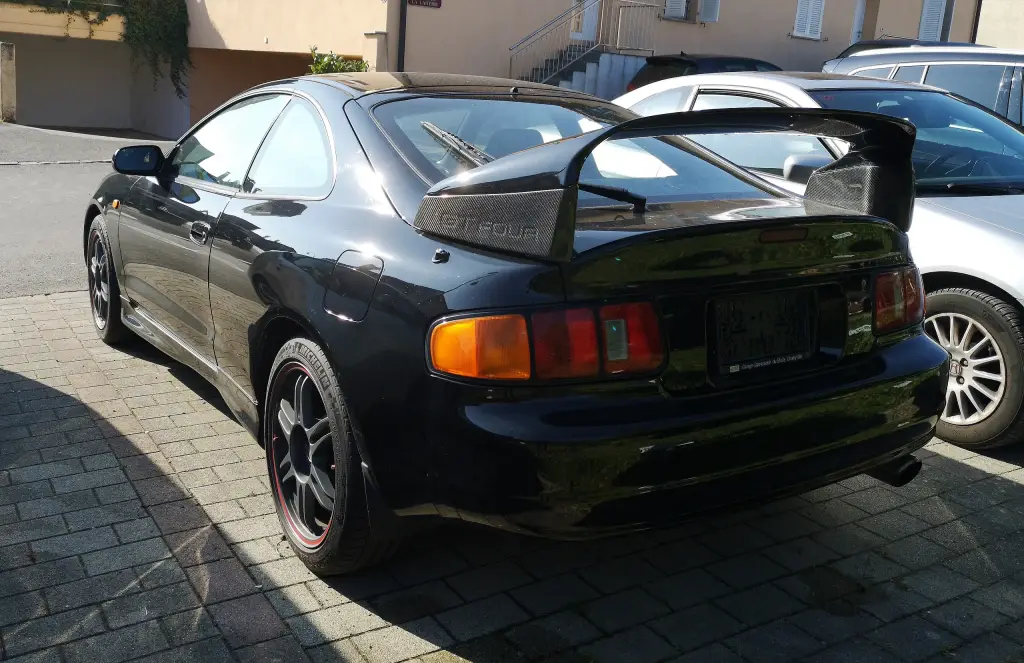
- ST185 (1989–1993): the “super round” shape; wide-body models for export.
- ST205 (1994–1999): the last generation, used in Group A rallying.
The GT-Four was one of the Celica line; see also the Toyota Celica and the later Toyota Supra. More cars are in our Toyota collection.
Sources
- Toyota Celica GT-Four, English Wikipedia: history, drivetrain, generations, rallying