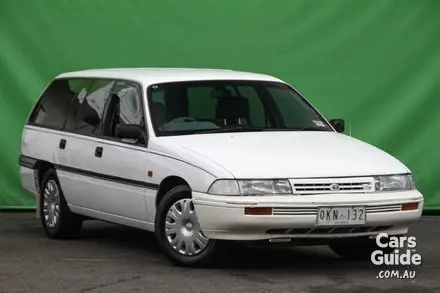
The Toyota Lexcen was a rebadged version of the second-generation Holden Commodore sold in Australia between 1989 and 1997. It existed because of an Australian government policy on local manufacturing, and it gave Toyota a large rear-wheel-drive car without developing one of its own.
Toyota Lexcen at a glance
| Maker | Toyota, built by Holden |
|---|---|
| Sold | Australia, 1989–1997 |
| Based on | Holden Commodore (second generation) |
| Class | Full-size saloon and estate |
| Layout | Front engine, rear-wheel drive |
| Platform | GM V-body, derived from Opel designs |
| Body styles | Saloon and station wagon |
| Rival | Ford Falcon |
| Government policy | Australian local-content and badge engineering scheme |
| Successor | Nothing; the Commodore continued as a Holden |
The Lexcen is a rebadged Holden Commodore and is mentioned only briefly in the English Wikipedia article on the Commodore; this page uses that article and keeps the description general. No free photograph of a Lexcen was available, so the record keeps its existing cover.
History of the Toyota Lexcen
Why the Lexcen existed
The Holden Commodore of 1978 replaced the Kingswood and Premier and was built on Opel’s V-body rear-wheel-drive platform, strengthened and enlarged by Holden for Australian conditions. Rivalry came mainly from the locally built Ford Falcon, and Australian government policy between 1989 and 1997 encouraged badge-engineered cars: the result was the Toyota Lexcen, a Commodore with Toyota badges, sold through Toyota dealers alongside the Corolla and Camry.
The car underneath
The Lexcen used the second-generation Commodore, introduced in 1988. That car followed the VB, VC, VH and VK Commodores, which had been re-engineered from the Opel Rekord and Senator: during the VB’s development Holden found the Opel body would break apart at the firewall on harsh Australian roads, and ended up with only 35 per cent commonality with the Rekord, replacing the recirculating-ball steering with rack and pinion and modifying the MacPherson strut front suspension. The Commodore range grew to include a station wagon in 1979, the Calais flagship from 1984 and, later, utilities and long-wheelbase Statesman and Caprice models.
What it meant
For buyers the Lexcen was a Holden in all but badge, with the same engines, rear-wheel drive and body styles, including the estate. It was not a Toyota design and did not continue after 1997, when the scheme ended and Holden moved to the third-generation Commodore. Toyota Australia returned to large cars of its own with the Avalon and then the Aurion, while the Commodore itself remained in production until 2017 and the Holden name disappeared in 2020.
Design and features
- Holden underneath: a second-generation Commodore with Toyota badges.
- Rear-wheel drive: a large Australian family car with a live rear axle.
- Saloon and estate: the same body styles as the Commodore.
- Policy product: created by an Australian badge-engineering scheme, not by Toyota engineering.
Toyota Lexcen versions
- Lexcen (1989): the first rebadged Commodore.
- Estate: the station-wagon body.
- Later updates: following the Commodore’s model-year changes until 1997.
The Lexcen belongs with other rebadged Toyotas such as the Cavalier, and Toyota’s own large Australian car was the Aurion. More cars are in the Toyota collection.
Sources
- Holden Commodore, English Wikipedia: platform, history, Lexcen policy