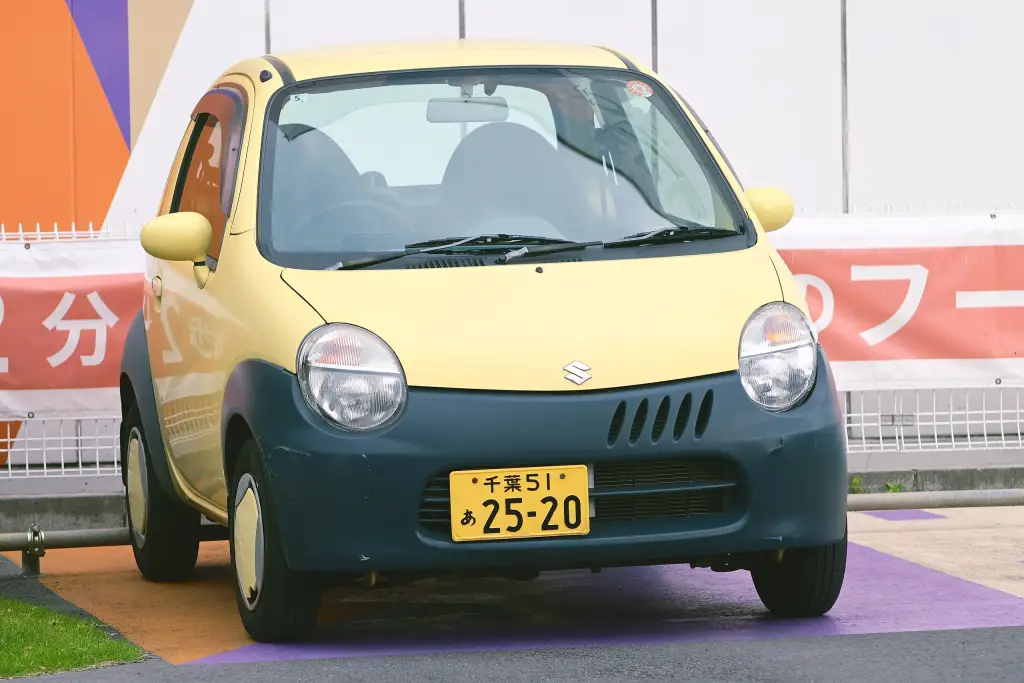
The Suzuki Twin is a two-seat kei car that Suzuki sold in Japan from 22 January 2003 to October 2005. It came in hybrid and non-hybrid forms and was the first hybrid kei car available in Japan.
Suzuki Twin at a glance
| On sale | 22 January 2003 – October 2005 |
|---|---|
| Market | Japan |
| Type | two-seat kei car |
| Versions | hybrid and non-hybrid |
| Hybrid distinction | first hybrid kei car sold in Japan |
| Fuel use, standard | 4.54 l/100 km on the Japanese cycle |
| Fuel use, hybrid | 2.93 l/100 km on the Japanese cycle |
| Concept | Suzuki PU3 Commuter |
| Length | slightly longer than a Smart Fortwo |
| Cabin | passenger seat folds flat into a storage tray |
History of the Suzuki Twin
From the PU3 Commuter
The Twin’s design and concept first appeared in the Suzuki PU3 Commuter concept car at the Tokyo Motor Show, and a near-production version was shown at the 2002 Tokyo Motor Show before the car went on sale in January 2003. It was designed mainly for young women and was slightly longer than a Smart Fortwo.

Clever details and economy
The Twin had several unusual features: a passenger seat that folded completely flat to become a storage tray, and only one power window, on the driver’s side, to reduce battery load and cost. Under the Japanese test cycle the standard car used 4.54 litres per 100 km, while the hybrid managed 2.93 litres per 100 km, a remarkable figure made it the first hybrid kei car on the Japanese market.
Critical reception
In August 2003 the American magazine Car and Driver tested the Twin and was mostly negative, criticising its acceleration, storage and interior fittings while praising headroom and the turning circle. Production ended in October 2005.
Design and features
- First hybrid kei: the earliest hybrid kei car sold in Japan.
- Very low fuel use: 2.93 l/100 km for the hybrid on the Japanese cycle.
- Cost-cutting design: one power window and a folding passenger seat.
- City car packaging: two seats in a body barely longer than a Smart Fortwo.
Suzuki Twin versions
- Twin standard: the non-hybrid version, 4.54 l/100 km.
- Twin hybrid: 2.93 l/100 km on the Japanese test cycle.
The Twin’s kei class is shared with the Alto and Kei, and its city-car role looks forward to the Celerio. More Suzukis are in the Suzuki collection.
Sources
- Suzuki Twin, English Wikipedia: dates, hybrid system, economy, design