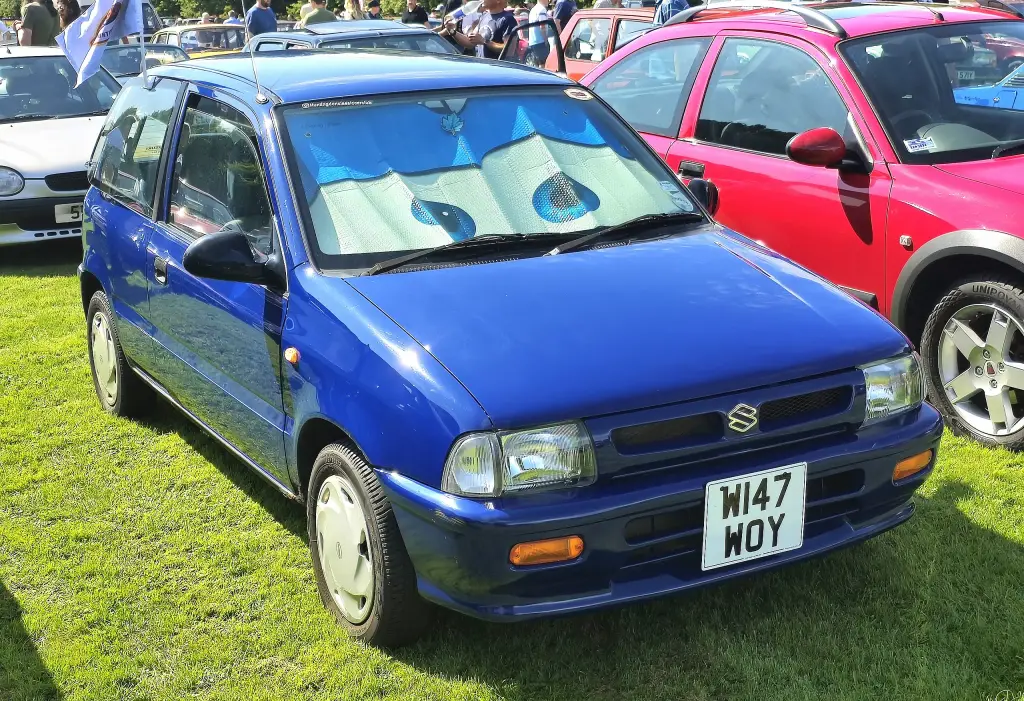
The Suzuki Alto is a kei car that Suzuki has produced since 1979. It was created as a commercial version of the Fronte passenger car, but the name became so popular that the Fronte was retired in 1989 and the Alto took over both roles.
Suzuki Alto at a glance
| Production | since May 1979 |
|---|---|
| Class | kei car in Japan, city car for export |
| Generations | nine |
| First generation | SS30V/40V, three-door cargo version of the Fronte |
| First engine | T5B two-stroke, 539 cc, 28 PS |
| Launch price | ¥470,000 |
| Four-stroke option | F5A 543 cc from January 1981 |
| Four-wheel drive | from October 1983 |
| Fronte retired | March 1989 |
| Export engine | 796 cc F8B three-cylinder |
| Replaced in Europe | by the Celerio in 2014 |
History of the Suzuki Alto
A cheap commercial Fronte
The first Alto appeared in May 1979 as a three-door cargo version of the Fronte, with a folding rear seat, coil-strut front suspension, leaf springs at the back and four-wheel drum brakes. Its 539 cc T5B three-cylinder two-stroke produced 28 PS. The car was a sensation largely because of its price: ¥470,000, helped by Japanese concessions for commercial vehicles, which allowed a simpler emissions system, and by the two-door body and commodity-tax exemption. Only one version was offered at first, yet Suzuki still fitted three-point front belts and individually fused headlamps.

Growing popularity
The formula worked. Rivals such as Subaru followed with cut-price commercial kei cars meant for private buyers, and Suzuki could not keep up with demand in the first years. In the last full year of the first generation the Alto outsold the passenger Fronte by about five to two. A two-speed automatic was added in May 1980 and the four-stroke F5A engine in January 1981, the year Suzuki began selling cars in Britain.
Export versions
Abroad the Alto badge was used for passenger as well as commercial versions, while Australian buyers knew the van as the Suzuki Hatch. Most export Altos were technically Frontes with the 796 cc F8B engine and the SS80 chassis code, which gave better performance and about ten percent better fuel economy. The SS80 was also assembled in New Zealand from March 1980. A four-wheel-drive Snow Liner arrived in October 1983 with 2.5 cm more ground clearance.
The badge takes over
As the distinction between kei commercial vehicles and passenger cars faded in Japan, the Alto name spread to the passenger range too, and the Fronte line ended in March 1989. Since the early 1990s the badge has also been used on Indian-built cars, from the Maruti Zen to the Maruti Suzuki Alto and A-Star, and in 2014 the Celerio replaced the Alto in Europe and many export markets.
Design and features
- Low price above all: the first Alto was built to a price and cost less than half the cheapest American subcompact.
- Kei packaging: a three-door body with a folding rear seat in the original.
- Early four-wheel drive: the Snow Liner of 1983.
- A global badge: used on Japanese kei cars and on Indian-built models alike.
Suzuki Alto versions
- First generation (1979): SS30V/40V with the 539 cc two-stroke.
- SS80 export Alto: 796 cc F8B engine and larger wheels.
- Snow Liner (1983): four-wheel drive with raised suspension.
- Maruti-built Altos: Indian derivatives sold under the Alto name from the 1990s.
The Alto grew out of the Suzuki Fronte and was replaced in Europe by the Celerio. The Alto Lapin is its retro-styled Japanese relative; more Suzukis are in the Suzuki collection.
Video: Suzuki Alto
Video by Motorvision Deutschland on YouTube.
Sources
- Suzuki Alto, English Wikipedia: history, engines, prices, export models