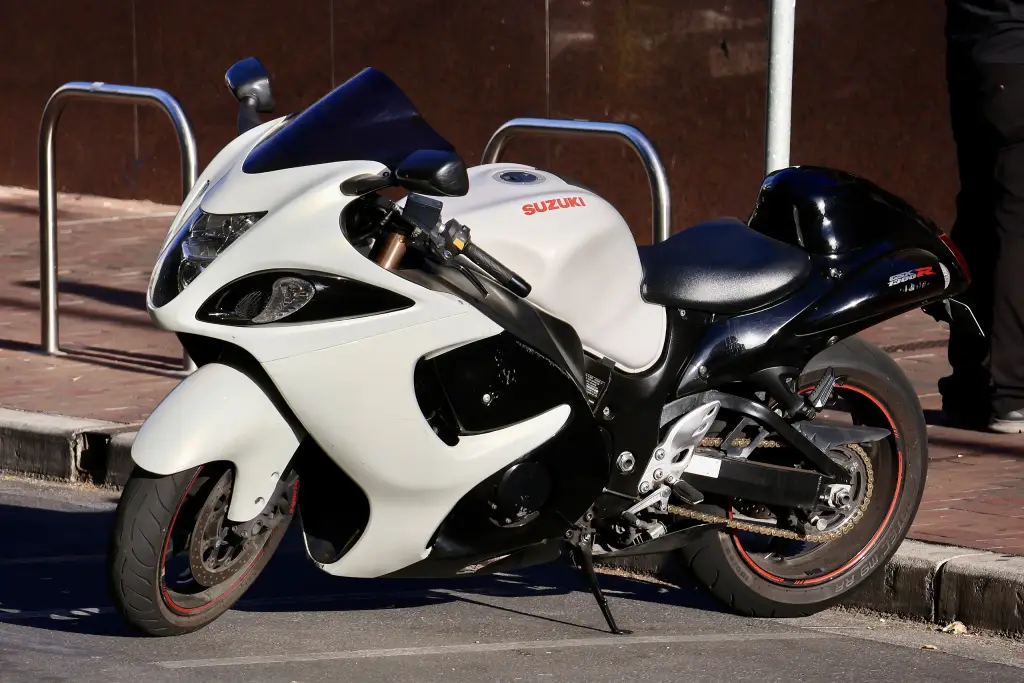
The Suzuki GSX1300R Hayabusa is a sports motorcycle built since 1999. It immediately became the world’s fastest production motorcycle, with a top speed of 303 to 312 km/h, and its name is Japanese for the peregrine falcon.
Suzuki Hayabusa at a glance
| Production | since 1999 |
|---|---|
| Model code | GSX1300R |
| Engine | 1,299 cc liquid-cooled inline four, sixteen valves |
| Power | 173 bhp at the crankshaft, 129 kW |
| Top speed | 303–312 km/h |
| Name | Japanese for peregrine falcon |
| Target | the Honda CBR1100XX Super Blackbird |
| Frame | conventional twin beam |
| Forks | fully adjustable upside-down |
| Tyres | Bridgestone, developed for the model |
| Voluntary limit | about 300 km/h from late 2000 |
History of the Suzuki Hayabusa
The falcon that hunts blackbirds
The Hayabusa was named after the peregrine falcon, which dives at 290 to 325 km/h, because that bird preys on blackbirds — and Suzuki’s target was the Honda CBR1100XX Super Blackbird. The new bike beat it by at least 16 km/h, a far bigger margin than the incremental gains that had preceded it. Its engine was a 1,299 cc liquid-cooled sixteen-valve inline four, unremarkable in layout but the largest ever in a sport bike, with ram-air ducts forcing pressurised air into the cylinders. It made a claimed 173 bhp.
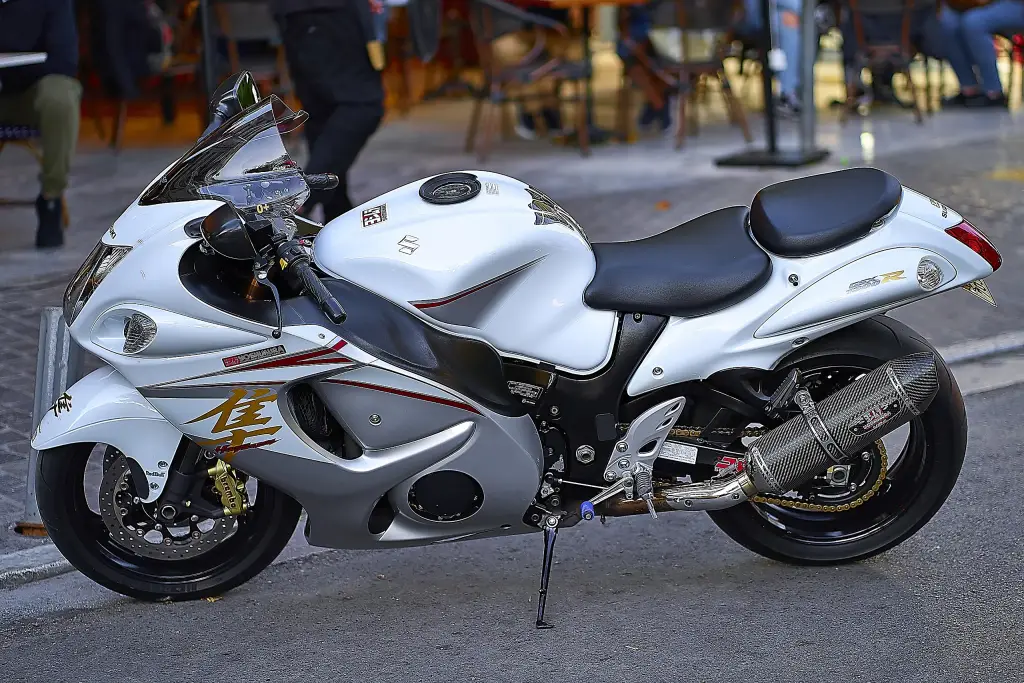
Styling for speed
The bulbous bodywork was shaped by aerodynamics: the ram-air ducts squeezed the frontal area away from the headlight, which is why the Hayabusa has a stacked headlight and high beam behind a single lens. The look divided opinion, but Suzuki’s designer Koji Yoshiura said the aim was a deliberately grotesque design with a strong first impact and a face that would not date. The engine used a gear-driven counterbalancer so it could be solidly mounted for chassis rigidity, and the bike ran conventional twin-beam frame, fully adjustable upside-down forks and specially developed Bridgestone tyres.
The speed agreement
In 1999 fears of a European regulatory backlash led Japanese and European manufacturers to agree informally to cap top speeds from late 2000, a limit reported as 186 mph, or about 300 km/h. That is why the 1999 and 2000 Hayabusas still hold the title unchallenged: no later standard model could go faster without modification. When the Kawasaki Ninja ZX-12R of 2000 fell 6 km/h short, the Hayabusa secured its place as the fastest production bike of the 20th century.
Design and features
- Record speed: 303 to 312 km/h, a leap of 16 to 23 km/h over the Blackbird.
- Ram air: pressurised cool air fed to the cylinders at speed.
- Biggest sport-bike engine of its time: 1,299 cc and 173 bhp.
- All-round ability: reviewers praised its handling, comfort and reliability, not only its speed.
Suzuki Hayabusa versions
- Hayabusa (1999–2000): the unrestricted record-breaking models.
- Later first-generation bikes: subject to the voluntary 300 km/h limit.
- Streetfighter conversions: unfaired versions built by owners.
The Hayabusa engine also went into the B-King, and the GSX-R range sits on the other side of Suzuki’s sports line. More Suzukis are in the Suzuki collection.
Video: Suzuki Hayabusa Swift | GRIP #285
Video by GRIP – Das Motormagazin on YouTube.
Sources
- Suzuki Hayabusa, English Wikipedia: speed, engine, styling, speed agreement