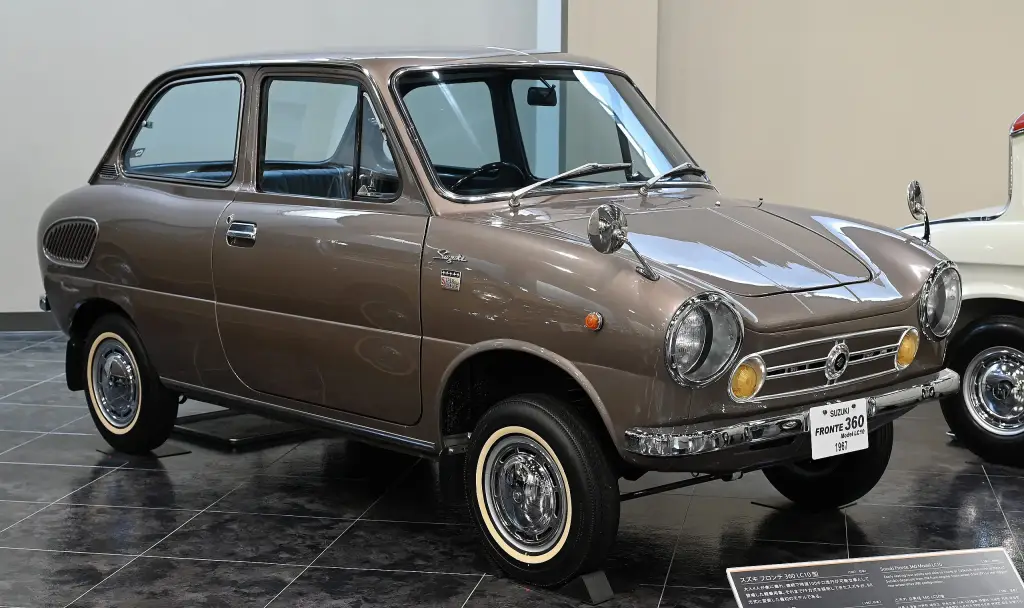
The Suzuki Fronte is a kei car introduced in March 1962 as the sedan version of the Suzulight Van. The name stayed on Suzuki’s small cars and some commercial derivatives until September 1988, when the Alto replaced it.
Suzuki Fronte at a glance
| Introduced | March 1962 |
|---|---|
| First model | TLA Suzulight Fronte |
| Layout | front-wheel drive, transversely mounted two-stroke |
| First engine | 360 cc two-cylinder, 25 PS |
| Second engine | FEA, 21 PS, with SELMIX lubrication |
| Gearbox | three-speed, then four-speed all-synchronised |
| Race win | first and second in class, Japanese Grand Prix, May 1963 |
| CCI lubrication | from October 1965 |
| Fronte 360 | LC10, March 1967, rear-engined three-cylinder |
| Replaced by | the Alto, September 1988 |
History of the Suzuki Fronte
The Suzulight Fronte
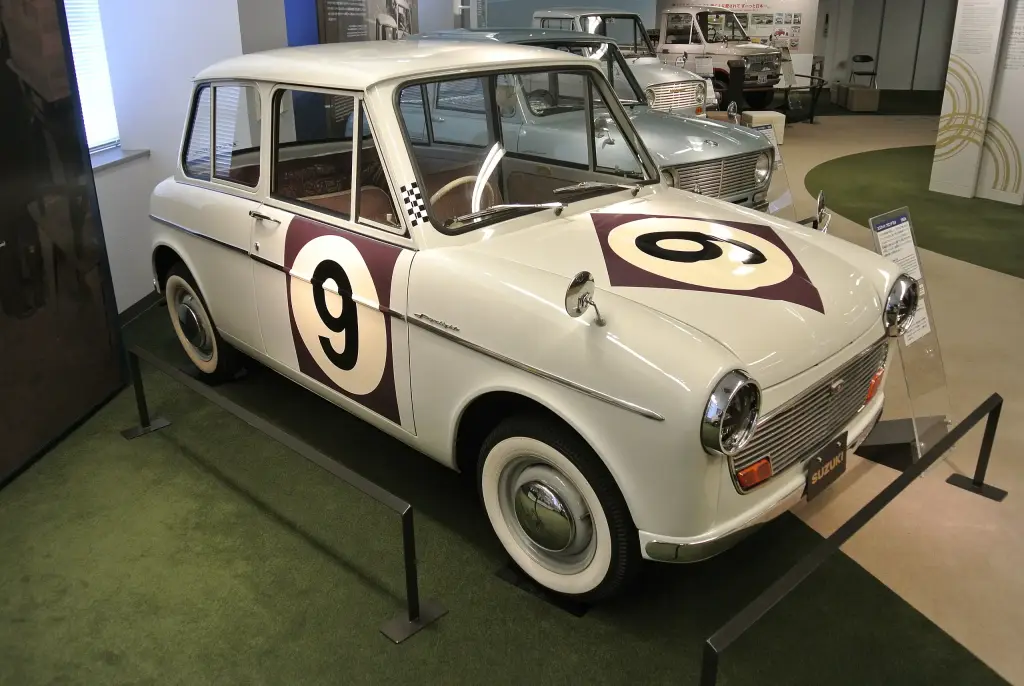
The first Fronte of March 1962 was a passenger version of the Suzulight light van, built at Takatsuka in Hamamatsu. It was based on the earlier Suzulight SS, itself a close copy of the Lloyd LP400, and had a transversely mounted two-cylinder two-stroke engine driving the front wheels, independent suspension on transverse leaf springs all round, and a three-speed gearbox with an unsynchronised first gear on the column. Its unique TLA engine, with separately cast cylinders, gave 25 PS and let Suzuki price the car below the spartan TL Van. The engine tended to seize after prolonged high revs and was replaced after a year by the FEA, which brought SELMIX automatic lubrication, 21 PS and a four-speed all-synchronised gearbox.
Racing credentials
In May 1963 two Frontes finished first and second in their class at the first Japanese Grand Prix, averaging 89.763 km/h, with two more cars fourth and eighth and the fastest lap also set by a Fronte. Production was about 150 cars a month at the time, against roughly 2,000 Subaru 360s, and the Suzulight Fronte was looking dated by the end of its run in 1967.
The Fronte 360
The LC10 Fronte 360 of March 1967 replaced it with a rear engine and ten-inch wheels for maximum packaging. Its rounded shape earned the nickname Daruma, after a Japanese roly-poly doll, and it used coke-bottle styling. The engine was a new 356 cc three-cylinder two-stroke, the gearbox a four-speed, and the rear lights and front indicators shared lenses in different colours. Suzuki called it the Queen of the keis. First deliveries were on 27 May 1967, and monthly production soon approached three times the original 3,000 target, staying above 8,000 until the end of the model’s life.
The end of the name
The Fronte line continued through further generations and was retired in September 1988, when the Alto, until then a commercial vehicle name, took over the passenger role as well.
Design and features
- Front-wheel drive at first: the original Fronte was Suzuki’s front-drive kei sedan.
- Two-stroke engineering: from the TLA and FEA twins to the LC10 three-cylinder.
- Race success: a class one-two at the first Japanese Grand Prix in 1963.
- Packaging first: the rear-engined LC10 with ten-inch wheels.
Suzuki Fronte versions
- TLA Suzulight Fronte (1962): 360 cc twin with 25 PS.
- FEA Fronte (1963): SELMIX lubrication and a four-speed gearbox.
- Fronte 360 LC10 (1967): rear-engined three-cylinder kei car.
- Fronte 800: the larger-engined relative shown in period photographs.
The Fronte was replaced by the Suzuki Alto, and its coupé branch led to the Cervo. More Suzukis are in the Suzuki collection.
Video: suzuki fronte 550 k
Video by นาฏศิลป์ ผร on YouTube.
Sources
- Suzuki Fronte, English Wikipedia: history, engines, racing, LC10