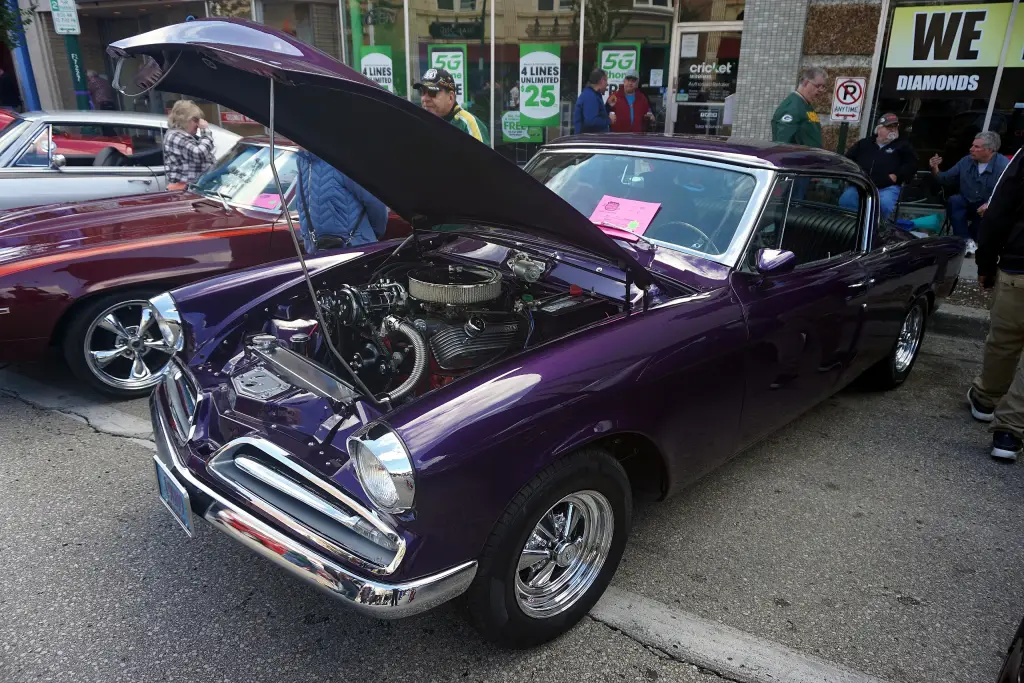
The Studebaker Starliner was the hardtop coupe of Studebaker’s 1953 range, the pillarless counterpart of the pillared Starlight. The two names belonged to a body style that began in 1947 with the Starlight coupe and its wrap-around rear window, and both were dropped after 1955 when the coupes became the Hawk series.
Studebaker Starliner at a glance
| Maker | Studebaker Corporation, South Bend |
|---|---|
| Starlight coupe | 1947–1955, on Champion and Commander series |
| Designer | Virgil Exner, then of Raymond Loewy Associates |
| Starlight name | adopted for 1949, before that simply the five-passenger coupe |
| Rear window | wrap-around, made of four fixed glass panels |
| Bullet nose | 1950 and 1951 facelift |
| 1953 redesign | Robert Bourke, Loewy’s Studebaker studio |
| 1953 coupe wheelbase | 120 in, against 116 in for the sedans |
| 1953 names | hardtop called Starliner, pillared coupe called Starlight |
| 1955 | names reverted to five-passenger coupe and hardtop |
| Successor | the 1956 Hawk series |
Based on one source: the English Wikipedia article on the Starlight, which covers the Starliner hardtop.
History of the Studebaker Starliner
Virgil Exner’s coupe
The Starlight coupe was a two-door body style offered by Studebaker from 1947 to 1955 on its Champion and Commander series, designed by Virgil Exner, formerly of Raymond Loewy Associates, along the lines of the ponton style that had just become mainstream after the war. Its most striking feature was an extremely long, hood-like cover over the luggage compartment of the sedan, exaggerated on the Starlight, which prompted critics to ask which way the car was going; the comedian Fred Allen joked that Studebaker was bringing out a model you could not tell was going sideways. The astonishment was compounded by the great expanse of the wrap-around rear window. Where other pillared two-door sedans used two side windows separated from the rear window by roof supports, Loewy’s team rounded the roof at the rear and used a wrap-around glass system with four fixed panels, giving a panoramic effect like a railway observation car. The roof was carried by two wide pillars behind the doors and in front of the rear window. The body was first called simply the five-passenger coupe and was renamed Starlight Coupe for 1949.
Bullet nose and the 1953 redesign
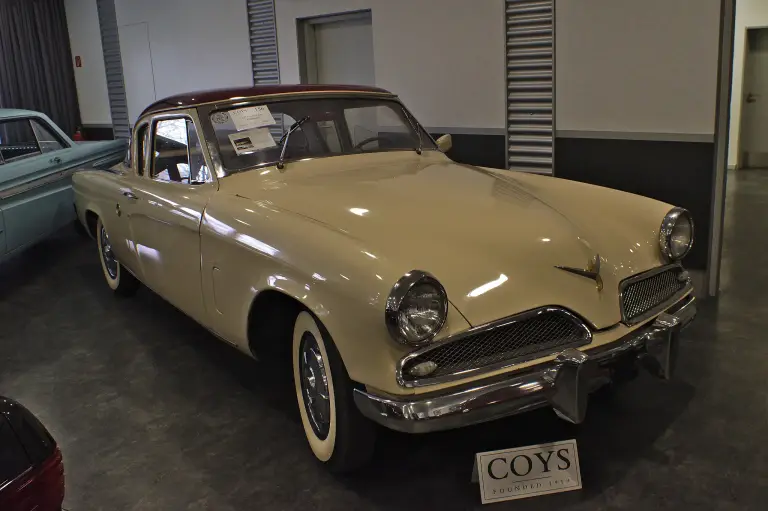
For 1950 and 1951 all Studebakers received a freshening of the 1947 design with the addition of the “bullet nose” or spinner front sheet metal, which shared its look with the 1949 Ford sedan; combined with the Starlight body the cars looked futuristic for their time. That version continued to the end of the 1952 model year, when it was sold alongside a hardtop Starliner version of the same model. For 1953 Robert Bourke, head of Raymond Loewy Associates’ Studebaker design operation, radically redesigned all the cars. Sedans rode on a 116 in wheelbase, but the emphasis was on the sports-car-like two-door coupes on the longer 120 in wheelbase. Offered in both Champion and Commander ranges, the coupes came as pillared and hardtop styles: the hardtops were Starliners, while the Starlight name went to the five-window pillared coupes. The styling of these 1953 cars influenced the Hillman Minx of the late 1950s and 1960s, also designed by Loewy.
The end of the names
In late 1952 Studebaker built one 1953 Commander convertible as an engineering study, based on the Starliner hardtop; the extra structural weight hurt acceleration, the company lacked the money for another body type, and the car was eventually sold to an employee on condition that he never sell it, resurfacing behind a South Bend filling station in the 1970s. For 1955 the pillared Starlight reverted to the name five-passenger coupe and the pillarless Starliner became the five-passenger hardtop. For 1956 these two-door coupes were heavily modified and reissued as the Studebaker Hawk series. In 1958 Studebaker used the Starlight name once more, on its first full-sized hardtops since 1952, and retired it at the end of that model year as sales fell and the company turned to the compact Lark.
Design and features
- Wrap-around rear window: four fixed glass panels giving an observation-car view.
- Long luggage cover: the hood-like deck that made the Starlight so recognisable.
- Bullet nose: the 1950–51 front that made the car look futuristic.
- 1953 Loewy coupe: Robert Bourke’s shape on a 120 in wheelbase, as hardtop Starliner or pillared Starlight.
- Influence: the 1953 styling fed into the Hillman Minx designed by Loewy’s studio.
Studebaker Starliner versions
- Starlight Coupe (1947–1952): pillared coupe with the wrap-around rear window, named Starlight from 1949.
- Starliner hardtop (1952–1953): pillarless version sold alongside the Starlight.
- 1953 Starlight: five-window pillared coupe on the new 120 in wheelbase.
- 1953 Starliner: pillarless hardtop, offered in Champion and Commander ranges.
- 1955 coupes: the names reverted to five-passenger coupe and hardtop before the 1956 Hawk.
The Starliner’s coupe body became the basis of the Hawk series and its chassis ideas fed into the Lark. The 1953 car was offered in Champion and Commander form, and more cars are in the Studebaker collection.
Video: 1953 Studebaker Commander V8 Starliner Coupe – My Car Story with Lou Costabile
Video by Lou Costabile on YouTube.
Sources
- Studebaker Starlight, English Wikipedia: body style, rear window, 1950 facelift, 1953 Starliner, end of the names