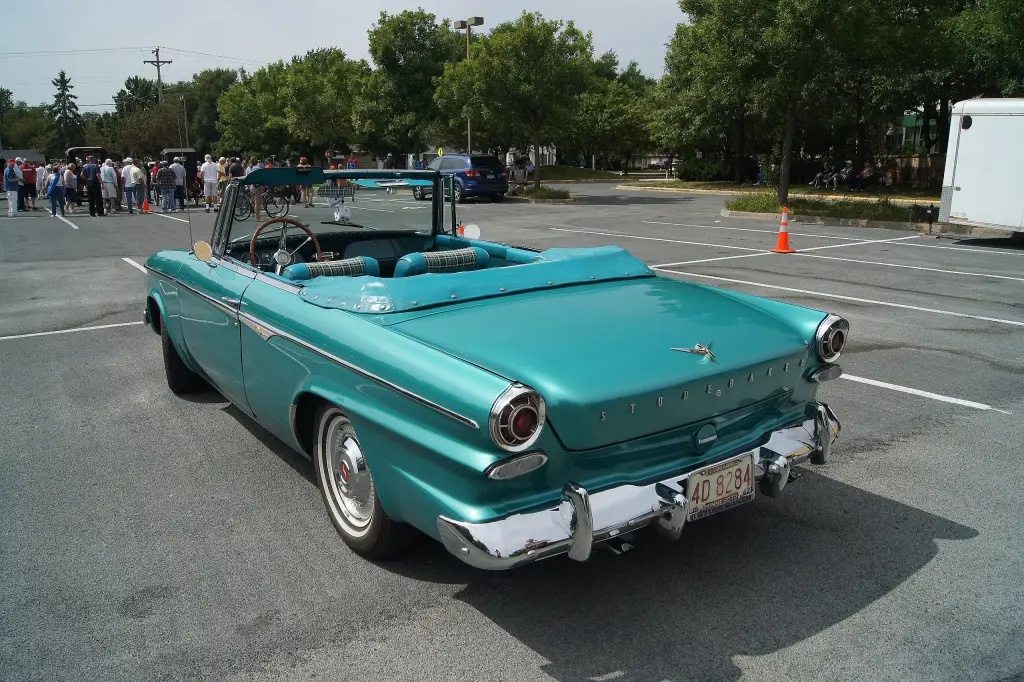
The Studebaker Lark was a compact car produced from 1959 to 1966. It was designed around the existing body of the full-size 1953–1958 Studebakers, shortened at both ends, and became the mainstay of the company’s range in its final years.
Studebaker Lark at a glance
| Maker | Studebaker-Packard Corporation, then Studebaker Corporation |
|---|---|
| Production | 1959–1966 |
| Class | compact |
| Built in | South Bend, Indiana; Hamilton, Ontario, Canada |
| Design basis | body shell of the 1953–1958 full-size Studebakers |
| Series at launch | Lark VI (six) and Lark VIII (V8) |
| Trim levels | Deluxe and Regal |
| Engines in 1959–1960 | 170 cu in flathead six or 259 cu in V8 |
| Firsts | first compact of its size with a V8 |
| Long-wheelbase body | 113 in, used for the Econ-O-Miler taxi and the Cruiser |
| Convertible | added for 1960, Studebaker’s first since 1952 |
| Later nameplates | Cruiser, Daytona and Commander |
Based on one source: the English Wikipedia article on the Lark. The Daytona, Cruiser and Regal records in this collection are versions of the Lark and redirect to this article.
History of the Studebaker Lark
Why the Lark existed
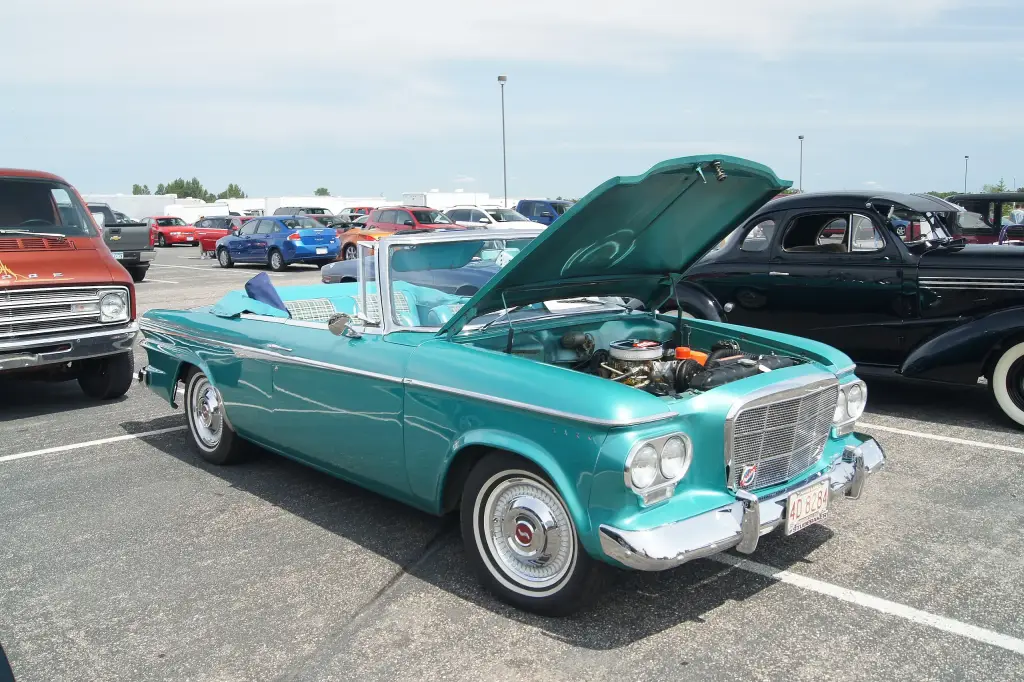
When the Lark was conceived, Studebaker-Packard was under a management contract with Curtiss-Wright and had been losing money for several years. Company president Harold E. Churchill decided to abandon the full-size market and build a compact instead, taking inspiration from the earlier Studebaker Champion and the low-priced Scotsman. The new car used the core bodyshell of the 1953–1958 Studebakers: by cutting the front and rear overhangs and shortening the wheelbase ahead of the firewall, the designers kept seating for six and a useful luggage space without paying for a new body. It was introduced in the autumn of 1958 as a 1959 model.
First generation, 1959–1961
Two series were offered, the Lark VI and the Lark VIII, the numbers referring to six or eight cylinders, and most body styles came in Deluxe and Regal trim. The initial range had two- and four-door sedans, a two-door hardtop and a two-door station wagon. With its simple grille, restrained chrome and clean lines the Lark ran against the “longer, lower and wider” fashion of Detroit, and its plain shape was closer to the Rambler American than to the new compacts that followed. Sales were helped by “dual” dealerships with Big Three dealers that had no compact of their own to sell. The Lark was also the first car of its size to offer a V8; a V8 Lark reached 60 mph in about ten seconds, while among the Big Three compacts that appeared in 1960 only the Plymouth Valiant could break 20 seconds.
For 1960 Studebaker added a convertible — its first since 1952 — and a four-door station wagon, which quickly outsold the two-door. A taxicab version called the Econ-O-Miler used the wagon’s longer 113 in wheelbase, and the extra 4.5 in went into rear-seat legroom. For 1961 the same long-wheelbase body with a more luxurious interior became the Cruiser, recalling the Land Cruiser sedans of the late 1940s; Cruisers can be told from other four-door Larks by their 1959–60 roofline and the opening vent windows in the rear doors. A canvas-covered folding sunroof called the Skytop was offered on sedans and the two-door hardtop, and the front end was restyled with a broader grille and quad headlamps, standard on Regal and Cruiser models.
The name fades, 1963–1966
Lark-based cars made up the bulk of Studebaker’s output after 1958 and sold far better than the Hawk and Avanti. From the 1963 Cruiser the Lark name was gradually dropped from the catalogue, and by early 1964 the range was marketed only as Commander, Daytona and Cruiser. The cars continued to be built in South Bend and, from 1959 to 1966, in Hamilton, Ontario, and were exported both complete and as CKD kits for local assembly. Studebaker stopped making cars in 1966.
Design and features
- Shortened full-size body: the 1953–1958 shell with reduced overhangs gave six seats without a new body programme.
- V8 in a compact: the 259 cu in V8 made the Lark the first car of its size with eight cylinders.
- Simple styling: a plain grille and little chrome, in deliberate contrast to Detroit fashion.
- Long-wheelbase body: the 113 in version served as taxi and later as the Cruiser.
- Skytop sunroof: a canvas-covered folding roof offered from 1961.
Studebaker Lark versions
- Lark VI: six-cylinder series, 170 cu in flathead at first.
- Lark VIII: V8 series with the 259 cu in engine.
- Deluxe and Regal: the two trim levels offered on most body styles.
- Econ-O-Miler: taxi on the long 113 in wheelbase.
- Cruiser: long-wheelbase luxury sedan from 1961, later a nameplate in its own right.
- Daytona and Commander: the names under which Lark-based cars were sold after the Lark name was dropped.
The Lark’s body came from the 1953 Starliner generation, and its engines were shared with the Champion and Commander. The Avanti used a shortened Lark convertible chassis. More cars are in the Studebaker collection.
Video: 1963 Studebaker Lark starts up
Video by ShowMeMyRival on YouTube.
Sources
- Studebaker Lark, English Wikipedia: development, series, body styles, Cruiser, end of the name