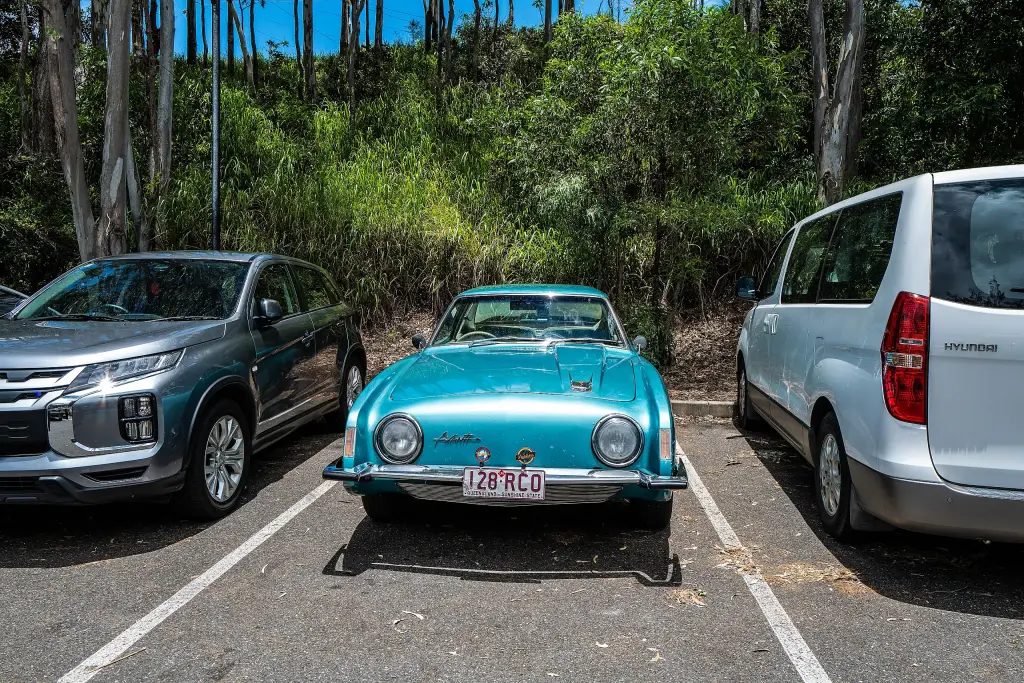
The Studebaker Avanti was a personal luxury coupe built between June 1962 and December 1963. Designed by Raymond Loewy’s team in a 40-day crash programme, it was marketed as “America’s only four-passenger high-performance personal car” and became one of the most distinctive American cars of the post-war years.
Studebaker Avanti at a glance
| Maker | Studebaker Corporation, South Bend |
|---|---|
| Production | June 1962 – December 1963 |
| Class | personal luxury coupe |
| Design | Raymond Loewy with Tom Kellogg, Bob Andrews and John Ebstein |
| Design time | 40 days |
| Body | fibreglass, moulded by Molded Fiberglass Body, Ashtabula, Ohio |
| Chassis | modified Studebaker Lark 109 in convertible chassis |
| Engine | modified 289 cu in Hawk V8; Paxton supercharger optional |
| Brakes | Dunlop-designed front disc brakes, Bendix-built |
| Public launch | 26 April 1962 |
| Built | about 1,200 in 1962 against a plan of 20,000 |
| Records | 29 world speed records at Bonneville; over 170 mph with the R3 |
Based on one source: the English Wikipedia article on the Avanti.
History of the Studebaker Avanti
Egbert’s doodle
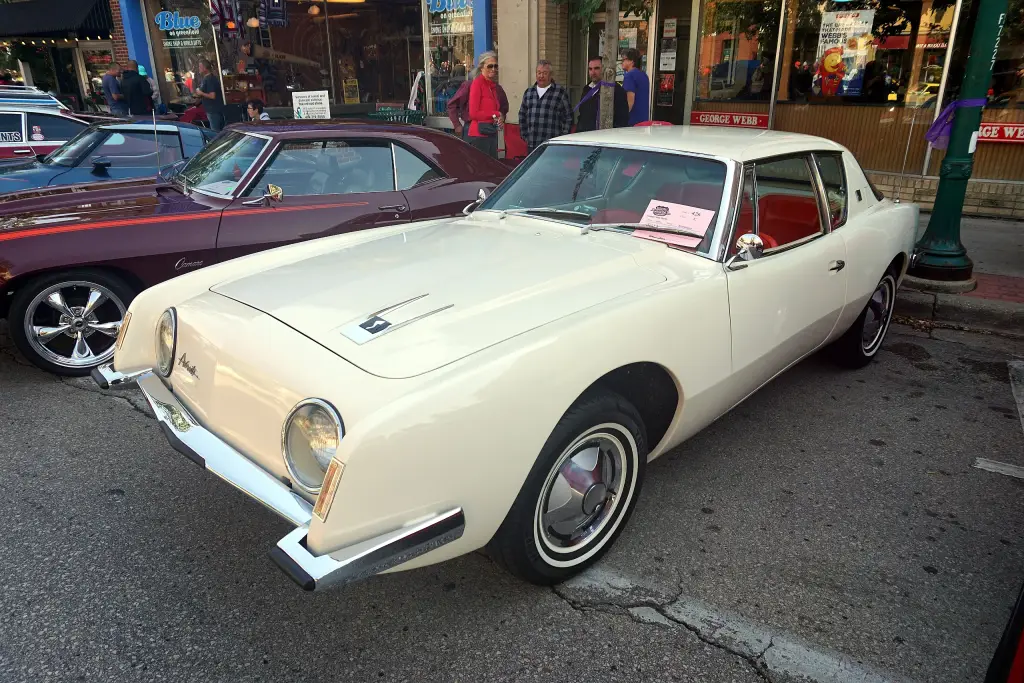
The Avanti was developed at the direction of Sherwood Egbert, who became Studebaker’s president in February 1961. The design theme was, in the words of the English Wikipedia article, allegedly doodled by Egbert on the back of an envelope during an aeroplane flight: he wanted an answer to Ford’s Thunderbird and a way to improve the company’s sagging performance. Raymond Loewy’s team — Tom Kellogg, Bob Andrews and John Ebstein — worked on a 40-day crash programme. In eight days the stylists produced a clay scale model with two different sides, one a two-place sports car and the other a four-seat GT coupe; Kellogg argued for the four-seat coupe, and Loewy’s vision was a low, long-bonnet, short-deck semi-fastback with a grilleless nose and a wasp-waisted curve over the rear wheels suggesting a supersonic aircraft.
Fibreglass and engineering
The complex shape would have been difficult and expensive to press in steel, so Studebaker moulded the exterior panels in glass-reinforced plastic, outsourcing the work to Molded Fiberglass Body in Ashtabula, Ohio — the company that had built the fibreglass panels for the 1953 Chevrolet Corvette. The body sat on a modified Studebaker Lark 109 in convertible chassis and was powered by a modified 289 cu in Hawk V8, with a Paxton supercharger as an option. The Avanti had front disc brakes of British Dunlop design made under licence by Bendix, making it the first American production model to offer them, and it was one of the first “bottom breather” designs, taking air from under the nose instead of through a grille above the bumper — an arrangement that became common after the 1980s.
Launch and records
The Avanti was introduced publicly on 26 April 1962, simultaneously at the New York International Automobile Show and at the company’s annual shareholders’ meeting. Rodger Ward, winner of the 1962 Indianapolis 500, received an Avanti as part of his prize and became its first private owner; a Lark convertible was the pace car that year and the Avanti the honorary pace car. A modified Avanti with the supercharged 289 cu in R3 engine reached over 170 mph at the Bonneville Salt Flats and broke 29 world speed records, and the car was called the fastest production car in the world on its introduction.
Production problems and the end
Egbert planned to sell 20,000 Avantis in 1962 but the company could build only 1,200. Problems with the supplier, fit and finish caused delays and cancelled orders, and in December 1962 the Los Angeles Times reported that Studebaker was starting operations at its own fibreglass body works to raise output. After the South Bend factory closed on 20 December 1963, Competition Press reported that Studebaker had only five Avantis left while dealers held about 2,500 and 1,600 had been sold since the launch — against 23,631 Corvettes built by Chevrolet in 1963. The name, tooling and plant space were then sold to two South Bend dealers, Nate Altman and Leo Newman, who reintroduced a hand-built, slightly modified Avanti using leftover chassis and General Motors engines, without any connection to the Studebaker brand. A succession of owners built derivatives, including the Avanti II, until 2006.
Design and features
- Loewy shape: a grilleless nose, long bonnet and wasp-waisted rear wings, designed in 40 days.
- Fibreglass body: moulded by the company that had built Corvette panels in 1953.
- Front disc brakes: the first offered on an American production car.
- Bottom breather: cooling air taken from under the nose rather than through a grille.
- Supercharged performance: the Paxton-blown R3 took a modified car past 170 mph.
Studebaker Avanti versions
- Avanti (1962–1963): the standard car with the 289 cu in Hawk V8.
- Supercharged Avanti: Paxton supercharger offered as an option.
- R3 Bonneville car: modified supercharged 289 that broke 29 records.
- Avanti II: hand-built continuation by Altman and Newman after Studebaker stopped.
- Later derivatives: further small-series versions built under the Avanti name until 2006.
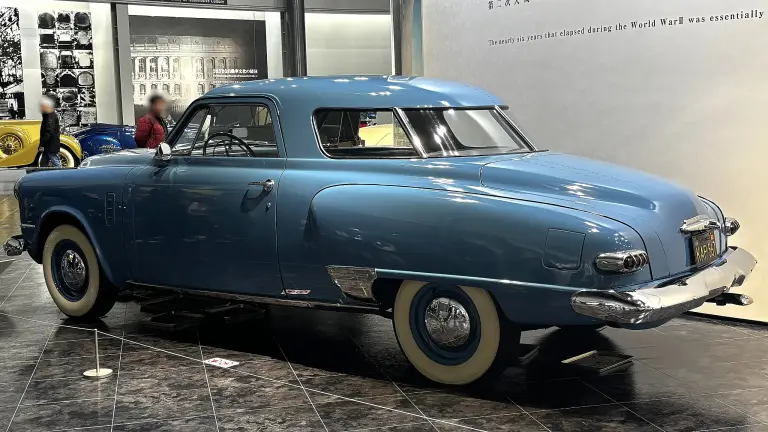
The Avanti used a shortened Lark convertible chassis and the V8 from the Hawk. The Loewy studio’s earlier Studebaker work is described in the Starliner article, and more cars are in the Studebaker collection.
Video: Test drive of a 1963 Studebaker Avanti
Video by Jim Davis on YouTube.
Sources
- Studebaker Avanti, English Wikipedia: design, engineering, launch, records, production and succession