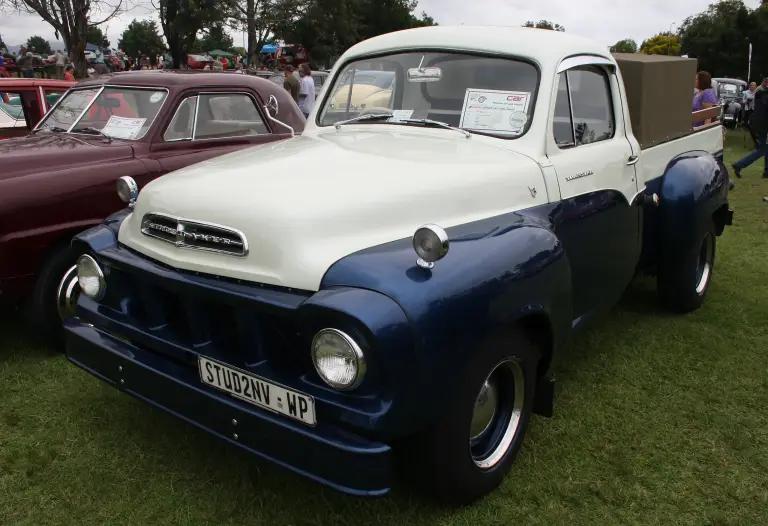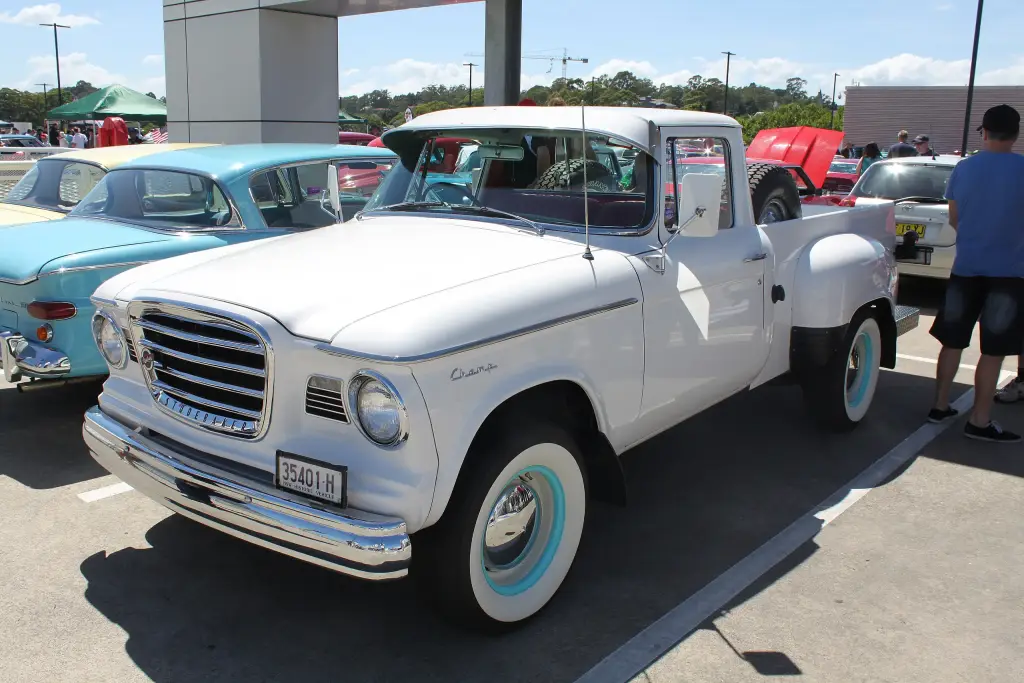
The Studebaker Champ was a light-duty pickup truck produced from 1960 to 1964. It was the last such vehicle Studebaker designed before it left the car business, and it was assembled largely from parts that already existed: a 1949 chassis, the front half of a Lark sedan and, later, a Dodge cargo box.
Studebaker Champ at a glance
| Maker | Studebaker Corporation, South Bend |
|---|---|
| Production | 1960–1964 |
| Type | light-duty pickup |
| Development budget | $900,000 |
| Chassis | the half- and three-quarter-ton E-series frame used since 1949 |
| Cab | front half of a Lark four-door sedan |
| Wheelbases | 112 in short and 122 in long |
| Cargo boxes | narrow P1 box, then the Dodge-sourced P2 Spaceside from 1961 |
| Engines in 1960 | 170 cu in flathead six, 245 cu in Big Six, 259 and 289 cu in V8s |
| Engine from 1961 | 170 cu in OHV six with 112 hp |
| Gearboxes | three-speed column manual, four- and five-speed, overdrive, Flight-O-Matic |
| Power steering | never offered on the Champ |
Based on one source: the English Wikipedia article on the Champ.
History of the Studebaker Champ
A truck on a budget
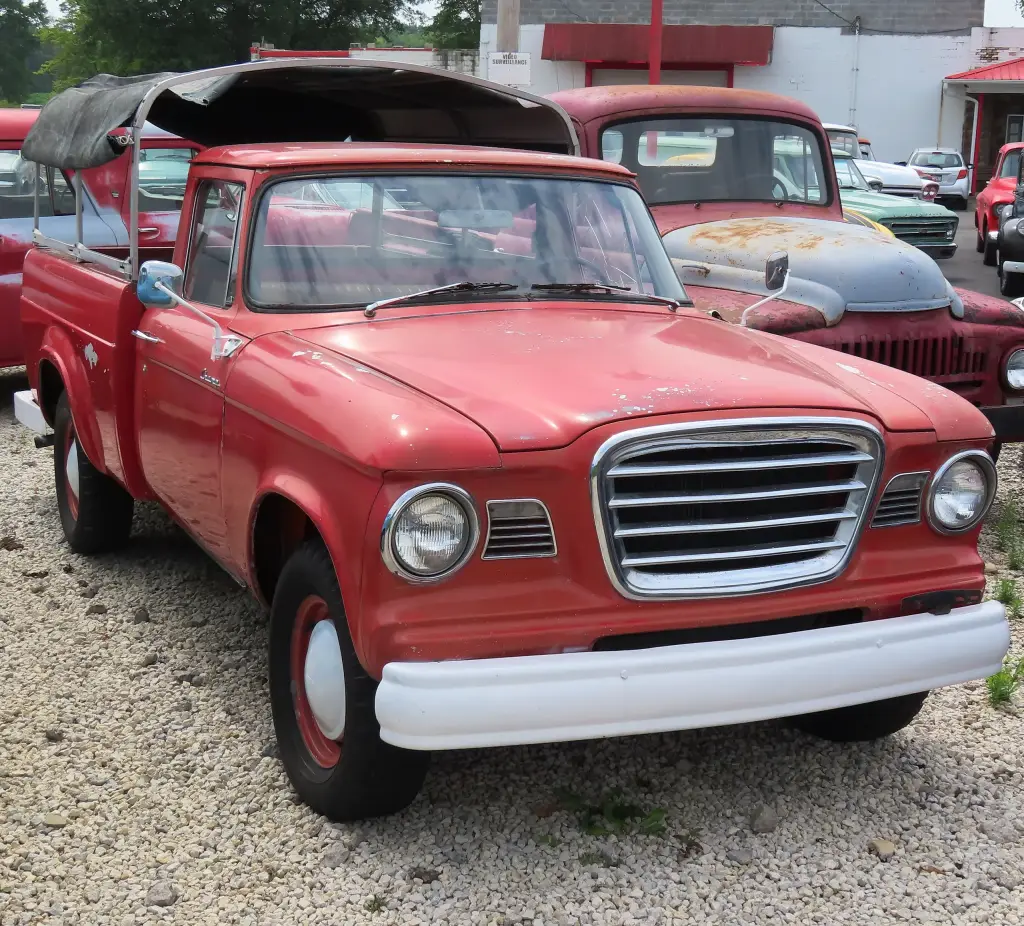
The Champ was designed at a time when Studebaker’s truck line had not seen a major upgrade for over ten years. Engineers were given a $900,000 budget by the board and had to reuse existing components, but the result was fresh and competitive in price, capability and performance with other American trucks of the era. The chassis was essentially the half- and three-quarter-ton E-series frame Studebaker had used since 1949: a ladder frame with solid axles front and rear. As the English Wikipedia article notes, those components were no more or less modern than those of GM, Ford, Chrysler or International Harvester trucks, which also still used solid axles.
The Lark cab
An entirely new cab was out of the question on the budget, but the new Lark compact’s body was the right size and shape. The engineers took a Lark four-door sedan, cut it in half behind the front doors and modified the front half slightly to fit the truck chassis; the only new sheetmetal stamping needed was the back wall of the cab. Money was found for a new horizontal-bar grille that gave the Champ a tougher look than the Lark’s mesh.
Cargo boxes
For 1960 and 1961 the Champ carried over the 1949-vintage cargo box, widened slightly in 1956. A wide box, codenamed P2 and known as the Spaceside, arrived in early 1961 from the Dodge C-Series after a deal between Studebaker and Dodge; the original narrow P1 box went out of production in late 1961, and the wide box was the only option afterwards. Both were available in short 112 in and long 122 in wheelbase versions.
Engines and the end
Buyers in 1960 could choose the last of Studebaker’s flathead sixes, the Lark’s 170 cu in unit with 90 hp, or the 245 cu in Big Six with 110 hp that dated to the early 1930s. The 170 was converted to overhead valves for 1961, gaining 22 hp for a total of 112, which let Studebaker retire the Big Six; the new engine suffered some cracked cylinder heads early on, a problem never completely solved. V8 buyers could have the 259 or 289 cu in engine with a two- or four-barrel carburettor. Transmissions ranged from a three-speed column manual with optional overdrive to four- and five-speeds and the Borg-Warner Flight-O-Matic automatic. The Champ never offered power steering, although the heavier Transtar and the diesels did; the final 8E models of 1963–64 had an improved steering box, suspended pedals, two-stage rear leaf springs and, for the first time, optional air conditioning. In December 1963 the board announced the closure of the South Bend factory, and the trucks went with it.
Design and features
- Lark cab: the front half of a Lark sedan, with only a new back wall as a fresh stamping.
- Dodge cargo box: the wide Spaceside box bought from Dodge in 1961.
- Sliding rear window: offered from 1960 to 1964 for ventilation and access to the load bed.
- No power steering: the Champ never had it, unlike the heavier Transtar.
- 8E improvements: suspended pedals, two-stage springs and optional air conditioning for 1963–64.
Studebaker Champ versions
- 5E (1960): first series, narrow cargo box, flathead sixes or V8.
- 6E (1961): Spaceside wide box and the new OHV 170 six.
- 7E (1962): few changes.
- 8E (1963–1964): suspended pedals, two-stage springs, improved steering and air conditioning.
The Champ used the front of a Lark and shared its range with the heavier Transtar; its chassis descended from the M-series. More trucks and cars are in the Studebaker collection.
Video: Resurrection of a 1960 Studebaker Champ
Video by Joe Spana on YouTube.
Sources
- Studebaker Champ, English Wikipedia: development, chassis, cab, cargo boxes, engines, series