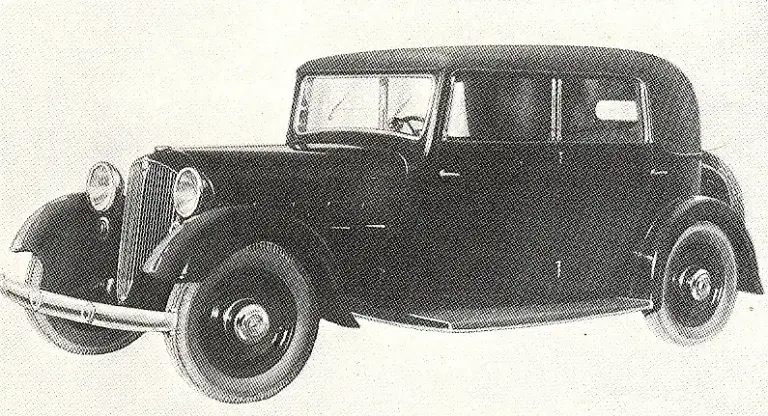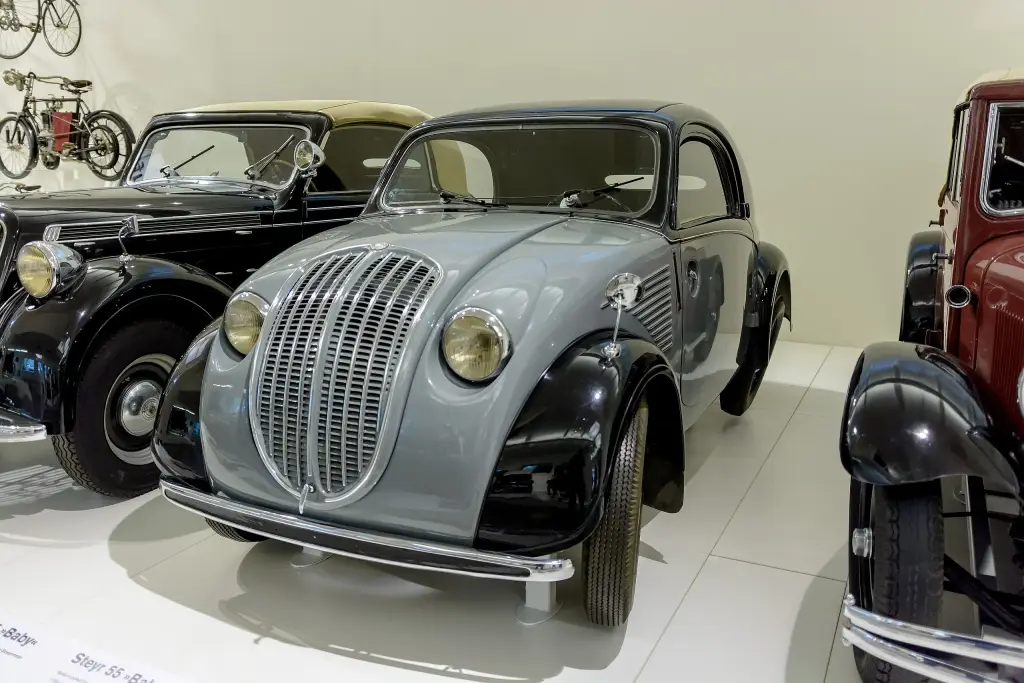
The Steyr 50 was the small car with which Steyr-Daimler-Puch answered the German Volkswagen idea in 1936. Austrians called it the Steyr-Baby. With the revised Steyr 55 of 1938 the model reached a total of 13,000 cars before production stopped in 1940.
Steyr 50 at a glance
| Maker | Steyr-Daimler-Puch A.G., Steyr |
|---|---|
| Production | 1936–1940 (50 and 55) |
| Designer | Karl Jenschke |
| First shown | February 1936, Berlin motor show |
| Engine | water-cooled four-cylinder boxer, thermosiphon cooling |
| Layout | rear-wheel drive |
| Gearbox | four-speed with centre shift |
| Brakes | hydraulic |
| Roof | large steel sliding roof |
| Price, 1937 | 2,865 Reichsmark in Germany |
| Followed by | Steyr 55 in 1938 |
| Built | 13,000 of the 50 and 55 |
| Nickname | Steyr-Baby |
History of the Steyr 50
Jenschke’s last design
The streamlined body with rear-hinged doors was the last design Karl Jenschke made for the Steyr works: he had approved it in 1935, but in November of that year he moved to Adler in Frankfurt as chief designer. The car was shown to the public in February 1936 at the 26th International Motor and Motorcycle Exhibition in Berlin and presented to the press on 6 March 1936. The four-cylinder boxer engine sat at the front and drove the rear wheels through a four-speed gearbox with a central gear lever. To save weight and space a dynastarter was used, which also served as the shaft of the radiator fan.
The Austrian Volkswagen
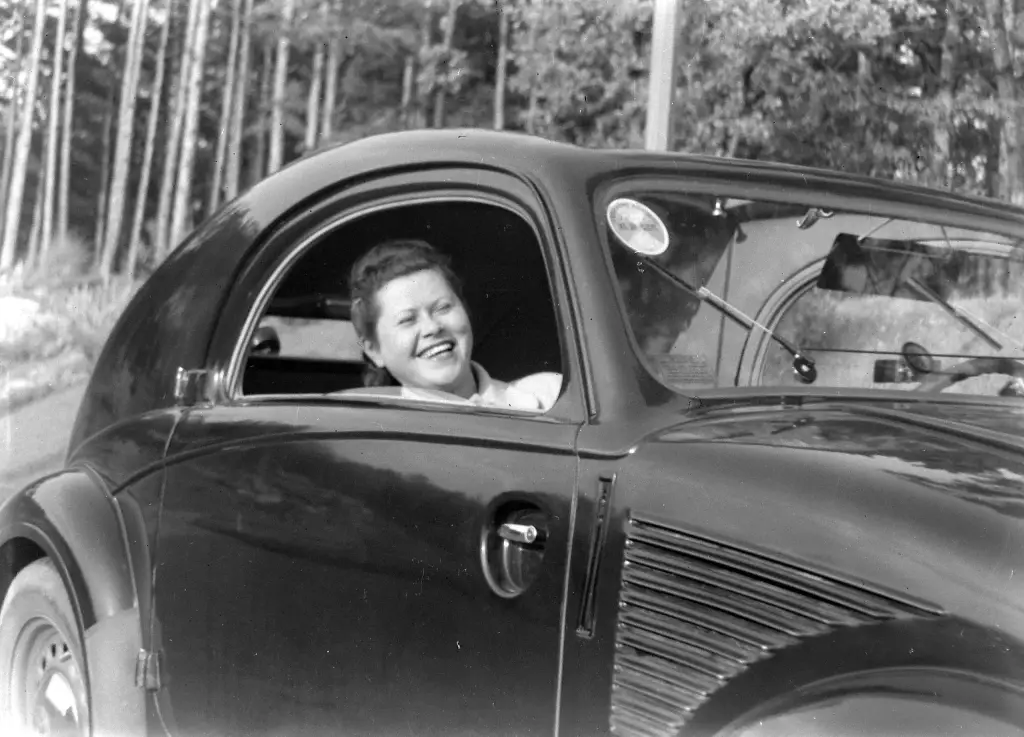
Contrary to rumours of the time, Ferdinand Porsche had nothing to do with the car, and neither had Hans Ledwinka, who had built the Tatra V 570 prototype in 1931. The Steyr-Baby offered better seating and luggage space than Porsche’s Volkswagen in a shorter overall length, and it had hydraulic brakes where the early Volkswagen still used cable-operated ones. In Germany the car cost 2,865 Reichsmark in 1937. The thousandth car was delivered in the middle of 1936 and the five-thousandth at the beginning of December 1937.
The 55 and the vans
In the spring of 1938 the car was revised. The new Steyr 55 received a larger and more powerful engine and perforated wheel discs; the wheelbase stayed the same, but changed bumpers made the car slightly longer. Production ended in 1940 because of the war, after 13,000 cars of both types. On the basis of the 55 Steyr also built delivery vans: the Steyr 150 with a 35 PS 1.5-litre engine, a 750 kg payload and a strengthened chassis, of which 205 were sold in 1938–1939, and the Steyr 250 as a delivery or open Kübelwagen with an additional off-road reduction gear, built 1,200 times between 1938 and 1940, most of them for the Wehrmacht.
Design and features
- Streamlined small body: a rounded shape with rear-hinged doors designed by Karl Jenschke.
- Flat-four engine: water-cooled boxer with thermosiphon cooling and a combined starter-generator.
- Sliding steel roof: a large opening roof was part of the equipment.
- Hydraulic brakes: an advantage over the cable brakes of the early Volkswagen.
Steyr 50 versions
- Steyr 50 (1936–1938): the original Steyr-Baby with the water-cooled flat-four engine.
- Steyr 55 (1938–1940): stronger engine, perforated wheel discs, slightly longer body.
- Steyr 150 delivery van: 35 PS 1.5-litre, 750 kg payload, 205 built.
- Steyr 250: delivery and Kübelwagen with off-road reduction gear, 1,200 built.
The bigger stablemate was the Steyr 100, and the six-cylinder line is described with the Steyr 120 and 220. After the war the works returned to cars with the Steyr 2000. More cars are in the Steyr collection.
Sources
- Steyr 50, English Wikipedia: design, layout, the 55, production total, later models
- Steyr 50, German Wikipedia: dates, price, production landmarks, vans and military version