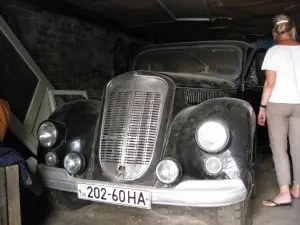
The Steyr 100 and the Steyr 200 were the Austrian middle-class cars that Steyr-Daimler-Puch built from 1934 to 1940. Karl Jenschke’s streamlined four-door body was made in Steyr, and the cars were the first from the company with independent front suspension.
Steyr 100 at a glance
| Maker | Steyr-Daimler-Puch AG, Steyr |
|---|---|
| Production | 1934–1940 |
| Designer | Karl Jenschke |
| Engine | four-cylinder in-line, 1.4 litre |
| Engine details | five main bearings |
| Gearbox | four-speed, synchromesh on the top two gears |
| Layout | rear-wheel drive, swing axle at the rear |
| Front suspension | independent, transverse leaf springs |
| Top speed | about 100 km/h (Steyr 100) |
| Steyr 100 built | 2,850 to 1936 |
| Steyr 200 built | 5,040 to 1940 |
| Bodies | four-door saloon, two-door cabriolet, bare chassis |
History of the Steyr 100
A new middle-class car
Steyr-Daimler-Puch began producing the Steyr 100 in 1934. Its moderately streamlined body was designed by the director Karl Jenschke and had doors that closed against each other, the front ones hinged at the front and the rear ones at the back, so that the centre pillar, the B-pillar, could be left out. All bodies were made in the Steyr works and were of steel apart from the wooden B-pillar of the cabriolet; a single “model body” was built by Gläser in Dresden on a Steyr 100 chassis and shown at the 1933 Berlin motor show.
Engineering
The four-cylinder in-line engine sat at the front and drove the rear wheels through a four-speed gearbox with synchromesh on the top two gears; the 1.4-litre engine had five main bearings, and the independent front suspension was a first for the company. At the rear there was a swing axle on longitudinal leaf springs. The cars were not very powerful, but they climbed the Alpine passes without trouble, which made them popular well beyond Austria. On 22 September 1934 Franz Rehrl, governor of Salzburg, and the engineer Franz Wallack drove a converted Steyr 100 up the Grossglockner High Alpine Road while the road was still unfinished, about a year before it officially opened. In 1935–36 the travel writer Max Reisch crossed Burma, Thailand and Laos in a Steyr 100 and went on through the United States. By 1936 exactly 2,850 cars had been built.
The 200
In 1936 the car was revised with a wider track, a larger and stronger engine and a new body, which as the Steyr 200 stayed on sale until 1940 and was built 5,040 times. One technical speciality was the combined starter and generator. In late 1937 the grille was redesigned to match the larger 220, losing its central bar, gaining a “200” script and changing from a concave to a convex shape. A light commercial version called the Steyr 110 was also offered, and 150 of them were built. A 1936 Steyr 100 and a 1937 Steyr 200 can be seen in the automobile museum at Aspang in Lower Austria.
Design and features
- Independent front suspension: a first for Steyr, combined with a rear swing axle.
- Pillarless doors: the four-door saloon had no B-pillar because the doors closed against each other.
- Alpine ability: the 100 climbed the Grossglockner before the road was finished.
- Starter-generator: the 200 combined the starter motor and the generator in one unit.
Steyr 100 versions
- Steyr 100 (1934–1936): four-door saloon, two-door cabriolet and bare chassis, 2,850 built.
- Steyr 200 (1936–1940): wider track, stronger engine, new body, 5,040 built.
- Steyr 110: light commercial version, 150 built.
The smaller stablemate was the Steyr 50, and the six-cylinder cars of the same period are described with the Steyr 120 and 220. More cars are in the Steyr collection.
Sources
- Steyr 100, English Wikipedia: design, chassis, Grossglockner run, Reisch journey, 200 details
- Steyr 100, German Wikipedia: doors and body construction, Gläser model body, production figures