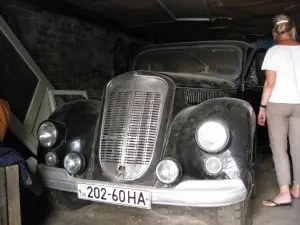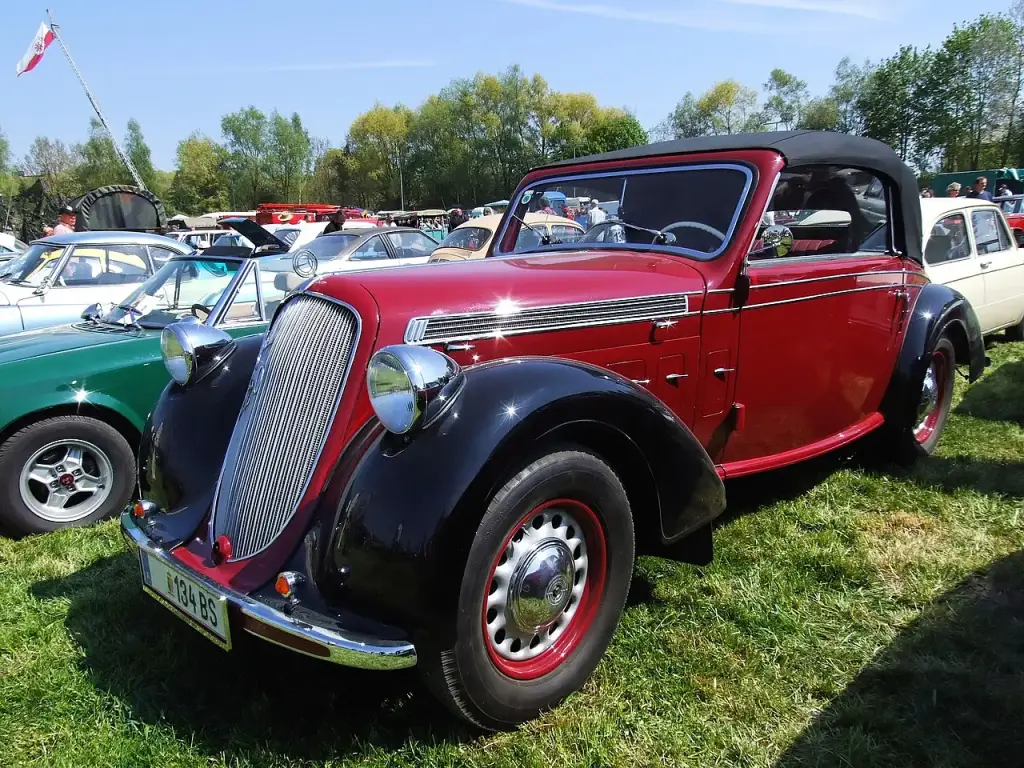
The Steyr 120 Super, the Steyr 125 Super and the Steyr 220 were three stages of one six-cylinder middle-class car that Steyr-Daimler-Puch built from 1935 to 1941. Karl Jenschke designed the coachwork, which was built by Gläser in Dresden, and the family stood above the four-cylinder Steyr 100.
Steyr 120 at a glance
| Maker | Steyr-Daimler-Puch AG, Steyr |
|---|---|
| Production | 1935–1941 |
| Designer | Karl Jenschke, bodies by Gläser, Dresden |
| Engine | six-cylinder in-line, front mounted |
| Gearbox | four-speed manual |
| Layout | rear-wheel drive |
| Front suspension | transverse leaf spring |
| Rear axle | swing axle on quarter-elliptic leaf springs |
| Steyr 125 Super | 1936–1937, 200 built |
| Steyr 220 | 1937–1941, 5,900 built |
| 220 engine | 2,260 cc, 55 PS |
| 220 bodies | limousine, cabriolet, two Gläser cabriolets |
History of the Steyr 120
The 120 Super
The 120 series used a six-cylinder in-line engine instead of the four of the smaller Steyr 100 and drove the rear wheels through a four-speed gearbox. At the front there was a transverse leaf spring, at the rear a swing axle on quarter-elliptic leaf springs. Like the 100, the four-door saloon had rear doors hinged at the back so that the B-pillar could be left out. The streamlined body followed the lines of the smaller car and was built by Gläser in Dresden. By 1936 a total of 1,200 Steyr 120 Super had been produced.
The 125 Super
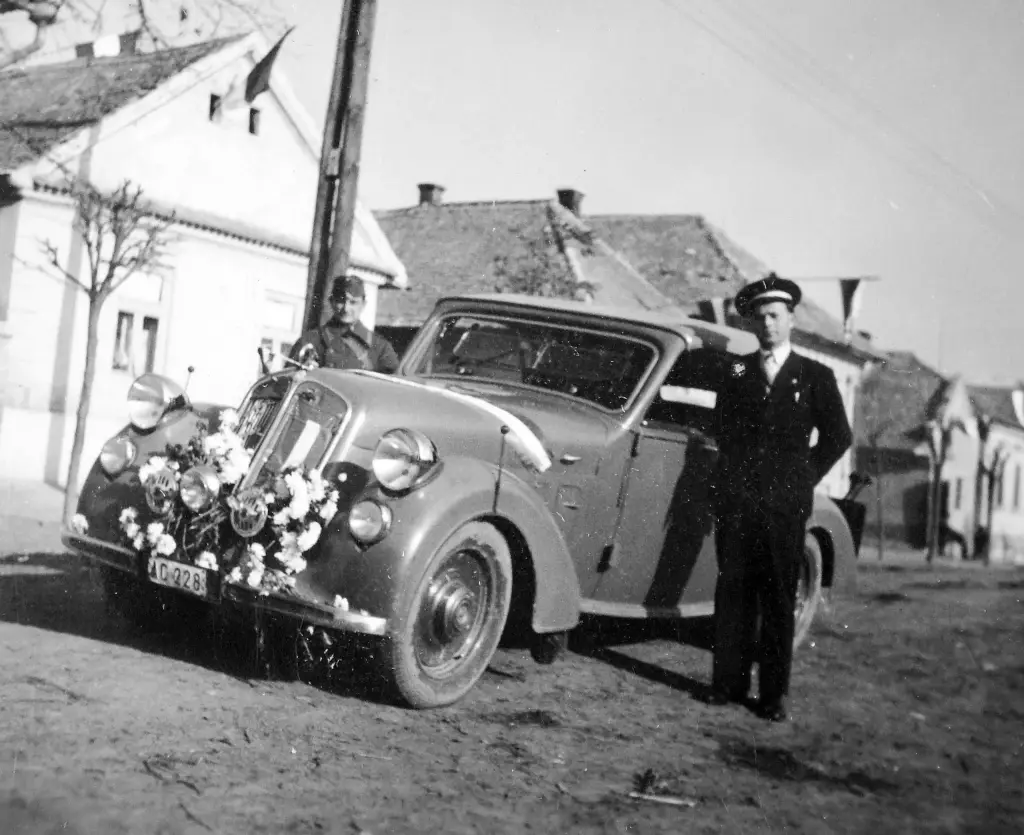
For 1936 the car was revised with a wider track and a larger engine, although the output stayed at 50 PS. The car was now sold mainly in Germany as the Steyr 125 Super, remained on offer until 1937 and was built only 200 times.
The 220
In 1937 the unchanged body received a still larger engine and the car became the Steyr 220. The bore grew to 73 mm, which gave 2,260 cc and 55 PS, and the car was available as a five-passenger limousine, a five-passenger cabriolet and in two cabriolet versions bodied by Gläser. With a light and rigid chassis and independent suspension at all four wheels, its performance and handling were exceptional for the day. The 220 stayed in production until 1941 and 5,900 were built. Only about six of the Gläser-bodied roadster variant are known to have been made and two survive, one in the United States and one in an Austrian museum; the American car has been shown at Pebble Beach and won Best of Show at the Pinehurst Concours d’Elegance.
War and memory
During the Second World War the 220, especially as a cabriolet, was used by high-ranking German commanders and officers. On 20 June 1942 Kazimierz Piechowski, Stanisław Gustaw Jaster, Józef Lempart and Eugeniusz Bendera escaped from the Auschwitz concentration camp in a Steyr 220 belonging to the camp commandant Rudolf Höss, dressed in SS uniforms; none of the four was recaptured. The 220 was the last pre-war model built by Steyr, and between 1920 and 1940 the company made 34,776 cars in all.
Design and features
- Six-cylinder engines: clearly stronger than the fours of the smaller Steyr models and suited to Alpine passes.
- Pillarless saloon: rear-hinged rear doors allowed the omission of the B-pillar.
- Gläser coachwork: the Dresden coachbuilder supplied the bodies, including the rare 220 roadster.
- Independent suspension: all four wheels were independently sprung on the 220.
Steyr 120 versions
- Steyr 120 Super (1935–1936): the first of the line, 1,200 built.
- Steyr 125 Super (1936–1937): wider track and bigger engine, mainly for Germany, 200 built.
- Steyr 220 limousine and cabriolet (1937–1941): 2,260 cc, 55 PS, 5,900 built.
- Steyr 220 Gläser Roadster: about six made, two surviving.
The four-cylinder car underneath this family was the Steyr 100, and the classical-styled successor was the Steyr 430. The company itself is described with the Steyr-Daimler-Puch article. More cars are in the Steyr collection.
Sources
- Steyr 120 Super, 125 Super and 220, English Wikipedia: engines, body, 220 variants, Auschwitz escape, Gläser roadster
- Steyr 120, German Wikipedia: production figures, suspension details, museum car