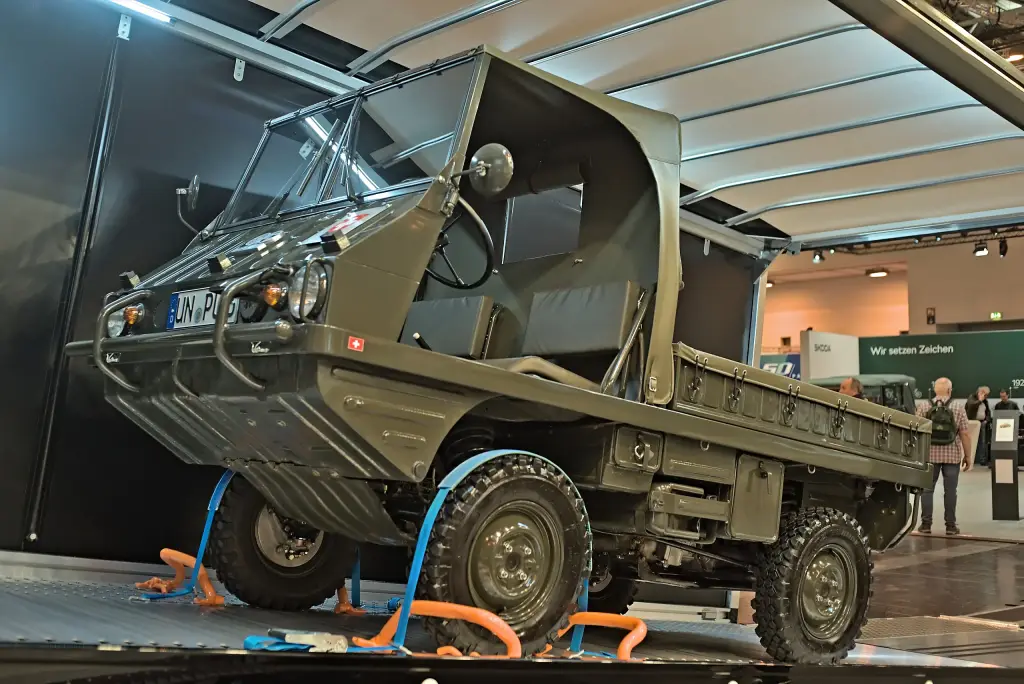
The Steyr-Puch Haflinger was a small, very light four-wheel-drive vehicle that Steyr-Daimler-Puch produced from 1959 to 1974. Its aim was to replace the Austrian army’s ageing Willys Jeeps with something designed and built at home, and it became one of the most capable off-road vehicles of its size.
Steyr-Puch Haflinger at a glance
| Maker | Steyr-Daimler-Puch, Graz |
|---|---|
| Production | 1959–1974 |
| Designer | Erich Ledwinka |
| Length | about 2.85 m, 3.15 m long-wheelbase |
| Width | about 1.35 m |
| Engine | 643 cc air-cooled flat-twin, rear mounted |
| Power | 22 PS at first, later 24 and 27 PS |
| Weight | about 600 kg empty |
| Payload | about 500 kg |
| Top speed | 75, 64, 58 or 52 km/h depending on gearing |
| Built | 16,647 |
| Successor | Steyr-Puch Pinzgauer |
History of the Steyr-Puch Haflinger
From motorcycle demonstration to vehicle
A decade after the war the Austrian army was thinking about retiring its surplus Willys and Ford Jeeps in favour of something more modern and locally made. The Steyr-Puch Haflinger, which takes its name from the mountain horse breed, resulted from talks held during a motorcycle demonstration for the army. Erich Ledwinka, son of the Tatra designer Hans Ledwinka, was responsible for the design. The works type numbers were AP 700 for the short wheelbase and AP 703 for the long one, the letters standing for Allrad-Plattform, a four-wheel-drive platform. Its resemblance to the larger Tatra all-wheel-drive lorries was obvious, and it was even called a little Tatra.
Layout and off-road ability
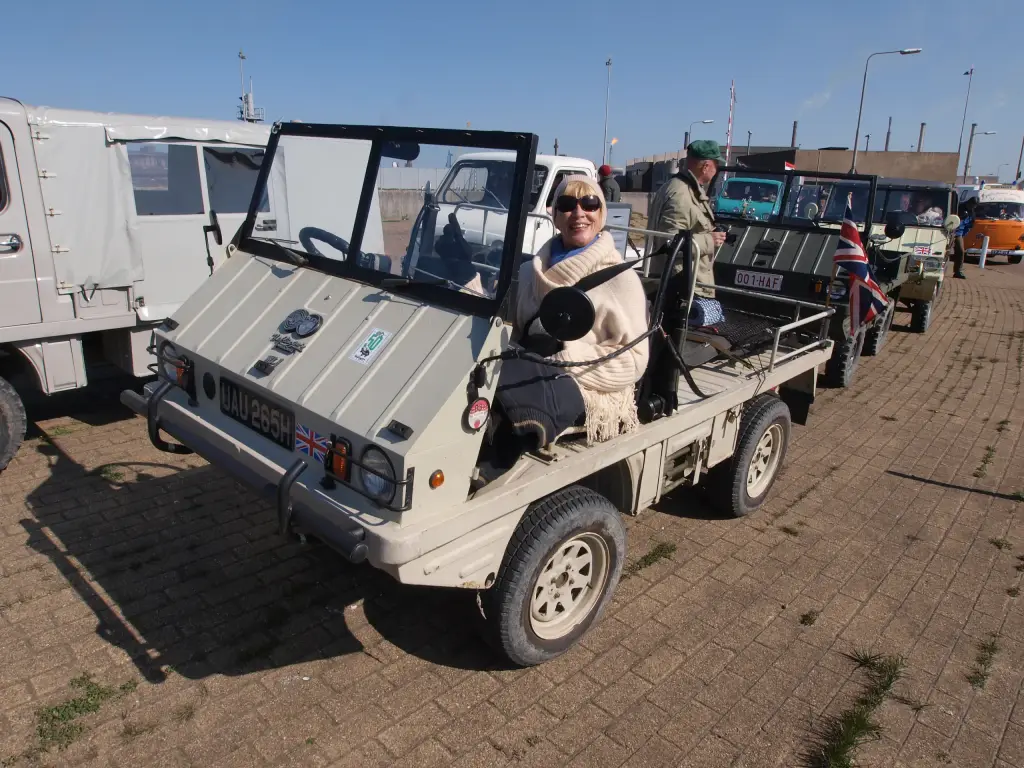
The vehicle was about 2.85 or 3.15 metres long and 1.35 metres wide, with a steel central tube frame in the manner of the Tatra lorries. The engine was an air-cooled two-cylinder boxer of 643 cc at the rear, giving 22 PS at first, then 24 and finally 27 PS. Empty weight was about 600 kg, payload about 500 kg and trailer load around 350 kg; the four-wheel-drive machine could be lifted by four strong people. Independent swing half-axles with about 250 mm of travel carried portal axles, with drop gears in each hub, and the front and rear differentials could be locked separately, so that the vehicle could still make progress with only one wheel on firm ground. All this gave a low centre of gravity, generous approach and departure angles and good ground clearance despite the small wheels. The weak point was the modest engine output and the resulting low top speed of 75, 64, 58 or even 52 km/h depending on gearbox and axle ratio, so owners today prefer to carry their Haflingers to meetings on trailers or small lorries.
Variants and users
The Haflinger was sold above all to the armies of Austria and Switzerland, but also to Sweden, Indonesia and Australia, and about 7,000 went into military service with these forces and the Royal Navy; the Australian army bought 46 in 1966, each with a matching trailer. Civilian versions included the Kommunalhaflinger, usually with a fixed polyester cab, the Tropenhaflinger with a cyclone air filter on the nose, the US Pathfinder and the Italian Steyr-Puch 700 AP. Some armed forces used the small vehicle as a weapons platform: the Austrian army mounted a heavy Browning M2 machine gun or an M18 recoilless gun on it, while Switzerland and Sweden fitted Bofors Bantam anti-tank missiles, six facing forward and eight backward. A larger brother with a very similar layout appeared later as the Steyr-Puch Pinzgauer, and the planned H2 successor eventually led to the Puch G and the Mercedes-Benz G-Class.
Design and features
- Air-cooled flat-twin: 643 cc at the rear, between 22 and 27 PS.
- Portal axles: drop gears in the hubs give ground clearance with small wheels.
- Two differential locks: the vehicle moves on as long as one wheel has grip.
- Light and compact: about 600 kg and under three metres long.
Steyr-Puch Haflinger versions
- AP 700: the short-wheelbase version.
- AP 703: the long-wheelbase version.
- Kommunalhaflinger: municipal version with a fixed polyester cab and about 1,200 kg payload.
- Tropenhaflinger: tropical version with an additional cyclone air filter.
- Pathfinder and Steyr-Puch 700 AP: versions for the United States and Italy.
- Military versions: for Austria, Switzerland, Sweden, Indonesia and Australia.
The company behind it is described with the Steyr-Daimler-Puch article, and the post-war passenger cars are remembered with the Steyr 2000. More vehicles are in the Steyr collection.
Sources
- Steyr-Puch Haflinger, English Wikipedia: dimensions, engine, weight, military users, off-road features
- Steyr-Puch Haflinger, German Wikipedia: designer, type numbers, power steps, variants, top speeds, total