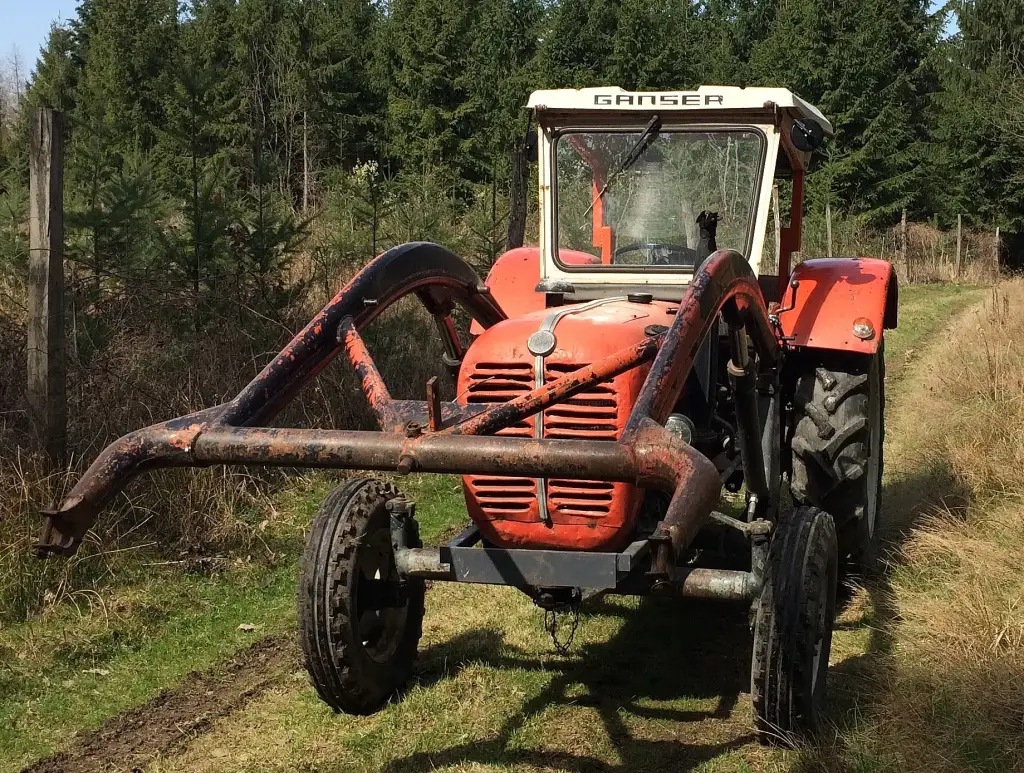
The Steyr 288 was a model of the anniversary series with which Steyr-Daimler-Puch renewed its tractors at the beginning of the 1960s. Its 45 PS four-cylinder diesel and its two-group gearbox made it a capable all-round machine, and 6,253 were built between 1962 and 1966.
Steyr 288 at a glance
| Maker | Steyr-Daimler-Puch, Steyr |
|---|---|
| Production | 1962–1966 |
| Engine | WD 406 four-cylinder diesel, water-cooled |
| Engine size | 2,660 cc, prechamber injection |
| Power | 45 DIN PS (33 kW) at 2400 rpm |
| Maximum torque | at 1300 rpm |
| Specific consumption | 188 g/PSh (255.6 g/kWh) |
| Gearbox | four gears in two groups, preselected |
| Speed range | 1.65 to 28.7 km/h |
| Rear lift | up to 1,600 kg, category I and II |
| Built | 6,253 |
based on one source: the German Wikipedia article on the Steyr 288.
History of the Steyr 288
Four cylinders for the anniversary series
The Steyr 288 belonged to the anniversary series and was the four-cylinder member of the family, powered by a Steyr WD 406 diesel of 2,660 cc. The water-cooled four-stroke engine with prechamber injection produced 45 DIN PS (33 kW) at 2400 rpm and reached its greatest torque at 1300 rpm; the specific consumption was quoted as 188 g/PSh. Between 1962 and 1966, 6,253 of these tractors were built.
The gearbox
The gearbox had four gears in two groups. A preselection lever allowed the driver to change between the agricultural and the road group while the tractor stood still, and a direction selector beside the gear lever, also to be used only at standstill, let every gear work forwards or backwards. With this gearbox the tractor covered a speed range from 1.65 to 28.7 km/h at full engine speed. To keep the weight and size of the gearbox down, a further reduction took place in a planetary gear in each axle half, and the rear differential could be locked.
Power take-off and hydraulics
The tractor had a rear power take-off and a front one, the latter placed not at the front of the tractor as on modern machines but in the middle of the vehicle. The rear unit could be switched as an engine-driven take-off between 540 and 1000 rpm, or used as a ground-speed take-off driven in proportion to the wheels, and a second clutch let the drive to the gearbox be cut while the take-off kept running, which was needed with threshing machines. Unusually for Steyr tractors, the ground-speed take-off could also be used while the tractor stood still, by putting the group lever into neutral and choosing speed and direction with the other two levers, so that the engine could run at its most economical speed for stationary work. For front-loader work the works offered a loader with two single-acting cylinders, whose bucket was released mechanically by a cable. The rear lift raised up to 1,600 kg, could be changed between category I and II, and with its Bosch control hydraulics offered both position and draft control.
Design and features
- 45 PS four-cylinder: the WD 406 diesel with prechamber injection and modest specific consumption.
- Two-group gearbox: 1.65 to 28.7 km/h, with every gear available in reverse.
- Versatile power take-off: 540 or 1000 rpm, ground-speed mode and a mid-mounted front unit.
- Rear lift to 1,600 kg: category I and II with position and draft control.
Steyr 288 versions
- Steyr 288 (1962–1966): the standard tractor of the anniversary series.
- With front loader: factory loader with two single-acting cylinders and a cable-released bucket.
- With Bosch control hydraulics: draft control for ploughing.
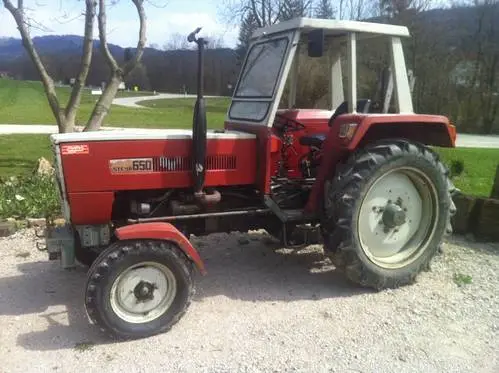
The lighter tractor of the same series is the Steyr 188, and the later four-cylinder type of the Plus series is the Steyr 650. More machines are in the Steyr collection.
Sources
- Steyr 288, German Wikipedia: engine data, gearbox, power take-off, loader, lift, production