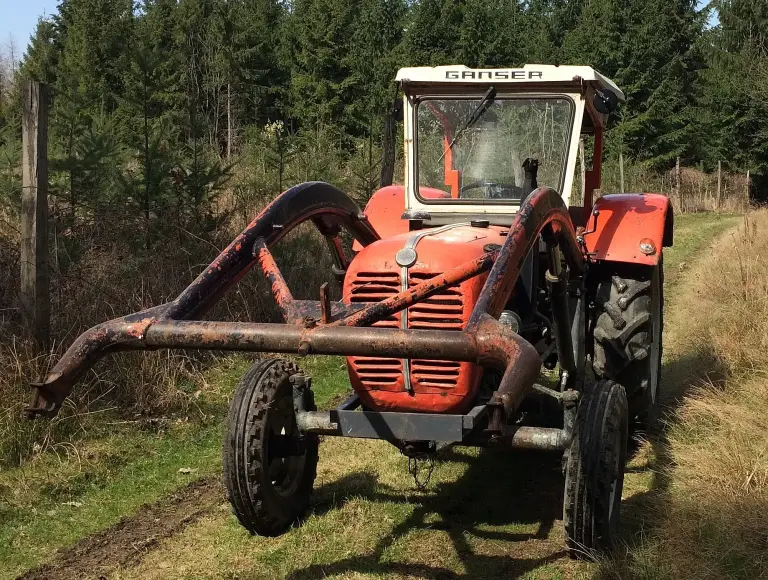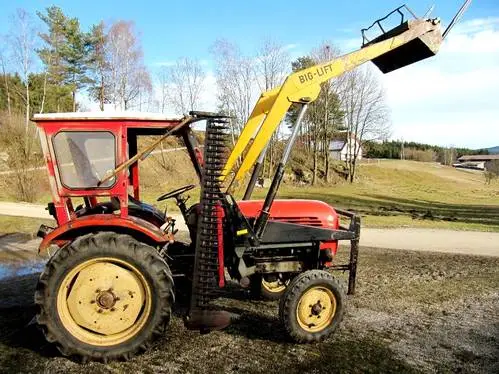
The Steyr 188 was the first model of the anniversary series with which Steyr-Daimler-Puch modernised its tractors in 1960. It was a light 28 PS machine with a waisted body, and it was the first Steyr tractor to have hydraulic lifting gear as standard. Between 1960 and 1966, 26,425 were built.
Steyr 188 at a glance
| Maker | Steyr-Daimler-Puch, Steyr |
|---|---|
| Production | 1960–1966 |
| Engine | WD-209 two-cylinder diesel, water-cooled |
| Engine size | 115 mm stroke, 1,991 cc |
| Power | 28 PS |
| Gearbox | group gearbox, agricultural and road groups |
| Gearbox ratios | 2 × 4 forward, 2 × 3 reverse |
| Hydraulics | standard, Bosch draft control optional later |
| Front axle track | 1,250–1,750 mm, five settings |
| Rear axle track | 1,250–1,650 mm, eight settings |
| Built, 188 | 23,223 |
| Built, 188n | 3,202, 1965–1966 |
based on one source: the German Wikipedia article on the Steyr 188.
History of the Steyr 188
A modern light tractor
The Steyr 188 was the first model of what the works called the anniversary series. Unlike its predecessors of the 13 series it was a light, modern tractor with a waisted body, which also allowed implements to be mounted between the axles. For the first time on a Steyr tractor the hydraulics were standard, and they were fitted with a Bosch wheel-load booster that transferred part of the implement weight to the rear wheels to gain adhesion; some years later a draft-controlled hydraulic system could be ordered. Driver comfort came from a rubber-sprung parallelogram seat and a sprung front axle with coil springs at the steering knuckles. The sprung axle did not prove itself in continuous use, as it soon lost its springing, and was often replaced by a rigid one.
Transmission and chassis
The 8/6 group gearbox, divided into agricultural and road groups, was particularly well suited to work with a front loader. Power came from a water-cooled four-stroke two-cylinder diesel of the WD-209 type from the Steyr lorry division, with a 115 mm stroke and 1,991 cc, mounted rigidly to the gearbox housing. The tractor had mechanical internal-expanding brakes acting on the rear wheels, a pendulum front axle with a track adjustable in five steps from 1,250 to 1,750 mm, a portal rear axle adjustable in eight steps from 1,250 to 1,650 mm, and worm-and-roller steering.
The 188n and the verdict
A mountain version, the Steyr 188n, was offered as a low-built tractor with a lower centre of gravity and smaller 10-24 rear tyres for work on mountain slopes; between 1965 and 1966, 3,202 were built, and otherwise it was identical to the standard model. Additional weights, cage wheels, twin tyres and half or full tracks could be ordered. The 188 was regarded as an extremely successful tractor, competitive internationally as well: with its low weight, its waisted body and its gearbox it was in line with the trend of Central European tractor building. Steyr also had the tractor tested as quickly as possible at the federal research and testing station for agricultural machinery, where it did very well. Altogether 26,425 of the 188 and 188n were made, proof that the machine was a commercial success as well.
Design and features
- Waisted body: the narrow middle section allowed mid-mounted implements.
- Standard hydraulics: the first Steyr tractor with lifting gear in the standard equipment.
- Group gearbox: agricultural and road groups with 2 × 4 forward and 2 × 3 reverse gears.
- Adjustable track: five settings at the front and eight at the portal rear axle.
Steyr 188 versions
- Steyr 188 (1960–1966): the standard tractor, 23,223 built.
- Steyr 188n (1965–1966): low mountain version with 10-24 rear tyres, 3,202 built.
The type before it was the Steyr 180, and the more powerful member of the same series is the Steyr 288. More machines are in the Steyr collection.
Sources
- Steyr 188, German Wikipedia: production figures, hydraulics, gearbox, axles, engine, 188n