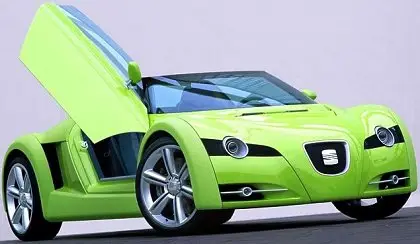
The SEAT Fórmula was a rear-wheel-drive, mid-engined roadster concept shown at the 1999 Geneva Salon. Developed with an eye on limited production, it was designed at the Volkswagen Group’s Design Center Europe in Sitges and built by the Turin coachbuilder Stola. It never reached showrooms.
SEAT Fórmula at a glance
| Type | concept car, mid-engined roadster |
|---|---|
| Shown | 1999 Geneva Salon |
| Design | Volkswagen Group Design Center Europe, Sitges |
| Team leader | Erwin Leo Himmel |
| Among the designers | Julian Thomson, designer of the Lotus Elise |
| Body built by | Stola, Turin |
| Chassis | aluminium, about 900 kg |
| Engine | 2.0-litre 20-valve turbo four-cylinder, 240 hp |
| Gearbox | six-speed sequential Sportronic |
| 0–100 km/h | 4.8 seconds |
| Top speed | 235 km/h |
| Production | none; the project was aimed at a limited run |
This page is based on one source, the English Wikipedia article on the SEAT Fórmula. Free photographs of the concept car were not found on Wikimedia Commons, so the page has no photographs.
History of the SEAT Fórmula
Designed in Sitges
The Fórmula was designed at the Volkswagen Group’s Design Center Europe at Sitges, near Barcelona, a facility jointly owned by Volkswagen, Audi and SEAT. The team was directed by Erwin Leo Himmel and included Julian Thomson, the designer of the Lotus Elise, and the car was intended to show the design language of the brand’s future models. Its name was a deliberate link with SEAT’s past: the Spanish Fórmula Nacional race series of the 1960s, created when SEAT first became involved in motorsport.
Geneva 1999
The first concept, built by the Turin company Stola, was shown at the 1999 Geneva Salon international de l’automobile. Under the skin sat a water-cooled 2-litre 20-valve turbocharged four-cylinder engine of 240 hp, mounted behind the seats in an aluminium chassis weighing almost 900 kg. The engine produced its maximum power at 5,800 rpm and 295 Nm of torque between 2,100 and 4,800 rpm, and drove through a six-speed sequential Sportronic electro-hydraulic semi-automatic gearbox, both of them derived from SEAT’s rally cars.
Numbers and details
The combination of low weight and a strong engine gave the Fórmula a 0–100 km/h time of 4.8 seconds and a top speed of 235 km/h. It rode on 20-inch light alloy wheels, 7.5 J by 20 inches at the front and 9 J by 20 inches at the rear, with 205/45 R20 and 255/35 R20 tyres, on an independent suspension with Formula One-style wishbones in front and horizontally mounted dampers at the rear. Ventilated disc brakes were fitted at all four wheels, and there was even a 100-litre luggage compartment. The car was aimed at limited production, but that plan was never carried through.
Design and features
- Mid-engine layout: a rear-wheel-drive roadster built around a light aluminium chassis.
- Rally-derived running gear: engine and six-speed sequential gearbox taken from SEAT’s rally cars.
- Serious performance: 240 hp, 0–100 km/h in 4.8 seconds and 235 km/h.
- Design showcase: a preview of SEAT’s future design language, drawn at Sitges.
SEAT Fórmula versions
- SEAT Fórmula concept (1999): the only car built, a Geneva show car by Stola.
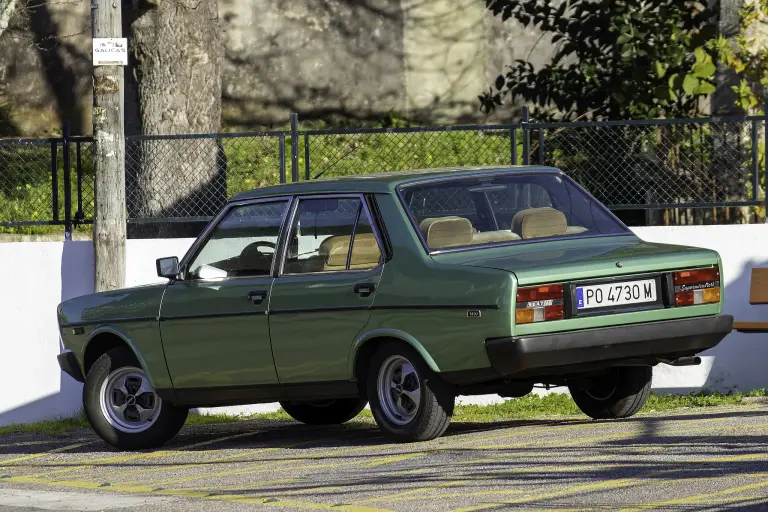
The Fórmula took its name from SEAT’s racing past, the Fórmula Nacional series that grew out of the SEAT 1430, and it was followed by another concept, the SEAT Salsa. More Spanish cars are in the SEAT collection.
Sources
- SEAT Fórmula, English Wikipedia: design, engine, chassis, performance, history