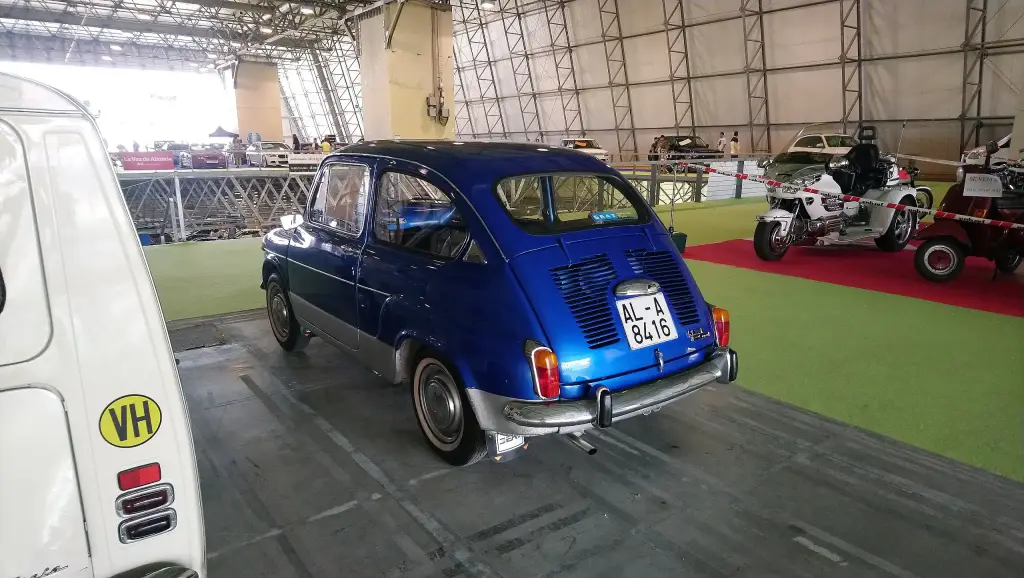
The SEAT 600 is the car that motorised Spain. Built under licence from Fiat at Zona Franca in Barcelona from 27 May 1957 to 3 August 1973, the small rear-engined saloon was the first car within reach of ordinary Spanish families and became a symbol of the country’s economic miracle.
SEAT 600 at a glance
| Maker | SEAT, Zona Franca, Barcelona |
|---|---|
| Production | 27 May 1957 – 3 August 1973 |
| Design | Dante Giacosa, for Fiat |
| Body | two-door saloon, rear engine, four seats |
| Length | 3.322 m |
| Price at launch | 65,000 pesetas, cut to 63,000 in 1964 |
| Built | 797,319 SEAT 600 and 18,200 SEAT 800 |
| Four-door version | SEAT 800 |
| Exports | almost 10 per cent, about 80,000 cars |
| Best seller | in Spain 1958–1966 and 1968 |
| Replaced by | SEAT 133 |
This page is based on one source, the English Wikipedia article on the SEAT 600.
History of the SEAT 600
1957: a car for ordinary families
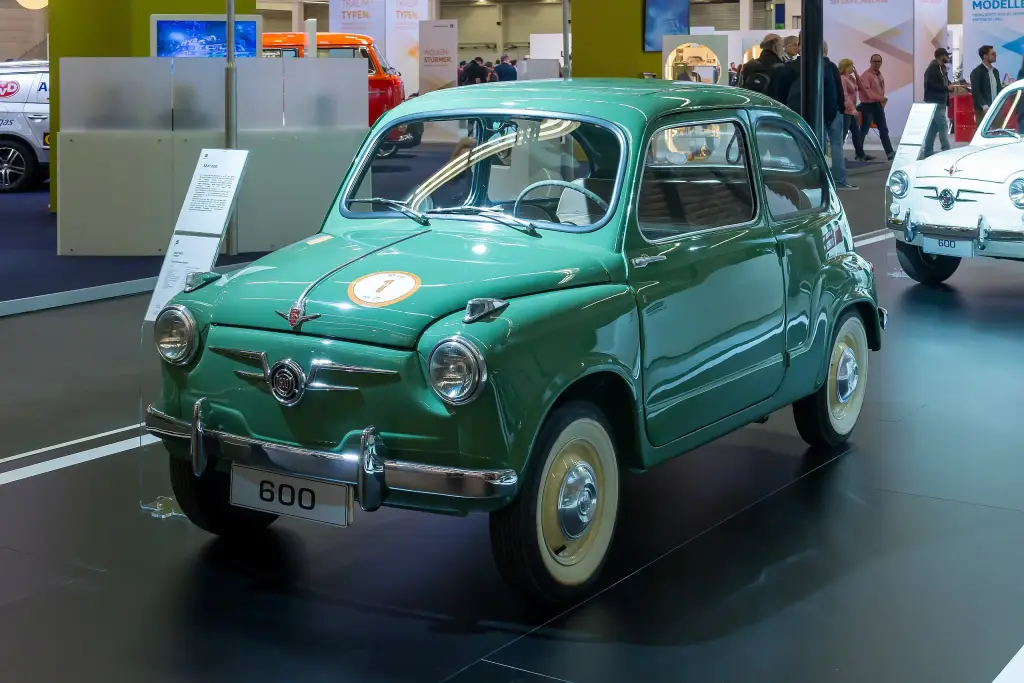
The 600 was the Italian Fiat 600 designed by Dante Giacosa, and SEAT began building it under licence at its new Zona Franca plant. The first car left the line on 27 May 1957; it was registered in Madrid on 5 December that year as M-184018 and stayed in use until February 1985, while the first 600 actually registered was a Barcelona car, B-141141, from 8 June 1957. Sales to the public started on 24 June 1957 at 65,000 pesetas before tax, a price low enough to be affordable. Demand was so strong that the order book held the equivalent of four years of production, and SEAT introduced a deposit on each order to control the queue.
The boom years
SEAT cut the price to 63,000 pesetas in 1964 and held it until 1969, and in 1967 it set up Fiseat, its own customer finance company, to speed up purchases and promote payment by instalments. The 600 was the best-selling car in Spain from 1958 to 1966 and again in 1968; by 1971 one car in four on Spanish roads was a SEAT 600. From March 1958 cars were delivered to the customer’s province, and a long list of accessories followed, from chrome hubcaps to roof racks that made up for the lack of storage space. A fixed-profile convertible with a sliding canvas roof was offered from July 1958 for 5,000 pesetas more, and in February 1961 a basic commercial body without rear seats or rear side windows appeared.
Versions and the end
The first two series were the 600 of 1957–1963, unofficially the 600 N, and the 600 D of 1963–1970, both with so-called suicide doors; the D brought front position lights under the headlamps, the lock in the door handle and an ignition key in the centre of the dashboard, and in 1966 it was restyled with more curved bumpers and rubber overriders. A four-door body was sold as the SEAT 800. Exports began in November 1965 with 150 cars sent to Colombia, followed by Argentina, Belgium, Chile, Finland, Poland and Portugal, where the 600 D was the best seller from 1971 to 1973; when Fiat stopped making the 600 in 1969, SEAT supplied the demand with cars badged “Fiat costruzione SEAT”. Production ended in 1973 partly because the thin B-pillars made it hard to fit seat belts under the new safety rules. After that SEAT still exported 171,500 cars in kit form, and about 10,000 Seiscientos are thought to survive in Spain today.
Design and features
- Rear engine, four seats: a compact two-box saloon only 3.3 m long.
- A price people could pay: 65,000 pesetas at launch, later 63,000, with instalment finance from 1967.
- Many bodies: saloon, sliding-roof convertible, commercial van and the four-door 800.
- Exported widely: almost a tenth of production went abroad, plus more than 170,000 kits.
SEAT 600 versions
- 600 N (1957–1963): the original two-door with suicide doors.
- 600 D (1963–1970): revised details, restyled in 1966.
- 600 convertible: fixed profile with a sliding canvas roof, from 1958.
- 600 commercial (1961): no rear seat or rear side windows.
- SEAT 800: four-door version, 18,200 built.
The 600 sat below the SEAT 850 and later the SEAT 124, and its four-door version was the SEAT 800. More Spanish cars are in the SEAT collection.
Sources
- SEAT 600, English Wikipedia: dates, price, versions, exports, production