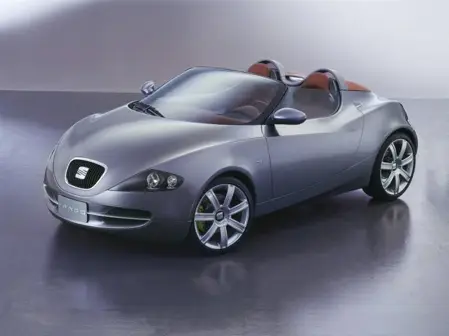
The SEAT Tango was a small two-seat roadster concept shown at the 2001 Frankfurt Motor Show. Designed under Walter de Silva, it used a shortened SEAT Ibiza platform and a 180 PS turbocharged engine, and for years it was expected to become a production car; in the end Audi refused to sign it off.
SEAT Tango at a glance
| Type | concept car, two-seat roadster |
|---|---|
| Shown | 2001 Frankfurt Motor Show |
| Design | team led by Walter de Silva, with Steve Lewis |
| Platform | shortened SEAT Ibiza |
| Engine | 1.8-litre 20-valve turbo, 180 PS |
| Drive | front-wheel drive |
| Weight | 1,150 kg |
| 0–100 km/h | 7.0 seconds |
| Top speed | 235 km/h |
| Suspension | MacPherson struts front, self-steering rear |
| Award | Autonis 2002, concept car category |
| Production | never approved |
This page is based on one source, the English Wikipedia article on the SEAT Tango. Free photographs of the concept car were not found on Wikimedia Commons, so the page has no photographs.
History of the SEAT Tango
A Spanish roadster
The Tango was presented at the 2001 Frankfurt Motor Show, designed by a team directed by Walter de Silva with the contribution of Steve Lewis, SEAT’s chief of exterior design. It was a two-door, two-seat roadster riding on a cut-down SEAT Ibiza platform, powered by a 180 PS version of the Volkswagen Group’s 1.8-litre 20-valve turbo engine driving the front wheels. The engine produced 178 hp at 5,600 rpm and 235 Nm between 2,100 and 5,000 rpm. Weighing 1,150 kg, the car reached 100 km/h in 7.0 seconds and a top speed of 235 km/h, with MacPherson struts at the front and a rear suspension with a degree of self-steer, ventilated front discs and ABS, ESC and traction control. It was an internal concept, and it was originally going to be called the Tanga because of the lines of its rear end, but Volkswagen Group management turned the name down as too provocative.
Safety and derivatives
Extensive safety measures were built into the project: a progressive deformation structure and a central passenger cell to cushion impacts, twin front airbags, side airbags, anti-lock brakes, electronic stability control and traction control. Several derivatives were proposed on the same base, among them the SEAT Tango spyder, the Tango coupé and the Tango Racer. The design was well received and won the Autonis award in 2002 in the concept car category.
Why it was never built
For a long time the Tango was the subject of speculation about whether it would become a production model. It had the support of SEAT’s, and later the Volkswagen Group’s, chairman Bernd Pischetsrieder, it was seen as important for the brand’s sporting image and the public response was overwhelming, yet it never got the green light. SEAT’s integration into the Audi brand group meant decisions had to be taken in consensus with Audi’s management, and Audi was opposed to turning the Tango into a production car at any cost. Audi board chairman Martin Winterkorn put it bluntly: “I am not signing a production contract with blood until I see the right numbers.” Audi preferred new models in segments that made more sense in sales terms, such as the SEAT Altea MPV, which was meant to succeed Audi’s own A2.
Design and features
- Ibiza-based roadster: a shortened Ibiza platform under a two-seat open body.
- Turbo performance: 180 PS, 1,150 kg, 0–100 km/h in 7.0 seconds and 235 km/h.
- Full safety package: twin front and side airbags, ABS, ESC and traction control.
- Design award: the Autonis prize of 2002 for concept cars.
SEAT Tango versions
- Tango roadster (2001): the Frankfurt concept.
- Tango spyder and coupé: proposed derivatives on the same base.
- Tango Racer: a further racing-oriented study.
The Tango was built on the SEAT Ibiza platform and shared the design language of the SEAT Salsa; its place in the range was taken by the SEAT Altea. More Spanish cars are in the SEAT collection.
Sources
- SEAT Tango, English Wikipedia: design, engine, safety, award, production decisions