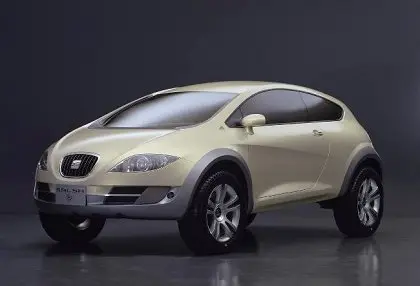
The SEAT Salsa was the concept car that introduced Walter de’Silva’s new design language for SEAT. A three-door coupé shown at the 2000 Geneva Motor Show, it packed a 250 PS 2.8-litre V6 and a “Multi Driving” system that let the driver change the car’s character at the touch of a switch.
SEAT Salsa at a glance
| Type | concept car, three-door coupé |
|---|---|
| Shown | 2000 Geneva Motor Show |
| Design | under Walter de’Silva |
| Engine | 2.8-litre 24-valve V6, 247 hp (250 PS) |
| Power at | 6,200 rpm |
| Torque | 297 Nm at 3,200 rpm |
| Drive | four-wheel drive |
| Tyres | Michelin PAX 225-640 R 460, 7.5J x 18 wheels |
| Weight | 1,570 kg |
| 0–100 km/h | 7.5 seconds |
| Top speed | 245 km/h |
| Evolution | Salsa Emoción, Paris 2000 |
This page is based on one source, the English Wikipedia article on the SEAT Salsa. Free photographs of the concept car were not found on Wikimedia Commons, so the page has no photographs.
History of the SEAT Salsa
A taste of the new SEAT
The Salsa was presented at the 2000 Geneva Motor Show as a foretaste of SEAT’s new design line under Walter de’Silva. It was a three-door coupé powered by a 2.8-litre 24-valve V6 in a 15-degree vee, with double overhead camshafts, producing 247 hp at 6,200 rpm and 297 Nm of torque at 3,200 rpm. Drive went to all four wheels through a four-wheel-drive system, and the car rode on 7.5J by 18-inch wheels with Michelin PAX 225-640 R 460 tyres. It weighed 1,570 kg, reached 100 km/h in 7.5 seconds and had a top speed of 245 km/h. Ventilated disc brakes were fitted front and rear, with anti-lock braking.
Multi Driving
SEAT described the Salsa as a Multi Driving concept car because the driver could select several driving modes through a switch on the dashboard: sport, comfort and city. Each mode changed not only the engine and gearbox settings but also the driving position, the interior lighting and even the layout of the dashboard. It was an early attempt to make a single car behave like several, an idea that later spread through the industry.
Salsa Emoción
Six months after the Geneva presentation, SEAT revealed the SEAT Salsa Emoción at the 2000 Paris Motor Show. It was an evolution of the original Multi Driving concept, adding new features for all-road adaptability. The Salsa family is also notable for its design process: the car was modelled using Alias StudioTools CAID software. The ideas it introduced, from the shape language to the driving modes, carried into production models such as the Altea, which SEAT itself described as having been previewed by the Salsa Emoción.
Design and features
- New design language: the first public taste of Walter de’Silva’s SEAT.
- Multi Driving: sport, comfort and city modes that change engine, gearbox and cabin.
- Strong hardware: 2.8 V6 of 247 hp, four-wheel drive and 18-inch wheels.
- Digital design: modelled in Alias StudioTools CAID software.
SEAT Salsa versions
- Salsa (2000): the original Geneva concept coupé.
- Salsa Emoción (2000): Paris evolution with all-road features.
The Salsa introduced the design language used by the SEAT Altea, and it followed the earlier SEAT Fórmula concept. More Spanish cars are in the SEAT collection.
Sources
- SEAT Salsa, English Wikipedia: design, engine, driving modes, dimensions, performance