The Scania 4-series bus and coach range was introduced in 1997 as the successor to the 3-series bus range. Unlike its predecessor, which consisted of 45 different chassis models, it was one basic chassis with modular configurations, marketed as the F94, K94, K114, K124, L94 and N94.
Scania 4-series (bus) at a glance
| Introduced | 1997, after the OmniCity of September 1996 |
|---|---|
| Predecessor | Scania 3-series bus range |
| Principle | one basic chassis with modular configurations |
| Initial configurations | F HB, K EB, K IB, L IB, L UB, N UA, N UB |
| Added later | F HA, K UB, L IA, L UA, N UD |
| Engine positions | F front, K rear central, L rear inclined, N rear transverse |
| Launch engines | DSC9 9.0-litre, DSC12 11.7-litre |
| 1999 engines | Euro III DC9, DC12 and the new 10.6-litre DC11 |
| Successor | Euro IV K-, N- and F-series, 2006 |
based on one source
History of the Scania 4-series (bus)
A modular range
The 4-series bus range was first shown in September 1996, when the integral low-floor city bus OmniCity was revealed. Production of the chassis range began in the second half of 1997, and by the end of 1998 every production facility worldwide had changed from the 3-series to the 4-series. The 3-series had been a range of 45 different chassis models; the 4-series was one basic chassis with different modular configurations. At launch there were seven major configurations, presumably the F HB, K EB, K IB, L IB, L UB, N UA and N UB, later joined by the F HA, K UB, L IA, L UA and N UD.
Reading the designation
The first letter describes where the engine sits: F ahead of the front axle, K behind the rearmost axle and mounted centrally, L behind the rearmost axle and inclined 60 degrees to the left, N behind the rearmost axle and transverse, inclined 60 degrees to the rear. The next figures give the engine generation — 9, 11 or 12 litres — and the 4 the series. That is why the range is known as F94, F114, K94, K114, K124, L94 and N94. The remaining letters describe the type of transport (E coach, H intercity on F chassis, I intercity, U urban), the chassis adaptation (A articulated, B normal, D double-decker), the wheel configuration, the chassis height and the suspension.
Engines
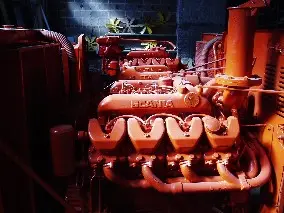
The launch engines were the 9.0-litre (8,974 cc) DSC9 and the 11.7-litre (11,705 cc) DSC12, both Euro II inline sixes, turbocharged and intercooled. The DSC9 came with 220, 260 and 310 hp, the DSC12 with 360 and 420 hp. In November 1999 Scania presented Euro III truck engines that soon became available in the buses: the DSC9 and DSC12 were renamed DC9 and DC12, with outputs of 230, 260 and 300 hp for the DC9 and 420 hp for the DC12, and they were joined by the new 10.6-litre DC11 with 340 and 380 hp. Alternative-fuel versions included the OSC9 CNG engine at 260 hp, later the OC9 at 260 and 300 hp, and in selected markets the ethanol DSI9 at 230 hp.
Chassis families
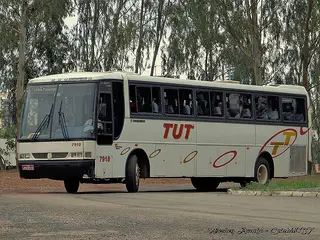
The front-engined F94 and F114 replaced the F93 and F113 and were mainly built in São Bernardo do Campo, Brazil and Tucumán, Argentina for Latin America and Africa. The rear-engined K94, K114 and K124 replaced the K93 and K113; the K114 arrived in 2000, and the family could be built as a premium coach (K EB), a coach or intercity bus (K IB) or, rarely, a city bus (K UB). The K EB versions were the only 4-series chassis with independent front suspension. The L94 replaced the L93, and the N94 the N93. In 2006 the range was superseded by the Euro IV K-, N- and F-series, although some 4-series products remained available for a couple of years.
Design and features
- One chassis, many buses: a modular design replacing 45 separate 3-series chassis.
- Four engine positions: F, K, L and N, each with its own letter in the model name.
- Independent front suspension: fitted only to the K EB coach chassis.
- Alternative fuels: CNG and ethanol versions of the 9-litre engine.
Scania 4-series (bus) versions
- K94, K114, K124: rear-mounted coach and intercity chassis.
- F94, F114: front-engined chassis for Latin America and Africa.
- L94: low-entry city chassis with the engine inclined to the left.
- N94: transverse rear engine for low-floor city buses.
The integral city bus of the same generation is described in Scania OmniCity, and the chassis that followed in Scania K-series. The trucks of the generation are in Scania 4-series, and more vehicles are in the Scania collection.
Sources
- Scania 4-series (bus), English Wikipedia: configurations, designations, engines, chassis families