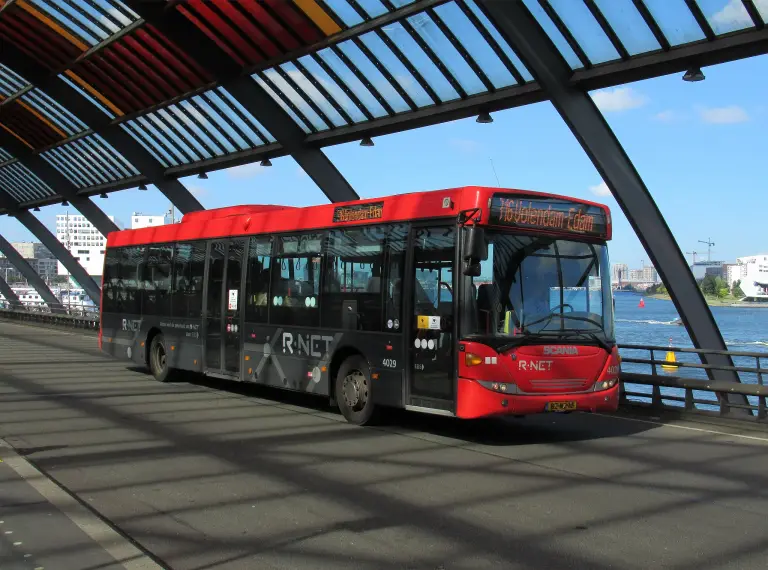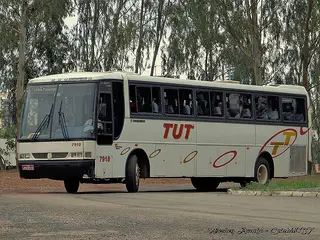
The Scania K-series is a range of city bus and coach chassis with a longitudinally mounted engine at the rear. It was first presented at the Busworld exhibition in Kortrijk, Belgium, in 2005, and models became available from 2006, replacing the K94, K114, K124 and L94 chassis of the 4-series.
Scania K-series at a glance
| First shown | Busworld, Kortrijk, 2005 |
|---|---|
| On sale | from 2006 |
| Replaced | K94, K114, K124 and L94 of the 4-series |
| Engine position | longitudinally mounted at the rear, behind the rearmost axle |
| Transport types | E coach, I intercity, U urban, H hybrid |
| Launch engines | 8.9-litre DC9 five and 11.7-litre DC12 six, Euro IV |
| Euro V engines | 9.3-litre DC9 and 12.7-litre DC13, from 2008 |
| Euro VI engines | DC09 from 250 to 360 hp, DC13 from 410 to 490 hp, from 2013 |
| Premium coach chassis | K EB with independent front suspension |
based on one source
History of the Scania K-series
A new chassis family
The K-series replaced the K- and L-type chassis of the 4-series: the K94, K114 and K124 and the L94. It was first presented at Busworld 2005 in Kortrijk and became available in 2006, with the engine mounted longitudinally at the rear, behind the rearmost axle.
Reading the designation
The letter K describes the chassis with its centrally mounted longitudinal engine behind the rearmost axle. A power code gives the output in horsepower to the nearest ten, with spaces on both sides. The next letter describes the type of transport: E for a high-comfort long-distance coach, I for intercity work, U for urban service and H for a hybrid electric bus. Then comes the chassis adaptation — A articulated, B normal, D double-decker — followed by the wheel configuration, such as 4×2, 6×2, 6×2/2, 6×2*4 or 8×2, the chassis height (L low front, M low front and middle, N normal) and the suspension (B air suspension with a rigid front axle, I air suspension with independent front suspension). So a K230UB4x2LB is a two-axle low-entry city bus, while a K480EB6x2*4NI is a tri-axle long-distance coach with a steerable tag axle.
Engines
At launch the K-series used Euro IV engines: the 8.9-litre (8,867 cc) five-cylinder DC9 with 230, 270 or 310 hp and the 11.7-litre (11,705 cc) six-cylinder DC12 with 340, 380, 420 or 470 hp, the last being a turbo-compound DT12. Scania used exhaust gas recirculation and selective catalytic reduction to meet the emission limits. In 2008 came Euro V engines: the DC9 grew to 9.3 litres (9,291 cc) and the DC13 replaced the DC12 at 12.7 litres (12,742 cc), with some outputs improved — the 310 hp DC9 became a 320 hp unit. With Euro VI in 2013 the DC09 offered 250, 280, 320 and 360 hp and the DC13 410, 450 and 490 hp, while earlier engines remained available for export markets.
Alternative fuels and body variants
The 9.3-litre engine was offered as the OC9 CNG unit with 270 and 305 hp, replaced under Euro VI by the OC09 with 280, 320 and 340 hp; the 8.9-litre was also available as the ethanol-fuelled DC9 E02 with 270 hp. The K EB chassis — K280EB through to K490EB — have independent front suspension and are used for top-end coaches. The K IA is an articulated intercity chassis sold in Latin America, and the K IB family covers intercity buses and coaches from the K250IB to the K420IB.
Design and features
- Rear-mounted engine: longitudinal installation behind the rearmost axle.
- Modular designations: letters for transport type, adaptation, wheel configuration, height and suspension.
- Premium K EB chassis: independent front suspension for top-end coaches.
- Alternative fuels: CNG and ethanol versions of the nine-litre engine.
Scania K-series versions
- K UB: urban low-entry city bus chassis.
- K IB: intercity bus and coach chassis, from K250IB to K420IB.
- K EB: premium coach chassis with independent front suspension.
- K IA: articulated intercity chassis for Latin America.
The range it replaced is described in Scania 4-series bus, and the integral buses of the period in Scania OmniCity and Scania OmniLink. More vehicles are in the Scania collection.
Sources
- Scania K series, English Wikipedia: launch, designations, engines, variants