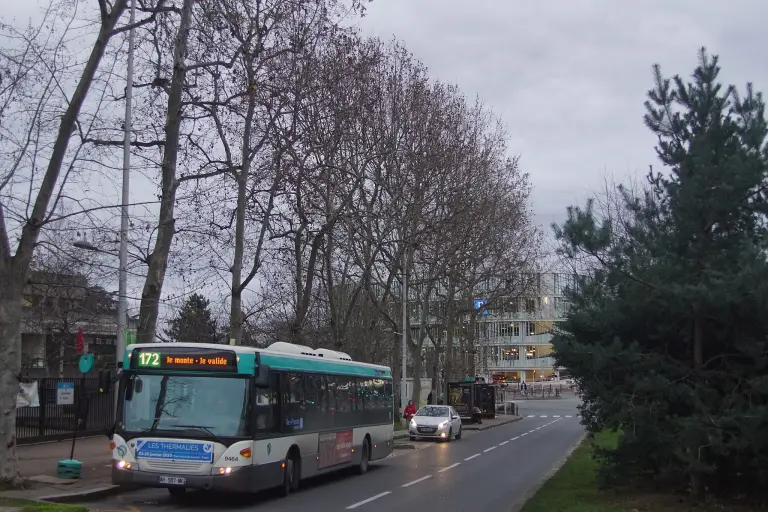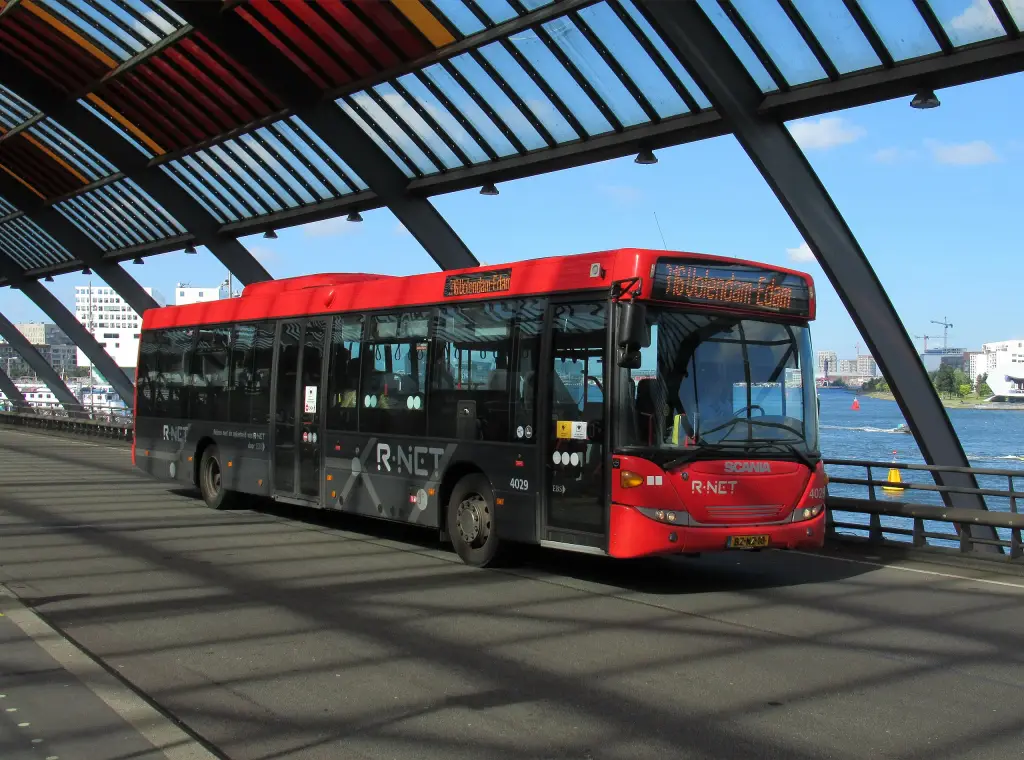
The Scania OmniLink is a series of integrally constructed low-entry city buses with a rear longitudinal engine, sold on the European market. It was launched in 1998 as the CL94UB, and production ceased in 2013 when the Scania Citywide LE took over for left-hand drive markets.
Scania OmniLink at a glance
| Launched | 1998 |
|---|---|
| Production ended | 2013 |
| Type | integral low-entry city bus, rear longitudinal engine |
| Original names | CL94UB rigid, CL94UA articulated |
| Euro IV names | CK230UB, CK270UB, CK280UB, CK310UB, CK320UB |
| Floor | raised at the rear compared with the OmniCity |
| Replaced by | Citywide LE (left-hand drive), Irizar i3-bodied K UB (right-hand drive) |
| Right-hand drive from | 2006 |
based on one source
History of the Scania OmniLink
Launched with a tilted engine
The OmniLink was launched in 1998 with an inclined engine and was designated CL94UB, with an articulated version called the CL94UA. When the Euro IV version arrived in 2006 the engine was no longer tilted and the designation changed to CK230UB, CK270UB, CK280UB, CK310UB and CK320UB for the rigid version. Unlike the flat-floored OmniCity, the OmniLink’s floor rises at the rear section. Production stopped in 2013; the model was superseded by the Scania Citywide LE for left-hand drive markets and by Irizar i3-bodied Scania K UBs for right-hand drive markets.
On the continent
At first the OmniLink was built only in left-hand drive for continental Europe. OmniLinks were sold in large numbers to Arriva subsidiaries such as Arriva Danmark, and 140 were sold for service in St Petersburg in Russia by 2005. Six ethanol-fuelled OmniLink hybrid fuel cell buses entered service with Swebus in 2009 for a two-year trial in Stockholm.
The British and Irish market
Right-hand drive OmniLinks for the United Kingdom and Ireland were produced from 2006, and the first three right-hand drive models, on tri-axle chassis, went to Nottingham City Transport in 2007. Nottingham also tried three ethanol hybrid OmniLinks on the EcoLink 30 service from Nottingham to Wollaton; the trial was not a success and the buses were later converted back to diesel. National Express West Midlands and National Express Dundee were the most significant right-hand drive operators, taking 180 two-axle OmniLinks between 2008 and 2010, fifteen of them first delivered to Dundee before moving to the West Midlands. Bus Éireann bought 25 for Cork, Arriva Midlands nineteen for Tamworth and Derby, Brighton & Hove seven and Johnsons Excelbus two. Nine K270UB tri-axles went to Stagecoach in Fife in October 2007 for the Express City Connect service between Dunfermline and Edinburgh, three of which later moved to Stagecoach North East.
Design and features
- Low-entry layout: a low floor at the front with a step up towards the rear.
- Inclined engine at launch: the CL94 design, replaced by an upright engine in 2006.
- Left- and right-hand drive: continental versions from 1998, British and Irish from 2006.
- Alternative-fuel trials: ethanol hybrid fuel cell buses with Swebus in Stockholm.
Scania OmniLink versions
- CL94UB / CL94UA (1998–2006): rigid and articulated versions with the inclined engine.
- CK230UB – CK320UB (from 2006): Euro IV rigid buses with an upright engine.
- K270UB tri-axle: used by Stagecoach in Fife for express work.
The flat-floor bus of the same family is the Scania OmniCity, and the intercity member is the Scania OmniLine. Its chassis family is described in Scania K-series, and more vehicles are in the Scania collection.
Sources
- Scania OmniLink, English Wikipedia: designations, production, operators