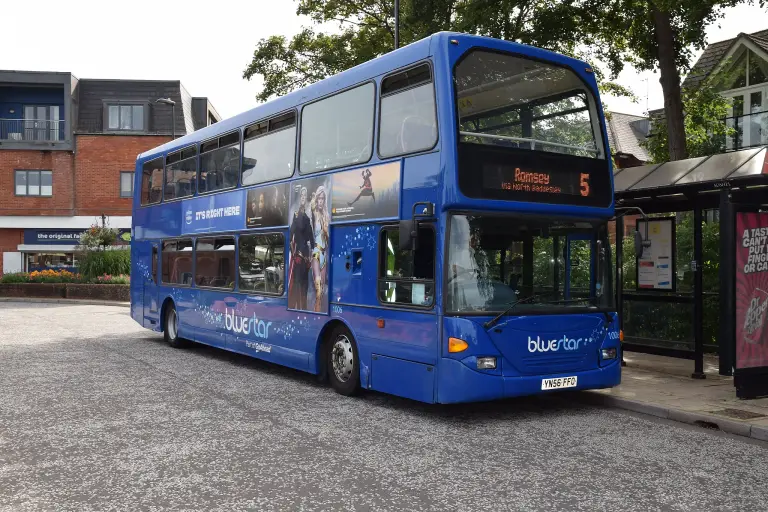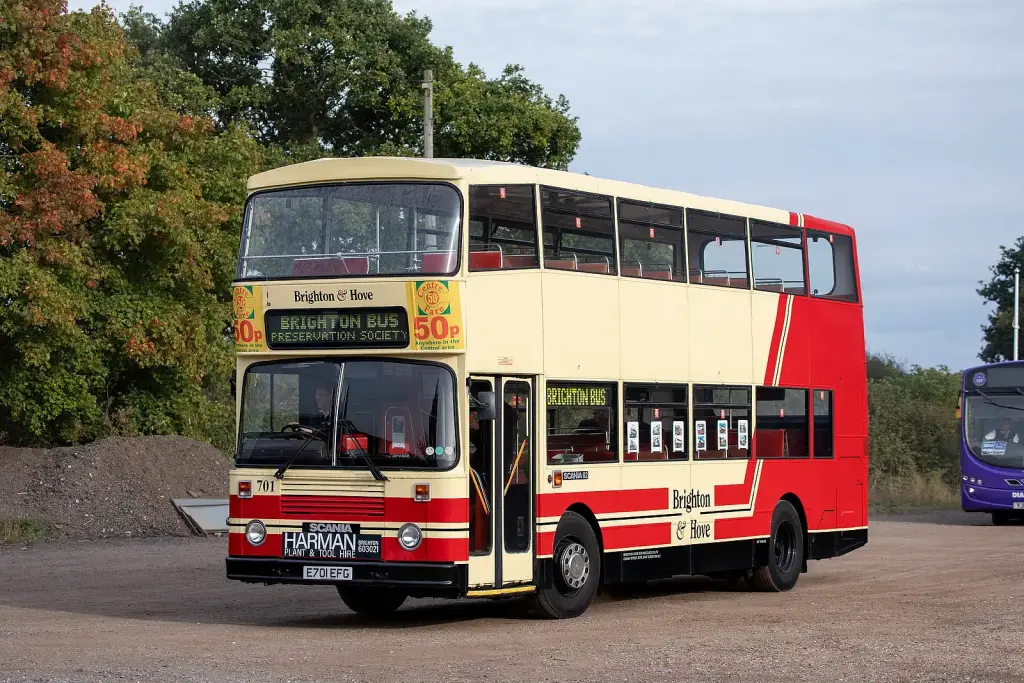
The Scania N112 was a transversely engined step-entrance chassis for single-deck, double-deck and articulated buses, manufactured by Scania between 1978 and 1987. Until 1984 it was sold as the Scania BR112, and it was replaced by the N113 when the 3-series arrived in 1988.
Scania N112 at a glance
| Also known as | Scania BR112 until 1984 |
|---|---|
| Production | 1978–1987 |
| Type | step-entrance chassis, transverse engine |
| Body styles | single-decker, double-decker, articulated |
| Engine | 11-litre DN11, later turbocharged DS11 |
| Gearbox | Scania three-speed or Voith automatic |
| Lengths | 9.5 m and 10.2 m |
| Replaced by | Scania N113, 1988 |
based on one source
History of the Scania N112
After MCW
In 1978 Scania ended a decade-long partnership with the Birmingham builder Metro Cammell Weymann, which had produced the Metro-Scania single-decker and the Metropolitan double-decker. MCW went on to build its own Metrobus chassis as a replacement for the Metropolitan, and in 1980 Scania launched its own replacement, the BR112DH. It was available in two lengths, 9.5 and 10.2 metres, and used the 11-litre DN11 engine, later the turbocharged DS11, with a Scania three-speed or a Voith automatic gearbox.
The British market
The biggest customer for the BR112DH was Newport Transport, which took 29, including nine single-deckers with Wadham Stringer Vanguard bodywork; the double-deckers were bodied by Marshall of Cambridge. Two were built with Alexander RH bodywork for the Tyne and Wear Passenger Transport Executive and two with Northern Counties bodies for Greater Manchester. Four demonstrators were also built, two each with East Lancs and Marshall bodywork; one of the Marshall-bodied demonstrators went to the Republic of Ireland in 1981, and one East Lancs-bodied bus was exported to Singapore in 1982 and joined Singapore Bus Services as SBS7000E. In Australia, one BR112H was bodied by Custom Coaches for Neville’s Bus Service in 1983.
The N112
In 1984 the BR112DH was renamed the N112DH, later N112DRB, with the same lengths and gearbox options, and an articulated chassis was added. Newport Transport again led, taking eight Alexander RH bodied N112s at the end of 1984 and eight East Lancs-bodied versions in 1986. Deregulation and London route tendering widened the customer base: Brighton & Hove took ten East Lancs-bodied N112s, Leicester Citybus four, A1 Service two, Grey-Green six, Kentish Bus five with Alexander RH bodies and Boro’line Maidstone two, while Kingston upon Hull City Transport had six East Lancs single-deckers.
Airport shuttles and the end
The N112 was also built as an airport shuttle with Van Hool Alizee single-deck coach bodywork and DAF Variomatic transmission; Capital Coaches of West Drayton ordered 23 for the British Airports Authority at Heathrow in 1987, and Terminus Securities took one for Gatwick in 1988. Australian deliveries included twelve Ansair-bodied buses for Metro Tasmania in 1987–88 and an articulated N112ARS bodied by Denning for Brisbane City Council in 1985. In 1988 Scania introduced its 3-series buses and trucks, and the N112 was replaced by the N113.
Design and features
- Transverse engine: the layout that gave the chassis its low, flat passenger area.
- Many body styles: single-deck, double-deck and articulated versions.
- British following: bodied by East Lancs, Marshall, Alexander and Northern Counties.
- Special variants: airport shuttles with Van Hool coach bodywork.
Scania N112 versions
- BR112DH (1980–1984): the original designation in 9.5 and 10.2-metre lengths.
- N112DH / N112DRB (1984–1987): renamed version, also as an articulated chassis.
- Airport shuttle: Van Hool Alizee bodywork with DAF Variomatic transmission.
- N112ARS: articulated chassis bodied by Denning for Brisbane.
The integral buses that followed it are described in Scania OmniCity and Scania N-series. The trucks of the same era are in Scania 2-series, and more vehicles are in the Scania collection.
Sources
- Scania N112, English Wikipedia: history, engines, operators