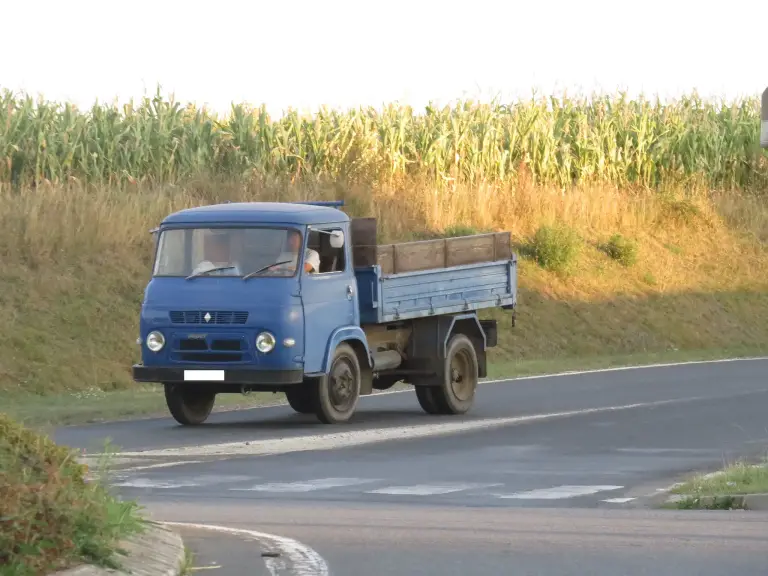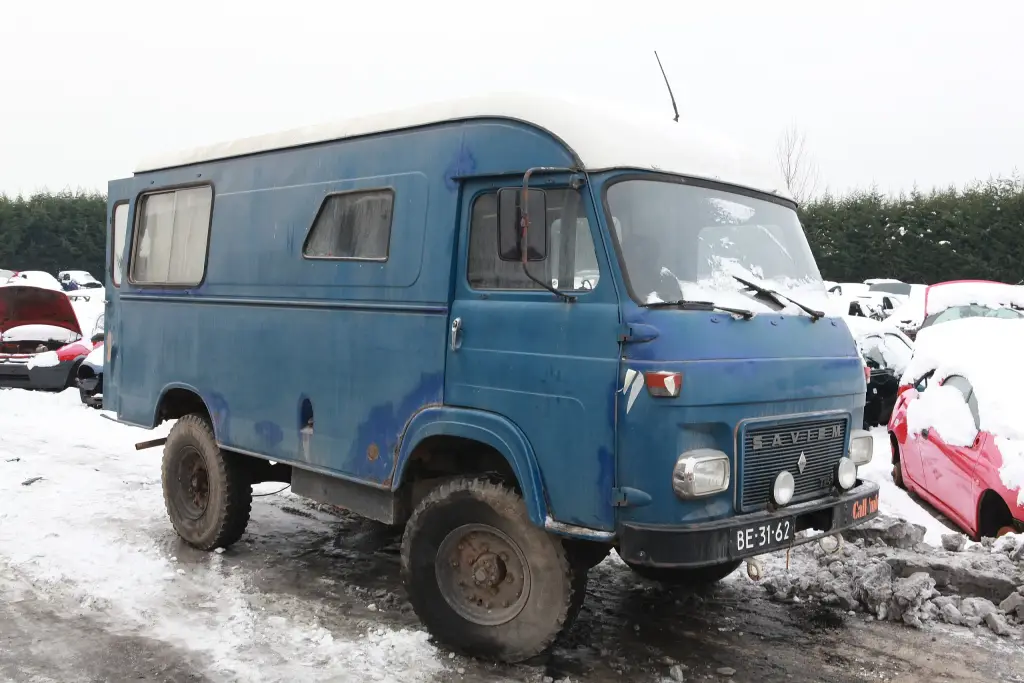
The Saviem TP3 was a four-wheel-drive tactical van built for the French army and derived from the Super Goélette. It entered service in 1970, replaced the Renault 2087 Goélette 4×4 and was built in almost 11,000 examples before production ended in 1983.
Saviem TP3 at a glance
| Maker | Saviem |
|---|---|
| Production | 1969–1983 |
| Built | nearly 11,000 |
| Based on | Super Goélette / Super Galion 4×4 |
| Petrol engine | 73 hp (TP3 L39) |
| Diesel engine | 72 hp (TP3 MB) |
| Length | 5,598 mm |
| Height | 2,410 mm |
| Gross weight | 3,950 kg (L39 and MB39); 3,500 kg (MB35) |
| Gearbox | from the Saviem SM8 |
| Versions | van, ambulance and torpedo pickup |
| Predecessor | Renault 2087 Goélette 4×4 |
History of the Saviem TP3
Replacing the Goélette 4×4
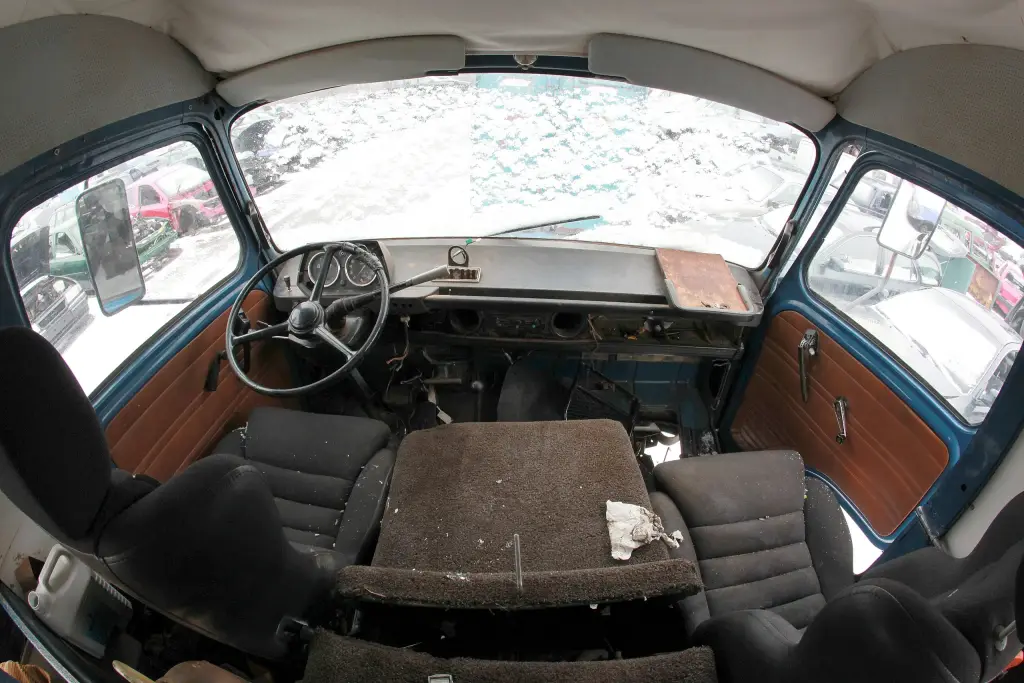
In 1966 the French army’s cross-country ambulance fleet consisted of Renault 2087 Goélette 4×4 and R2067 vehicles alongside elderly Dodge 4x4s handed over by the United States after the war. Goélette production had stopped in 1964, so a successor was needed. Two routes were studied: the chassis of the Simca Marmon and the much cheaper chassis of the Renault-Saviem SG. Renault proposed a prototype called SG2 4×4, using the short chassis of the Super Galion SG4 and the engine, gearbox and clutch of the Super Goélette SG2, which the army had already adopted as a road ambulance in 1966. Army testing showed that the road body was too weak for track use, so Renault designed a body for cross-country work. Ten pre-series vehicles, the TP2 F39, were ordered; after further changes the official name became, in May 1969, Sanitaire TP3 L39, known simply as the TP3.
Army and civilian use
After a final hesitation over the Marmon, the army staff adopted the TP3 for the first transport of wounded soldiers. The vehicle was presented at the Satory military equipment exhibition in 1969 and replaced the Renault 2087 Goélette 4×4 in the same van, ambulance and open torpedo pickup versions. From 1969 the TP3 L39 with its 2.6-litre petrol engine was also approved for road use at Saviem’s request, and from the 1971 models the SG2 4×4, now the TP3 for the army, was sold to civilian buyers. In 1974 a version rated at 3.5 tonnes, the TP3 L35, was approved. In 1980 diesel versions with a 3.3-litre MAN engine and 3.5 tonnes gross weight, the TP3 MB3, were homologated.
The end of the line
When Renault Véhicules Industriels absorbed Saviem, the last TP3s were renamed TRM 1200, for Toutes Roues Motrices and a payload of 1.2 tonnes. The French army replaced its TP3s with the Renault TRM 2000, and the ambulance versions with Citroën C25 4×4 Dangel and Peugeot J5 4×4 Dangel vehicles. Production ended in 1983 after nearly 11,000 vehicles, some of which were exported or sold to civilian operators.
Design and features
- Four-wheel drive: a militarised version of the Super Goélette for cross-country work.
- Purpose-built body: designed after the civilian body failed the army’s track test.
- SM8 gearbox: a stronger transmission than the civilian van’s.
- Three roles: van, ambulance and open torpedo pickup with a folding windscreen.
Saviem TP3 versions
- TP3 L39: 2.6-litre petrol of 73 hp, 3,950 kg gross weight.
- TP3 L35: 3.5-tonne version approved in 1974.
- TP3 MB35 and MB39: diesel versions of 1980 with a 3.3-litre MAN engine of 72 hp.
- TRM 1200: the final RVI-badged TP3s.
- Ambulance and torpedo: the two specialised army bodies.
The TP3 was the four-wheel-drive member of the SG2 and SG4 family, and its military successor was the TRM range. More vehicles are in the Saviem collection.
Sources
- SAVIEM TP3, French Wikipedia: origins, army adoption, versions, dimensions
- Renault Super Goélette, English Wikipedia: production start, SM8 gearbox, production total, successors