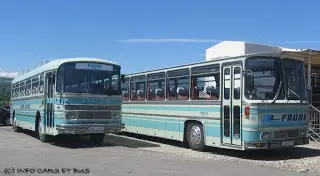
The Saviem E7 was an intercity and touring coach introduced in February 1969. It was Saviem’s answer to the new rear-engined coaches from Berliet and from foreign makers, with a flat roof, large windows and a MAN diesel behind the rear axle.
Saviem E7 at a glance
| Maker | Saviem, from 1980 Renault Véhicules Industriels |
|---|---|
| Production | 1969–1982 |
| Factory | Annonay, France |
| Type | intercity and touring coach |
| Layout | rear-mounted diesel engine |
| Lengths | 8 m, 9 m, 10.5 m, 11.5 m and 12 m |
| Seats | 37 to 53 depending on version |
| Engine | MAN 2156 HM, 235 ch (240 ch from 1980); Renault 798, 170 ch in the E7C |
| Luggage holds | 6.1–7.7 m³ |
| Suspension | air suspension, independent front wheels |
| Built | 3,496 |
| Replaced by | Renault FR1, 1983 |
There is no English article on the E7; this page is based on the French Wikipedia article.
History of the Saviem E7
A coach designed in a hurry
Saviem was formed in 1955 when Renault’s bus division merged with Latil and Somua, and it was joined by Chausson in 1959 and Floirat in 1961. At the end of 1964 the company presented its S45, S53 and S105 coaches. They sold well in France, but by the late 1960s buyers were turning to Mercedes-Benz, Fiat and Van Hool, whose vehicles looked modern while the French coaches sat low, had a front-mounted engine that filled the cabin with heat and noise on summer journeys, and were considered old-fashioned in style. Saviem’s design office was asked to produce a new coach quickly, with the square, heavily glazed body then in fashion. The result was the E7, offered from the start in four lengths: 9 m, 10.5 m, 11.5 m and 12 m.
Rear engine and 3,496 examples
The race to build the first French coach with its engine at the back was won by Berliet, which showed the Cruisair in October 1968; Saviem followed with the E7 in February 1969. The first two versions were the E7N, 10.50 m long with 45 seats, and the E7L, 12 m with 53 seats. Behind the rear axle sat a MAN 2156 HM diesel of 235 ch DIN, and the luggage holds took 6.1 to 7.7 m³, so a roof rack was no longer needed. Air suspension and an independent front suspension with coil springs gave a comfortable ride, though the plain styling was criticised next to the Setra, Mercedes and Van Hool coaches. The range grew in 1973 with the short E7C (8 m, 37 seats, smaller engine) and the E7M (11.45 m, 49 seats), and the urban E110 and E125 appeared in 1974.
Renault years and the end
Saviem was merged with Berliet in 1978 to form Renault Véhicules Industriels. On 24 April 1980 the Berliet and Saviem names disappeared and the coaches wore the Renault diamond. The engines stayed: a Renault 798 of 170 ch in the E7C and the MAN unit of 240 ch in the other versions. A facelift in 1978 had already changed the grille and the driving position, and an interurban S57 joined the range in 1980. The design was by then thoroughly out of date, and production ended in 1982 as the Annonay works prepared the line for the Renault FR1, which appeared in 1983. In all 3,496 E7s were built, half of them the long E7L. In 1979 the E7 accounted for 11.2 per cent of Saviem-Renault production, or 431 vehicles.
Design and features
- Rear engine: a MAN 2156 HM diesel behind the rear axle, the layout French operators wanted after years of front-engined coaches.
- Square, glazed body: a flat roof and large windows in the style of German and Italian coaches.
- Air suspension: with an independent front suspension on coil springs for a quieter, more comfortable ride.
- Four lengths at launch: from 9 m to 12 m, with 37 to 53 seats as the range developed.
Saviem E7 versions
- E7N (1969): 10.50 m, 45 seats.
- E7L (1969): 12 m, 53 seats; half of all E7s built were E7Ls.
- E7C (1973): short 8 m coach with 37 seats and a less powerful engine.
- E7M (1973): 11.45 m with 49 seats.
- E110 and E125 (1974): urban versions.
- S57 (1980): interurban model added at the end of the range.
The E7 followed the S45, S53 and S105 coaches and shared its market with the SC10 city bus. More vehicles are in the Saviem collection.
Sources
- Renault E7, French Wikipedia: history, versions, engines, production total