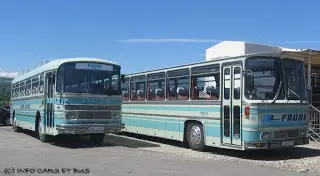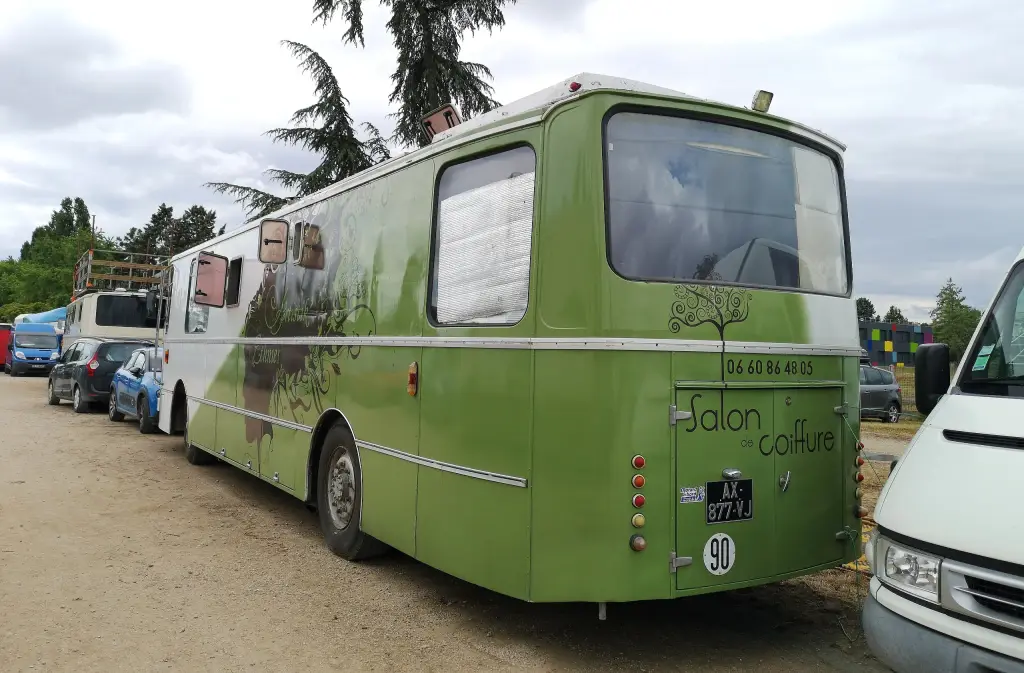
The Saviem S45, S53 and S105 were a family of intercity, school and touring coaches introduced in October 1964. They stayed in production for 44 years, through the Saviem and Renault badges and two restylings, and were replaced by the Renault Tracer and FR1.
Saviem S45, S53 and S105 at a glance
| Maker | Saviem, from 1977 Renault Trucks |
|---|---|
| Production | October 1964 – October 1993 |
| Factory | Annonay, France |
| Models | S45: 10 m, 45 seats; S53: 12 m, 53 seats; S105: 12 m, 105 passengers, urban |
| Layout | engine under the floor, amidships |
| Engines | 150 hp Fulgur or 165 hp MAN 7-litre; 170 hp MAN DO846 HM42U from 1970 |
| Gearbox | six-speed |
| 1977 restyling | S45 R, S53 R, S105 R: wider black grille, flat roof, taller windows |
| 1987 restyling | S45 RX, S53 RX, S105 RX: new headlamps, body-coloured grille |
| Replaced by | Renault Tracer (1991) and Renault FR1 |
| Preserved | several examples with Autocars Anciens de France, Wissembourg |
The three coaches are described on a single French Wikipedia page; this article is based on it and is marked as based on one source.
History of the Saviem S45, S53 and S105
The last evolution of the R4190
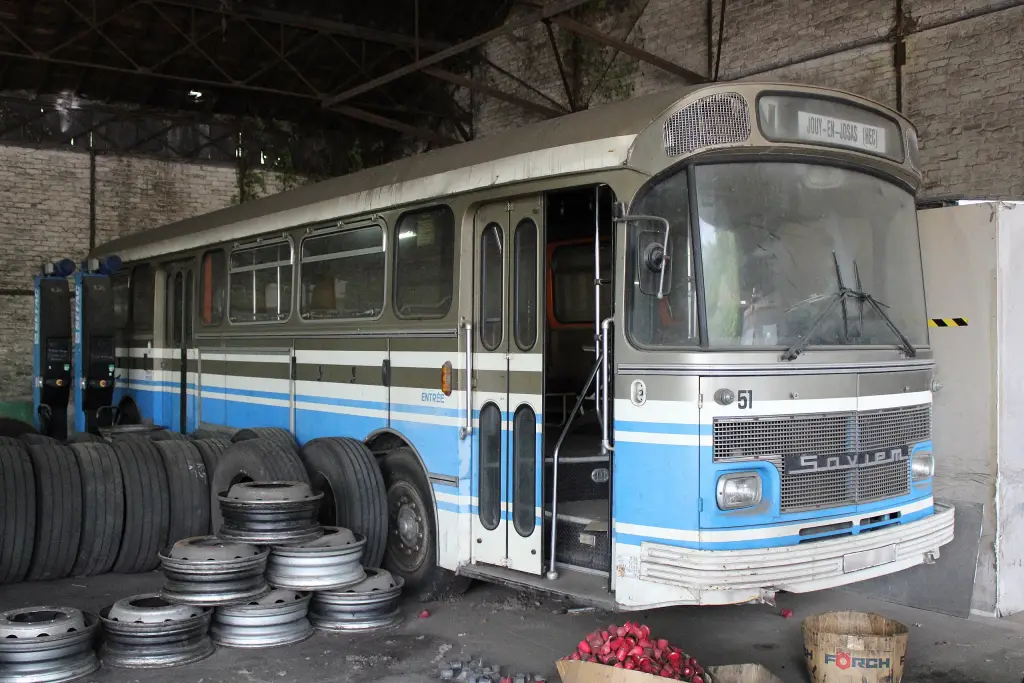
Saviem’s first coach, launched in 1964, was in reality a final development of the old Renault R4190. The S45 seated 45 and was 10 m long; the S53 was the 53-seat, 12 m version, and the S105 was a 12 m urban bus with room for 105 passengers, arranged so that they could stand. Compared with its predecessor the coach had a modernised front with rectangular headlamps and a six-speed gearbox. Buyers could choose a 150 hp French engine or a 165 hp diesel bought from MAN; from the autumn of 1970 the 170 hp versions received a MAN DO846 HM42U, which served until the end of production. The range was made at Annonay and replaced the Saviem SC1, itself a development of the ZR20.
Under the Renault badge
In September 1977 Renault Trucks took over Saviem and kept the range in production. The coaches were renamed S45 R, S53 R and S105 R, with a wider black plastic grille, a flat roof and taller windows, and some dashboard details were changed. In July 1987 came a second modernisation: new headlamps and a grille in the body colour, and the models became the S45 RX, S53 RX and S105 RX. A Grand Tourisme version, the S45 GT, was sold only under the Saviem name and was the direct ancestor of the Renault FR1.
Forty-four years
The range was withdrawn at the beginning of October 1993, ending 44 years of the model’s history, and its place was taken by the Renault Tracer, launched in 1991, and the FR1. Besides the standard coaches, Heuliez Bus built the PG 45, PG 53, PG 105 and PGU 180 for African routes: RVI coach bodies on a lorry chassis with a front-mounted engine, twin rear wheels and a tolerance for the overloads common in those markets. Several examples survive with the Autocars Anciens de France association at the Conservatoire des Transports in Wissembourg, including a Renault S 53 R, two S 53 RX and an S105 of the postal ambulance service.
Design and features
- Three sizes, one body: 45 seats in 10 m, 53 seats in 12 m, or a 105-passenger urban bus.
- Engine under the floor: a six-cylinder unit amidships, a Fulgur or a MAN of 150 to 170 hp.
- Two Renault restylings: the R of 1977 with a black grille and flat roof, the RX of 1987 with body-coloured trim.
- Long life: 29 years of production under two makers and four model designations.
Saviem S45, S53 and S105 versions
- S45 (1964): 10 m, 45 seats.
- S53 (1964): 12 m, 53 seats.
- S105 (1964): 12 m urban bus for 105 passengers, with standing room.
- S45 GT: Grand Tourisme version sold only as a Saviem.
- R and RX versions: the 1977 and 1987 Renault restylings of all three models.
- PG range: Heuliez-built bodies on lorry chassis for African routes.
The S range preceded the rear-engined Saviem E7 and shared the roads with the SC10 city bus. More vehicles are in the Saviem collection.
Sources
- Renault S 45 / S 53 / S 105, French Wikipedia: history, dimensions, engines, restylings, preservation