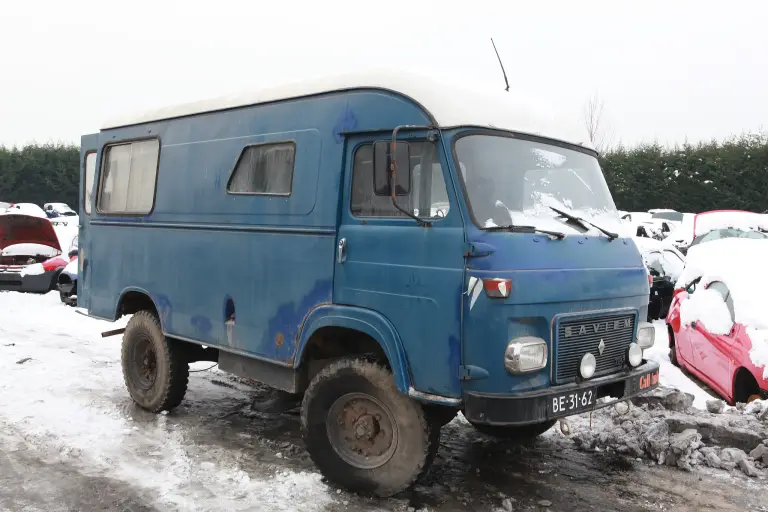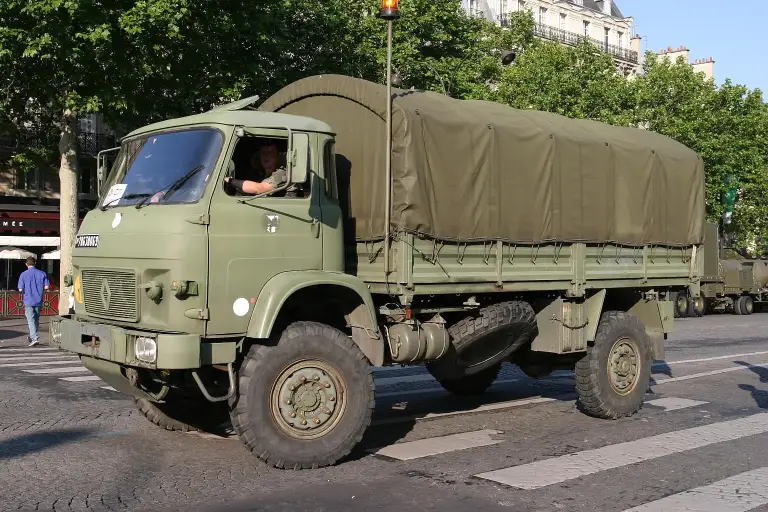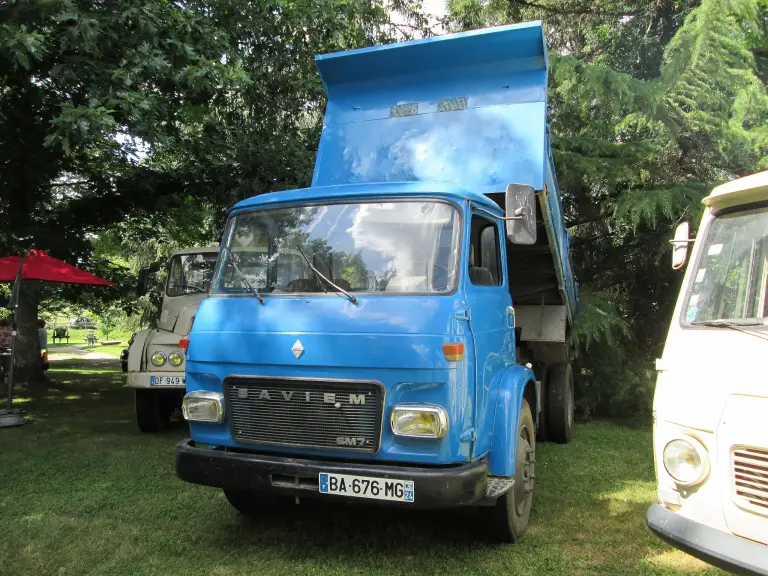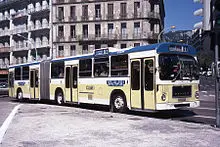
The Saviem JM was a range of forward-control trucks introduced in 1964 after Saviem’s agreement with the German engine maker MAN. It replaced the JL 20, from which its cabin was inherited.
Saviem JM at a glance
| Maker | Saviem |
|---|---|
| Production | 1964–1968 for the JM 170; the commercial range ran until 1975 |
| Predecessor | Saviem JL 20 |
| Cab | Somua forward control, type 830 (short) or 840 (long) |
| Engines | MAN D 0836 HM8, 166 hp (JM 29 and JM 170); MAN D 2146 HM 3F, 210 hp (JM 200) |
| Gross weight | 17.5 tonnes (JM 29) |
| Wheelbases | 4,000, 4,500, 4,750, 5,400 and 5,900 mm |
| Versions | JM 29, JM 170, JM 200, JM 200 V (6×2) |
| Built | 2,100 JM 170; 800 JM 200 |
| Rear axle | JL-type axle, too weak for the new power; replaced by a MAN axle on the SM Europe |
There is no English article on the JM; this page is based on the French Wikipedia article.
History of the Saviem JM
Why Saviem needed MAN
In 1962 Saviem was the third lorry maker in France, far behind Berliet with 45 per cent of the market and Unic, a Fiat subsidiary, with 22.4 per cent, on 5,348 vehicles. It lacked a top-of-the-range model at the maximum permitted weight. The Panhard D.615 engine could not be pushed beyond 200 hp and no French engine maker offered more than 160 hp, while German and Italian competitors had long been fitting engines of 200 hp and more. Saviem turned to Henschel and from 1962 to 1964 fitted its 204 hp engine to the JL 20.200, but Henschel ran into financial trouble and was bought by Mercedes-Benz, ending the supply.
The MAN-engined range
Saviem then signed with MAN of Augsburg, a respected engine maker with little presence in France. The old JL 20.200 was renamed the Saviem JM 170, 200 and 240 with MAN engines. The cabin was the Somua forward-control type, short 830 or long 840, on the JL 20.200 chassis with wheelbases of 4,000, 4,500, 4,750, 5,400 and 5,900 mm. The JM 170, shown at the Paris show in October 1964, used the MAN D 0836 HM8 of 7,035 cm³ and 166 hp; 2,100 were built up to 1968. The JM 200 took the MAN D 2146 HM 3F of 9,659 cm³ and 210 hp and was built 800 times up to 1966; the JM 200 V was the 6×2 version. A JM 29 with a 17.5-tonne gross weight was approved in December 1963 but never sold because it cost too much against the JL 29A it was meant to replace.
A strong engine, a weak axle
Power rose from 120 to 235 hp, more than the gearbox and rear axle of the JL could take. The gearbox was strengthened but the rear axle was not, and its shafts broke on average every six months. Saviem cured the problem only on the next range, the SM Europe, which used a MAN axle. The commercial JM was discontinued in 1975, though military versions continued to be built after that year.
Design and features
- MAN power: 166 hp in the JM 170 and 210 hp in the JM 200, against 150 hp for the Fulgur-engined JL.
- Somua cabin: the old JL 19 and JL 20 forward-control cabin in short 830 and long 840 forms.
- 6×2 option: the JM 200 V, at a time when 6×4 layouts were almost unknown in France.
- Axle trouble: the JL-type rear axle could not cope with the extra power and broke frequently.
Saviem JM versions
- JM 29 (1963): 17.5 tonnes, approved but never sold because of its price.
- JM 170 (1964): the volume model, 2,100 built to 1968.
- JM 200 (1964): the flagship with a 9.66-litre MAN engine, 800 built to 1966.
- JM 200 V: the 6×2 version of the JM 200.
The JM succeeded the Saviem JL and was followed by the wider Saviem SM range. More vehicles are in the Saviem collection.
Sources
- Saviem JM, French Wikipedia: market position, MAN agreement, models, production figures, axle problems
- Saviem JL, English Wikipedia: the JL 20 the JM replaced