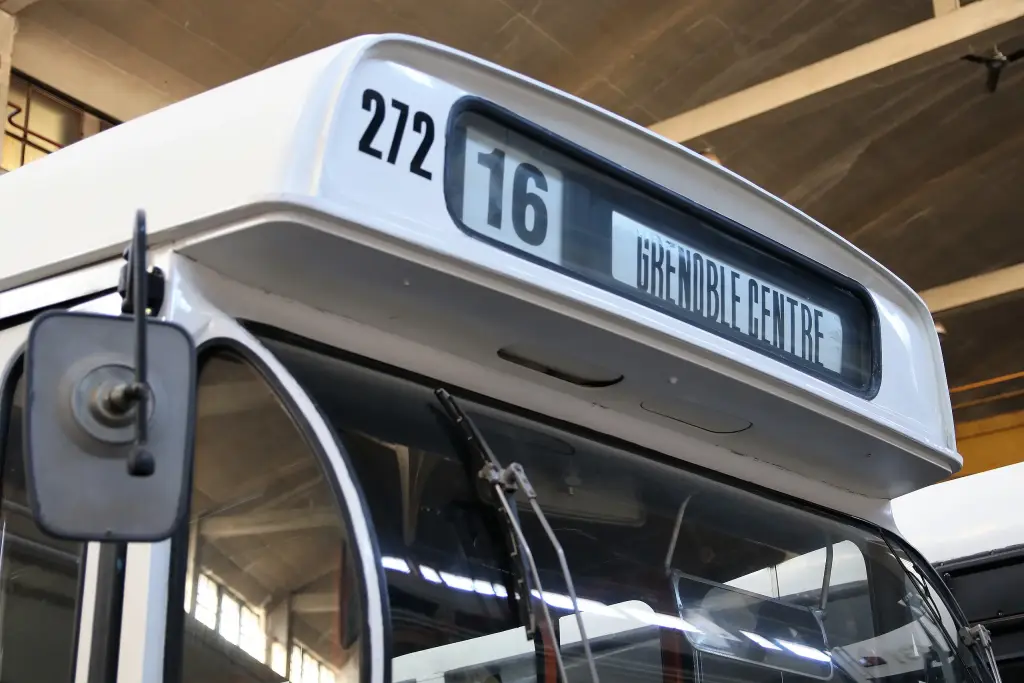
The Saviem SC10 was the standard French city bus, developed to a specification drawn up by the Paris transport authority and built at Annonay from 1965 to 1989 in 11,004 examples. Its letters stand for Saviem-Chausson.
Saviem SC10 at a glance
| Maker | Saviem, later Renault |
|---|---|
| Production | 1965–1989 |
| Factory | Annonay, France |
| Type | standard French city bus |
| Length | 11 m |
| Floor height | no more than 63.5 cm above the ground |
| Interior height | at least 2.20 m |
| Engine | MAN horizontal six-cylinder diesel, 150 hp, limited to 135 hp |
| Built | 11,004 |
| Export | 15 to Brescia, Italy |
| Versions | SC10 L, SC10 UM, SC10 UO, SC10 R, SC10 UPF |
History of the Saviem SC10
A bus by specification
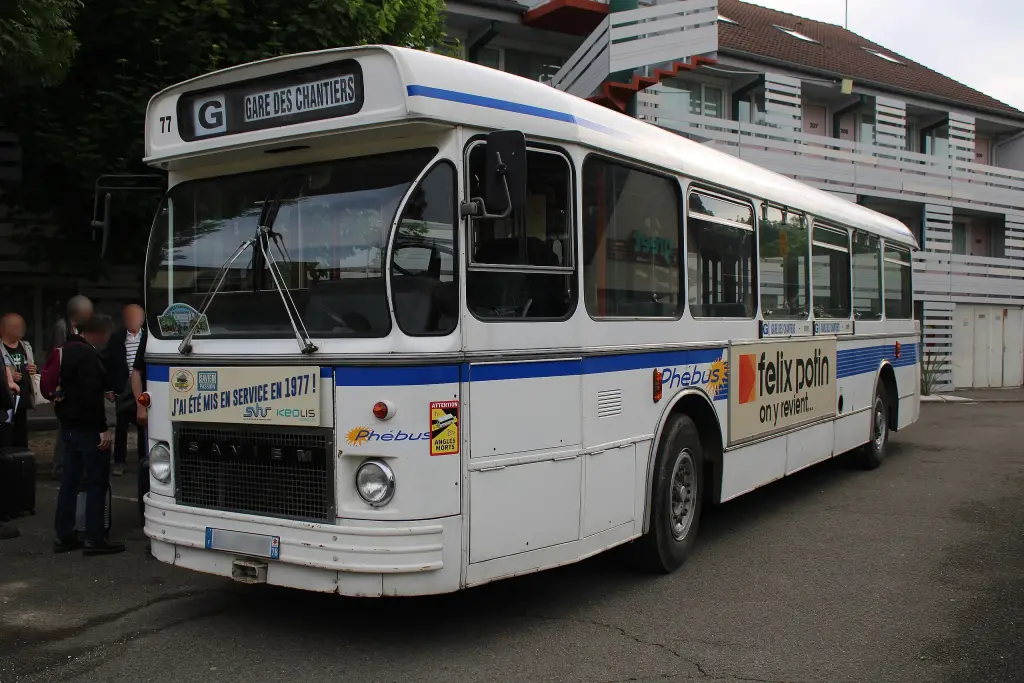
At the end of the 1950s urban transport in France was almost entirely by bus, apart from the Paris metro, a few trolleybuses and a handful of tramways. Buses were built in small series by many makers, expensive to buy and maintain, and uncomfortable: floors too high, ceilings too low, access cramped. In 1958 RATP and UPTUR, the union of provincial operators, drew up the specification for a standard city bus: 11 m long, a flat floor no more than 63.5 cm above the ground, an interior height of at least 2.20 m with windows 1.78 m above the floor, an anti-glare cylindrical windscreen and a 150 hp engine under the driver’s seat. Saviem, Berliet and Verney answered; Verney withdrew for lack of capacity.
From prototype to production
Saviem delivered its first SC10 prototype to RATP in 1961. It differed from the production bus in its front, where the cap carrying the destination blind did not run the full width of the roof, and in a windscreen with a central pillar. The bus was shown internationally in Vienna in June 1963, and on 19 May 1965 the first series vehicle left the Annonay line and was approved by the Ministry of Mines. Nancy was the first provincial network to receive SC10s, in 1965. The Fulgur engine of the prototypes was too weak, so production buses used a German MAN horizontal six-cylinder diesel of 150 hp, limited to 135 hp, with M3 combustion; MAN powered every SC10 until the end.
A French success
The SC10 sold in great numbers: by November 1969, 1,440 were in service. Many door layouts were offered, including the SC10 244 DPA with an offset door and the SC10 U 044 PA for one-man operation; the SC10 L had no rear corner windows and small round tail lights. In 1970 the front indicators moved above the headlamps. The SC10 UM of October 1974 brought better soundproofing through engine encapsulation, a twin-flow exhaust and intake silencers, and brakes to EEC standards. In 1975 a working group began the modernisation that produced the second generation, with a single large rear window replacing two.
Renault, restyling and the end
Saviem and Berliet merged in 1977 into Renault Véhicules Industriels, and the Saviem brand disappeared in 1980; the bus became the Renault SC10 and, after further improvements, the SC10 UO. In the autumn of 1981 the Renault SC10 R was presented with a new, tauter body that lost the rounded front, a windscreen no longer cylindrical but still curved at the top, fully glazed side doors and two steps instead of one. It was built for seven and a half years, 1,630 of them. Annonay celebrated its 10,000th SC10 on 4 March 1986, and in 1987 the type made up 91 per cent of the RATP fleet. Production ended in March 1989 after 11,004 buses in 24 years. The SC10 was barely exported: only 15 went to Brescia, Italy, though many were sold second-hand to developing countries. After a 1976 accident damaged SC10 U no. 5933, RATP created an open rear platform in the style of pre-war Renault TN buses, the SC10 UPF; Saviem then offered its own version with a sliding interior door. Number 5933 has been preserved by the Sauvabus association since 1983.
Design and features
- Standard bus: the first French city bus designed to a common RATP/UPTUR specification.
- Flat floor: 63.5 cm above the ground, with an interior height of 2.20 m.
- MAN diesel: a horizontal six-cylinder under the driver’s seat, limited to 135 hp.
- Long production: 24 years and 11,004 buses, including more than 3,000 restyled SC10 Rs.
- Open platform: the RATP-inspired SC10 UPF with a rear platform, later offered by Saviem itself.
Saviem SC10 versions
- SC10 (1965): the original production bus.
- SC10 L: no rear corner windows and small round tail lights.
- SC10 UM (1974): modernised with better soundproofing and EEC-standard brakes.
- SC10 UO: the Renault-badged update after the 1977 merger.
- SC10 R (1981): restyled body, fully glazed doors, 1,630 built.
- SC10 UPF: open rear platform version.
The SC10 worked alongside the S45, S53 and S105 coaches, and its place in the range can be compared with the later Saviem E7. More vehicles are in the Saviem collection.
Sources
- SAVIEM SC 10, English Wikipedia: specification, prototypes, production, versions
- SAVIEM SC 10, French Wikipedia: history, restyling, preservation