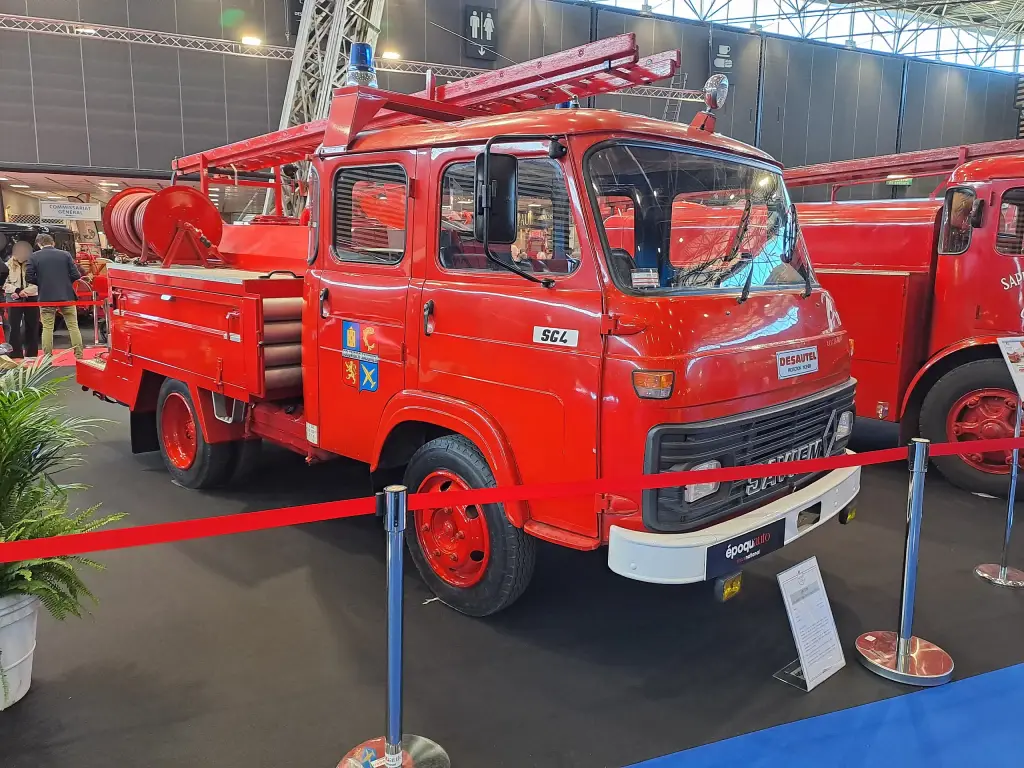
The Saviem SG4 and SG5 were the Super Galion light trucks, built at Blainville-sur-Orne from June 1965 as replacements for the Galion of 1946. The SG4 arrived first, the heavier SG5 joined it in 1969, and both stayed in production until 1982.
Saviem SG4 and SG5 at a glance
| Maker | Saviem (Renault) |
|---|---|
| Production | June 1965–1982 |
| Factory | Blainville-sur-Orne, Calvados |
| Payload | 3,500 kg (SG4); 5,040 kg (SG5) |
| Gross weight | 5,950 kg (SG4); 7,300 kg (SG5) |
| Cab | type 710, then type 812 from 1968 |
| Engines | 2.14 l petrol 70 hp; 3.02 l diesel 75 hp; from 1969 2.6 l petrol 78 hp and 3.32 l diesel 92 hp |
| Gearbox | four-speed, fully synchronised |
| Suspension | independent front with coil springs; leaf springs and rigid axle at the rear |
| Brakes | drums on both axles |
| Badges | Renault until 1970, then Saviem; RVI from 1980 |
| Licensed | Avia A15/A20/A30 in Czechoslovakia until 1998 |
There is no English article on the Super Galion; this page is based on the French Wikipedia article.
History of the Saviem SG4 and SG5
The Super Galion of 1965
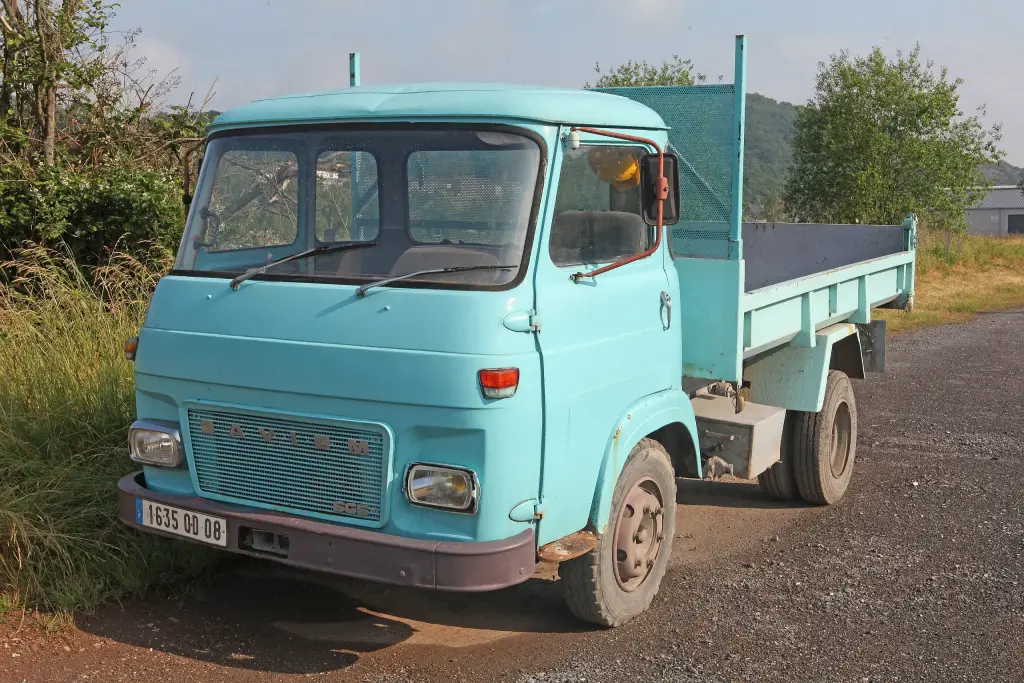
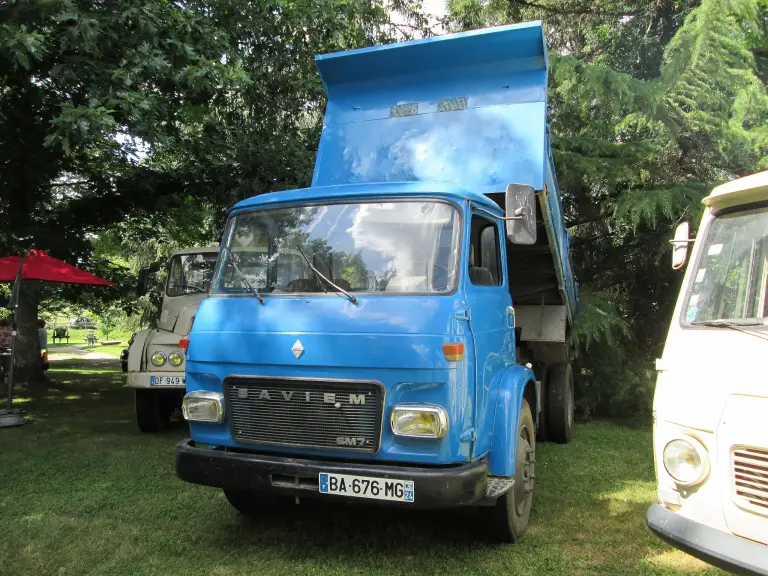
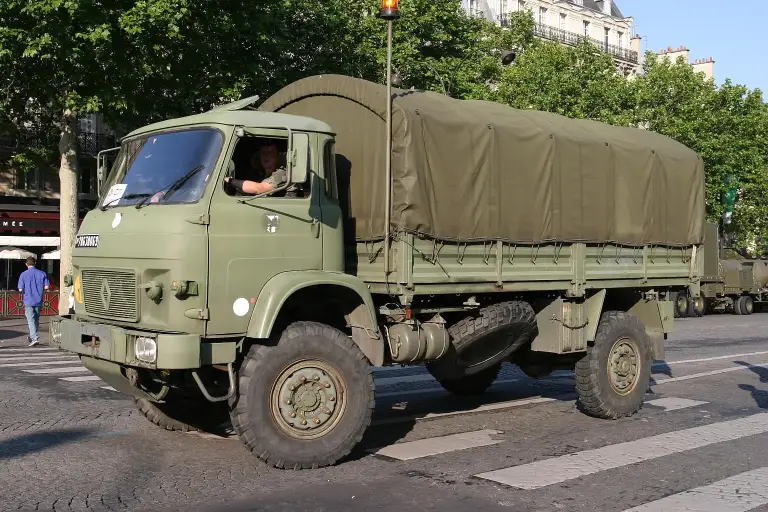
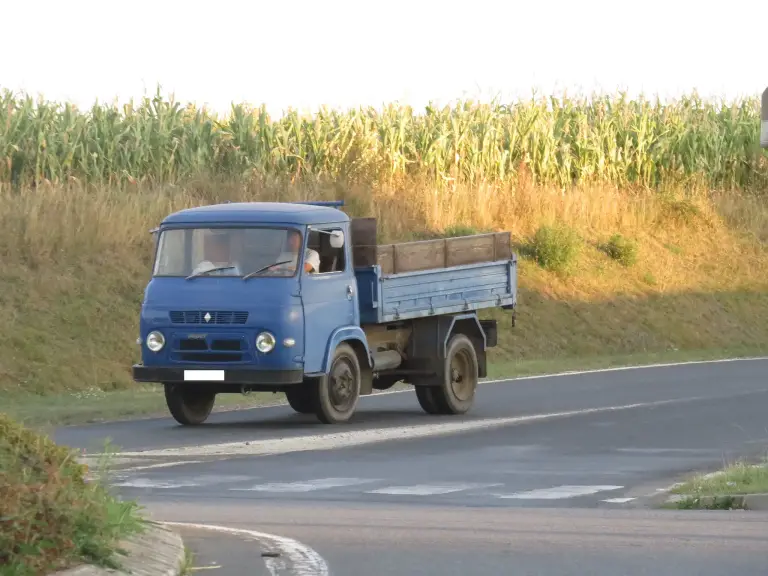
The SG4 was a light truck with a payload of 3,500 kg, launched in June 1965 together with the Super Goélette SG2. Both used the forward-control cabin of the Renault S7, S8 and S9 shown a year earlier, with rounded shapes, a curved windscreen, round headlamps and the gear lever behind the steering wheel. With a gross weight of 5,950 kg the SG4 stayed below the limit above which a transport licence was needed in France, and it was delivered from the factory as a flatbed with side boards unless a body was ordered. The type 710 cabin was mounted on four elastic points to reduce vibration, with a curved windscreen and a moulded plastic dashboard.
Updates and the SG5
The exterior followed the same changes as the SG2: for 1967 the windscreen was enlarged downwards, the grille lost its centre bar and the new square headlamps were two-coloured; for 1968 the new type 812 cabin brought rectangular headlamps. Two engines were offered at launch, a 2,141 cm³ four-cylinder petrol of 70 hp from the Frégate and a 3.02-litre six-cylinder diesel of 75 hp; in 1968 a Saviem/Alfa Romeo 599-01 with MAN direct injection appeared, soon replaced by the 712-01. For 1969 the SG4 received a 2.6-litre petrol of 78 hp and a 3.32-litre diesel of 92 hp. The SG5 arrived for 1969 with a payload of 5,040 kg and a gross weight raised to 7,300 kg, along with changes to the suspension and gearbox. The SG4 was the only six-tonne truck with independent front wheels: lower wishbones and coil springs in front, a rigid axle with semi-elliptic leaf springs at the rear, and telescopic dampers on both axles. Drive was through a four-speed fully synchronised gearbox, with drum brakes on both axles and worm-and-nut steering.
Licences and the end
In 1967 Renault and Alfa Romeo agreed that the Italian maker would build the SG range as the Alfa Romeo A15, A19, A38 and F20. In the same year Saviem signed a technical and commercial agreement with MAN for engines and the cabin of the future H32, and MAN sold the SG range in Germany as the MAN 4xx and 7-90. A licence was also granted to Avia in Czechoslovakia, which sold the range throughout Eastern Europe; from 1978 the ‘Licence Saviem’ badge was dropped because more than 98 per cent of components were local. Alfa Romeo stopped building the range in 1974. From 1970 the Renault logo disappeared and only the Saviem name was on the grille, so the Renault Super Galion SG4 became the Saviem SG4 beside the SG5. The last exterior update came in 1977 with a wider black plastic grille; after the Berliet-Saviem merger of 21 April 1980 the trucks were sold as Renault Véhicules Industriels and production continued until 1982. Avia kept building the SG2 and SG4 as the A15, A20 and A30, then A21T and A31T, until 1998.
Design and features
- Independent front suspension: the only six-tonne truck of its time with coil-sprung front wheels.
- Payload-focused range: 3.5 tonnes in the SG4, 5.04 tonnes in the SG5.
- Simple mechanicals: four-speed gearbox, drum brakes and worm-and-nut steering.
- Wide licensing: built or sold as Alfa Romeo, MAN and Avia in Italy, Germany and Czechoslovakia.
Saviem SG4 and SG5 versions
- SG4 (1965): 5,950 kg gross weight, 3,500 kg payload.
- SG5 (1969): 7,300 kg gross weight, 5,040 kg payload.
- Alfa Romeo A15, A19, A38 and F20: Italian-built versions, 1967–1974.
- MAN 4xx and 7-90: German-badged versions.
- Avia A15, A20 and A30, later A21T and A31T: Czechoslovak licensed versions built until 1998.
The SG4 shared its cabin and engines with the SG2 Super Goélette, and the heavier Saviem SM range sat above it. More vehicles are in the Saviem collection.
Sources
- Renault Super Galion, French Wikipedia: history, payloads, engines, suspension, licences