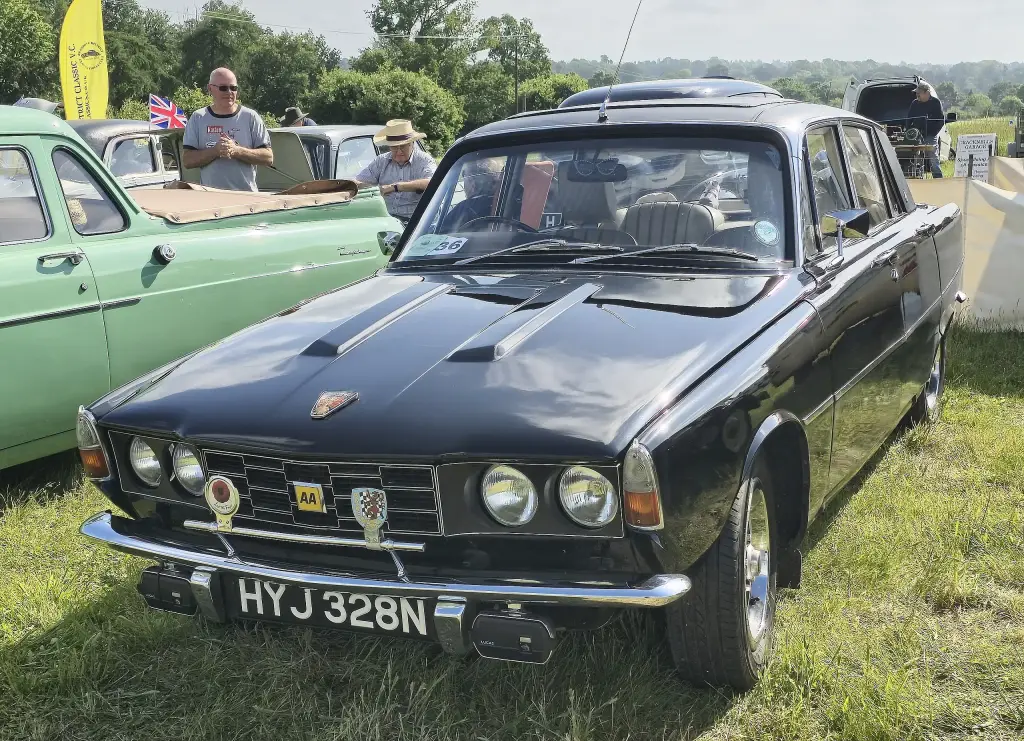
The Rover P6 series, sold as the 2000, 2200 or 3500 depending on engine size, was a saloon car produced by Rover and then British Leyland from 1963 to 1977 in Solihull. It was the first winner of the European Car of the Year award.
Rover P6 at a glance
| Production | 1963–1977, at Solihull |
|---|---|
| Announced | 9 October 1963, just before the Earls Court Motor Show |
| First model | Rover 2000, with a 1,978 cc engine and about 104 bhp |
| V8 | the Buick-derived Rover V8, available from April 1968 |
| Rear suspension | de Dion tube in two telescoping parts |
| Brakes | four-wheel discs, inboard at the rear |
| Structure | unibody with non-stressed panels bolted to a unit frame |
| Award | first winner of European Car of the Year |
| Rival | the Triumph 2000, launched a week later |
| Replaced by | Rover SD1 from 1976 |
Based on one source: the English Wikipedia article on the Rover P6.
History of the Rover P6
A clean-sheet executive car
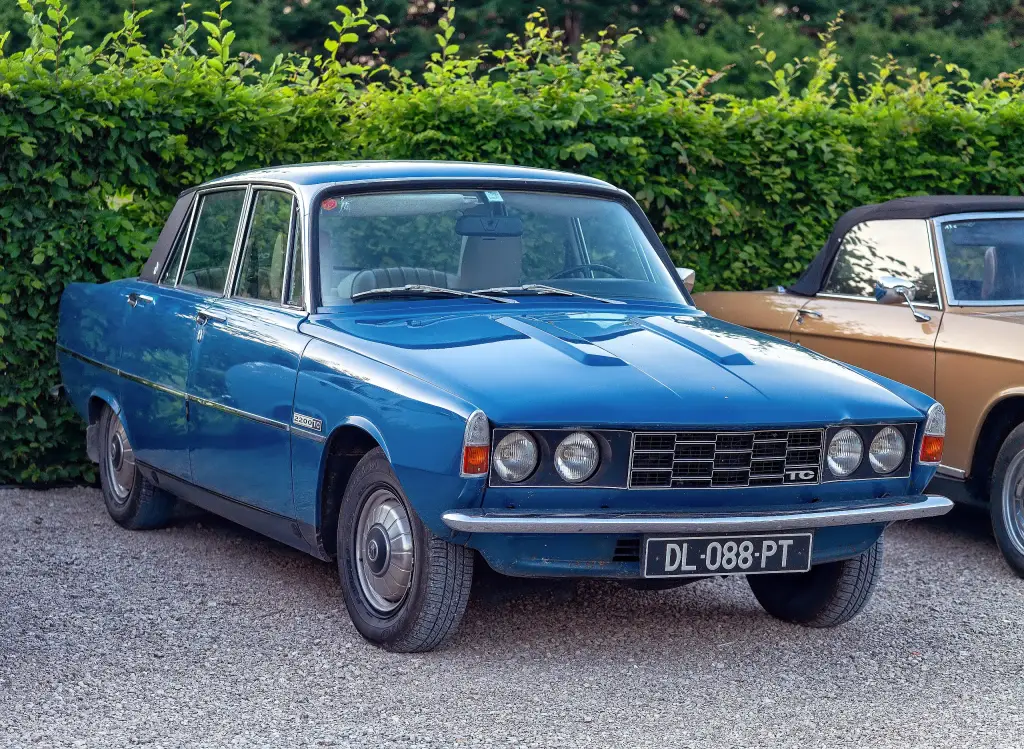
The P6 was announced on 9 October 1963, just before the Earls Court Motor Show, and was marketed first as the Rover 2000. It was a complete clean-sheet design intended to appeal to more buyers than earlier models such as the P4 it replaced. Rover had identified a developing market between the standard 1.5-litre saloon class, such as the Ford Consul and Singer Gazelle, and the accepted three-litre large saloons, typified by the Wolseley 6/99 and Vauxhall Cresta. Younger and increasingly affluent professional workers and executives wanted cars superior to the normal 1.5-litre models in style, design and luxury, but with more modern driving dynamics than the big three-litre class and lower purchase and running costs than sports saloons such as the Jaguar Mark 2. The replacement for the traditionally designed P4 would be a smaller car with a two-litre engine using the latest design, engineering and styling, making the P6 one of the earliest examples of what would now be called an executive car. It was lower-priced than the P4 and sales were expected to be much higher, and the more upmarket P5 was sold alongside it until 1973.
Engineering
The 2000 was advanced for its time, with a de Dion tube suspension at the rear, four-wheel disc brakes that were inboard at the rear and a fully synchromesh transmission. The unibody design had non-stressed panels bolted to a unit frame, inspired by the Citroën DS. The de Dion tube was in two parts that could telescope, which avoided the need for sliding splines in the drive shafts and the stiction they caused under drive or braking torque, while keeping the wheels vertical and parallel to the body. The Rover 2000 won industry awards for safety when it was introduced and had a carefully designed safety interior. One innovative feature was a plastic prism on top of the front side lights, which let the driver see the front corner of the car in low light and confirmed that the lights were on; the sharp projections did not meet homologation standards in some export markets, including Germany, so a lens with a smooth top was substituted where the law demanded it. The front suspension was unique: a bell crank conveyed the vertical motion of the wheel to a fore-and-aft, horizontally mounted spring fastened to the rear wall of the engine compartment, and the layout was designed to leave as much width as possible for Rover’s gas turbine engine. The styling outline was first seen in the 1961 T4 prototype, a front-engined, front-wheel-drive gas turbine saloon; T4 survives at the British Motor Museum. The turbine was never used in the P6, but the engine bay was wide enough for the Buick-derived Rover V8, available from April 1968.
Bodies and the V8
Sculptor Flaminio Bertoni’s Citroën DS body inspired David Bache, and the finished Rover incorporated a Kamm tail and a necessarily enlarged boot, filled otherwise by the de Dion rear suspension. Luggage space was limited by the complex rear suspension and, in Series II cars, by the boot-mounted battery; the spare wheel competed for room and was stored either flat on the boot floor or vertically at the side, with a later optional touring package allowing it to be carried on the boot lid under a vinyl cover, the mounting bracket being hidden by a circular Rover badge when not in use. Series II models briefly offered Dunlop Denovo run-flat tyres, which removed the need for a spare but were rarely chosen. The car’s main domestic rival was the Triumph 2000, released in October 1963 just a week after the P6, while on the continent the Rover 2000 competed with the Citroën DS, which also started with a four-cylinder engine. The Rover’s interior was less spacious than those of its rivals, especially in the back, where the sculpted two-person rear seat implied that buyers wanting to carry three should choose the larger P5. The first P6 used a 1,978 cc engine designed for the car, in pilot production since the start of 1963, so deliveries began immediately, with output in the order of 104 bhp. The P6 was replaced by the Rover SD1 from 1976.
Design and features
- de Dion rear suspension: a two-part telescoping tube kept the rear wheels upright without sliding splines.
- Four-wheel disc brakes: inboard at the rear, unusual for a British saloon in 1963.
- Safety interior: padded design and the plastic prism sidelights that won safety awards.
- V8 from 1968: the Buick-derived Rover V8 finally gave the P6 the power its chassis deserved.
Rover P6 versions
- Rover 2000 (1963): the original 1,978 cc four-cylinder car.
- 2000 TC: the twin-carburettor version.
- 2200: the larger four-cylinder model.
- 3500 and 3500S (1968): the V8 cars, the S with a manual gearbox.
- Series II: the updated cars with the battery moved into the boot.
The P6 replaced the Rover P4 and was itself replaced by the Rover SD1. More cars are in the Rover collection.
Video: Rover P6 3500 V8 at the Ace Cafe London 2013
Video by Performance Direct on YouTube.
Sources
- Rover P6, English Wikipedia: development, engineering, the V8 and the body