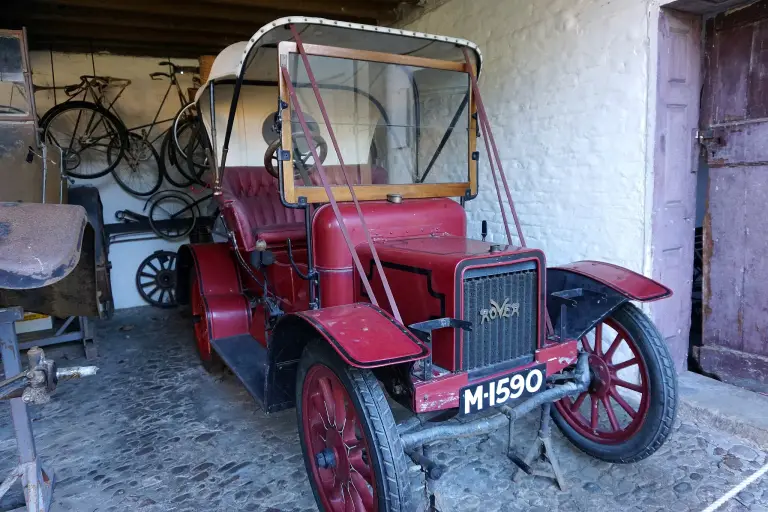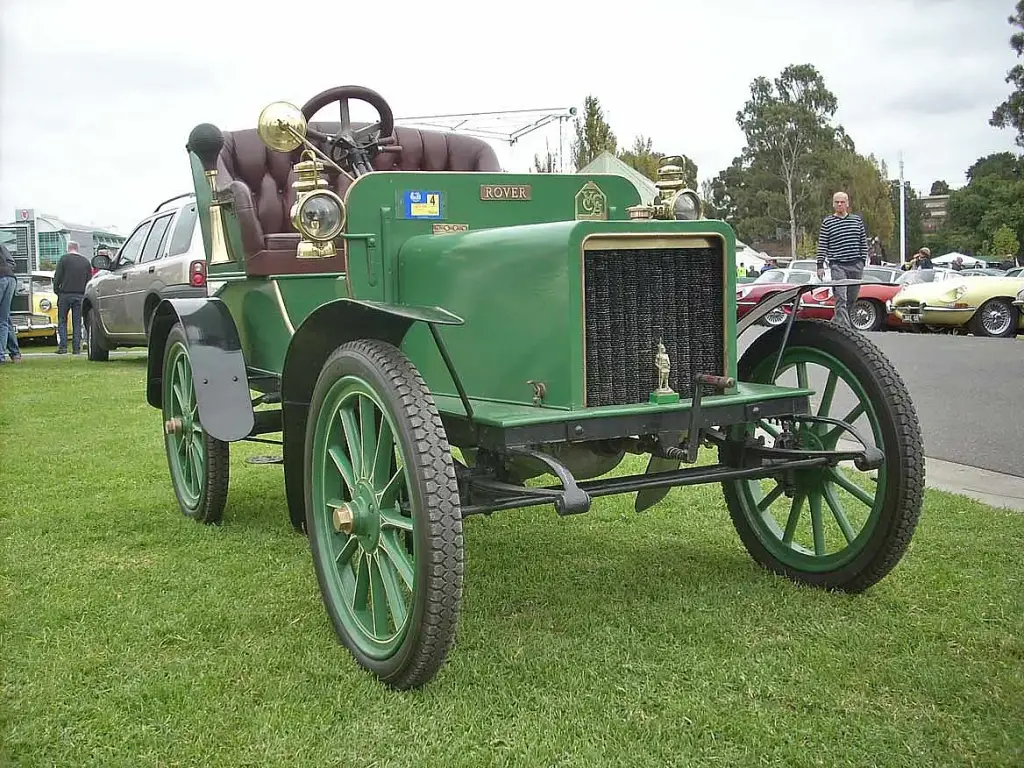
The Rover 6 was a small two-seater 6-horsepower car and only the second model made by the British Rover company. It was announced in January 1905, and a 6-horsepower Rover remained available until 1912.
Rover 6 at a glance
| Announced | January 1905; a 6 hp Rover stayed on sale until 1912 |
|---|---|
| Engine | 780 cc single-cylinder side-valve, water-cooled, 95 mm bore and 110 mm stroke |
| From 1908 | 812 cc, after the bore grew to 97 mm to match Rover’s fours |
| Normal engine speed | 1,200 rpm |
| Speeds | 24 mph in top, 16 mph in middle, 8 mph in low |
| Ignition | Bosch high-tension magneto, with low-tension accumulator ignition as well |
| Gearbox | three speeds, in a single pair of aluminium castings with the crankcase and clutch |
| Steering | rack and pinion |
| Price | £155 for a complete 1910 two-seater; an earlier car sold as the “hundred guinea car” at £105 |
| 1909 revision | exterior gear lever, Rover carburettor, bigger gearbox brake, separate throttle and ignition levers |
Based on one source: the English Wikipedia article on the Rover 6.
History of the Rover 6
The 1905 original
The Rover 6 was a 780 cc side-valve single-cylinder car with a 95 mm bore and 110 mm stroke, water-cooled, and it ran at a normal 1,200 rpm. Selecting top, middle or low gear gave 24, 16 or 8 mph respectively. The change-speed lever was mounted in a notched quadrant below the steering wheel and linked by a connecting rod to a vertical spindle in the gearbox. Ignition came from a Bosch high-tension magneto, with low-tension accumulator ignition also provided. Crankcase, flywheel, clutch and gearbox enclosures were made from one pair of aluminium castings, the upper half bolted directly to the frame at the front and to a thin steel cross-member at the rear. The clutch ran in oil and used the metal-to-metal gripping disc system of the 8 hp car, and drive went to the rear wheels through a three-speed gearbox and a jointed shaft. The brake drum at the back of the gearbox surrounded the universal joint, and the rear axle casing reached forward almost to it, with a bevel wheel in the differential case. The throttle and the ignition timing were worked by levers below the steering wheel, and petrol was carried in a tank beneath the driver’s seat.
Chassis and controls
The car used a conventional wooden chassis reinforced with steel flitch plates, half-elliptic leaf springs front and rear on rigid axles, their forward ends fixed to the frame and their rear ends sliding in brackets. The right pedal applied iron-lined external bands on the rear drums through levers and horizontal shafts, while the left pedal first released the clutch and then, when pressed further, applied a brake on the propeller shaft drum behind the gearbox to ease gear changes. Steering was by rack and pinion and the wheels were steel wire with tangent spokes. The Autocar drove a test car finished in dark green and black with pegamoid upholstery for ten days and some 400 miles, and reported that the single wide seat carried two people in comfort, that control was so simple a child could drive it, and that steering was excellent, although gear changing was a little stiff and the tester would have preferred a separate control for the spark. The magazine called the little Rover an ideal car for a man of very moderate means.
The 1909 revision
In May 1909 the car gained the Rover patented carburettor already used on the 8 hp, and the change-speed lever moved from beneath the steering wheel to an exterior quadrant near the driver’s right hand. The universal joint to the propeller shaft was redesigned and the shaft casing now acted as a torque rod, the clutch-controlled brake behind the gearbox became much larger, and there were separate levers for throttle and ignition timing. The front springs gained shackle pins, a fan was added to the cooling system, petrol moved to a tank on the dashboard and a pawl below the brake pedal allowed the car to be held on a slope. In 1910 a complete Rover 6 with a two-seater body and weather protection cost £155, though an earlier model had been sold as the hundred guinea car at £105. The capacity grew to 812 cc in 1908 when the bore went up to 97 mm to bring the dimensions into line with Rover’s new four-cylinder range.
Design and features
- Single-cylinder engine: 780 cc, later 812 cc, giving 8 hp at its normal 1,200 rpm.
- Simple controls: rack-and-pinion steering and a three-speed gearbox in one casting with the engine.
- Three speeds: 24, 16 and 8 mph, with a transmission brake behind the gearbox.
- Cheap motoring: the “hundred guinea car” at £105 put Rover within reach of modest means.
Rover 6 versions
- 1905 two-seater: the original 780 cc car with the gear lever under the steering wheel.
- 812 cc model (1908): the enlarged engine that matched Rover’s four-cylinder dimensions.
- 1909 revision: Rover carburettor, exterior gear lever and separate throttle and ignition levers.
- 1910 complete car: a two-seater with weather protection at £155.
The 6 was Rover’s second model, after the Rover 8. More cars are in the Rover collection.
Sources
- Rover 6, English Wikipedia: engine, chassis, the Autocar test and the 1909 revision