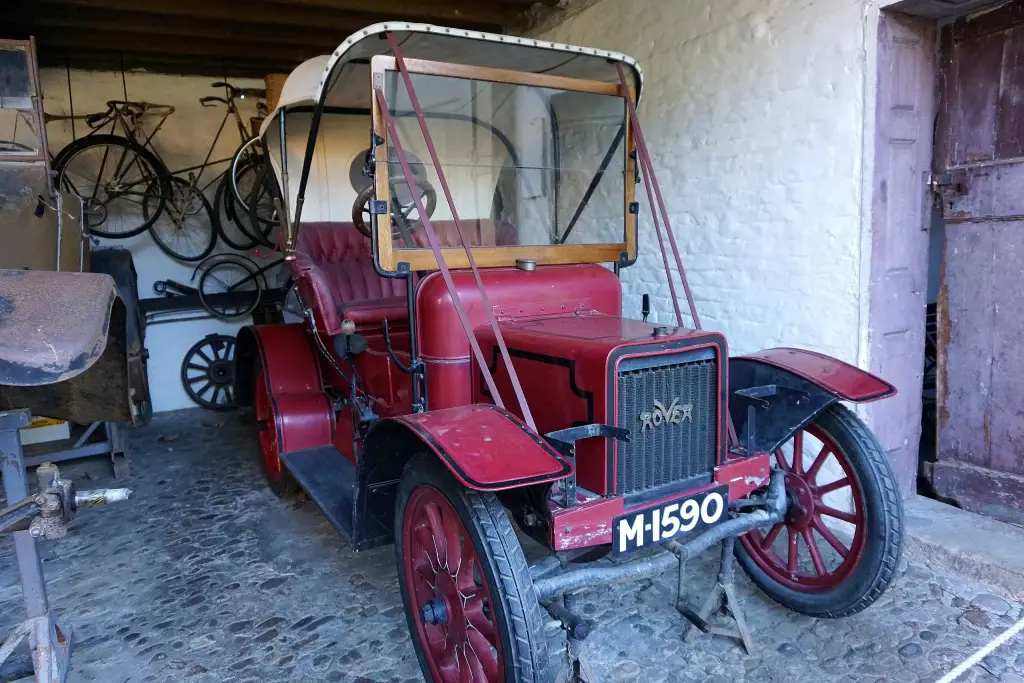
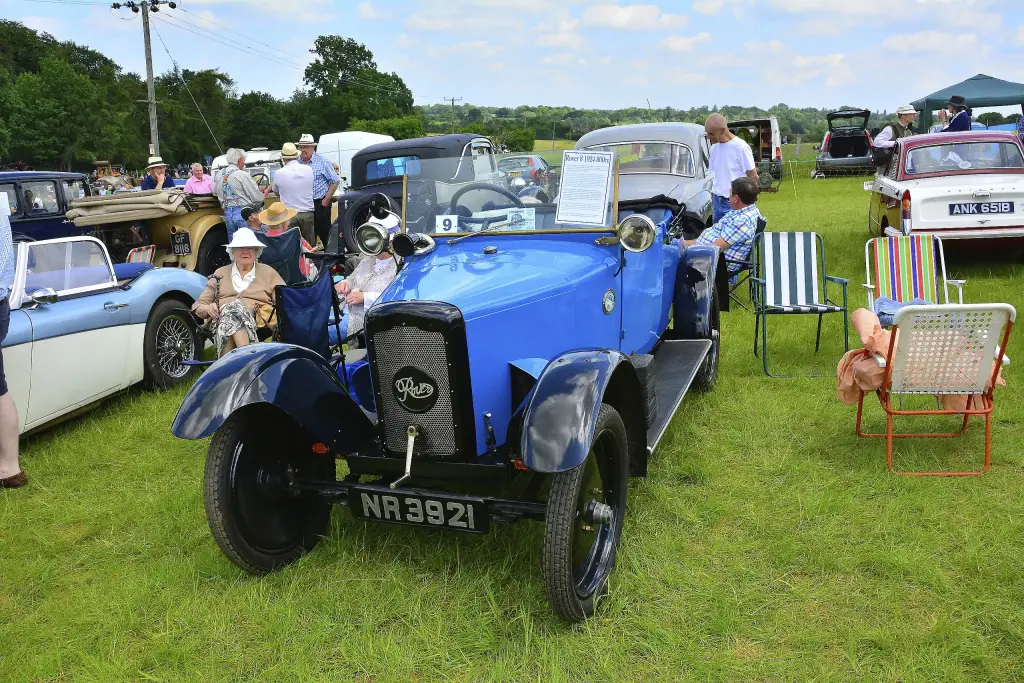
The Rover 8 was a small single-cylinder 8 hp car of 1,327 cc and Rover’s first production car. It was remarkable for a backbone chassis rather than a conventional ladder frame, and the name came back after the First World War on a twin-cylinder light car.
Rover 8 at a glance
| Single-cylinder model | 1904–1912 |
|---|---|
| Engine | 1,327 cc single-cylinder, 110 mm bore and 130 mm stroke |
| Output | 8 hp at 900 rpm, rising to 1,500 rpm on the throttle and ignition |
| Chassis | backbone of crankcase, gearbox, tubular propeller shaft housing and rear axle |
| Suspension | pivoted transverse leaf spring at the front; the car rested on three points |
| Gearbox | three speeds: 8, 16 and 24 mph, plus reverse at 8 mph |
| Steering | cable-linked, with a spring so only one cable was tight |
| Brakes | wrought iron drums on the rear wheels, worked by foot lever through compensating wires |
| Sleeve-valve option | Daimler-Knight engine offered in 1911 and 1912 |
| Post-war model | twin-cylinder 8 hp of 1919–1925, 998 cc then 1,134 cc |
| Replaced by | four-cylinder 1,074 cc Rover 9 in 1924 |
Based on one source: the English Wikipedia article on the Rover 8.
History of the Rover 8
The backbone chassis of 1904
The car was designed by Edmund Woodward Lewis, who had joined Rover from Daimler, and had an unusual structure. Instead of a conventional chassis it used a backbone formed by the engine crankcase, the gearbox housing, a rigid tubular propeller shaft housing and the rear axle housing, the whole described as having a box girder section. The backbone frame, with no bump compliance at the rear apart from the tyres, was suspended from the front axle at just one point by a pivoted transverse leaf spring that made no contribution to transverse rigidity, so the rest of the car rested on just three points, like an old four-wheeled farm tractor. The body was mounted on the rear axle through its own sub-frame on semi-elliptic springs. The single-cylinder engine displaced 1,327 cc with a 110 mm bore and 130 mm stroke, and both its inlet and exhaust valves were mechanically operated. At its normal 900 rpm it gave 8 horsepower, the same as its RAC tax rating, and it could be accelerated to 1,500 rpm by careful adjustment of throttle and ignition. An aluminium inspection plate above the combustion chamber could be removed to check the water jacket for blockages. The crankshaft and camshaft ran in large ball races, the sparking plug sat just above the inlet valve, and current came from an accumulator and a Bassée-Michel high-speed trembler coil; a switch on the centre of the steering wheel could cut the current without the driver lifting a hand. A propeller drew water from the base of the radiator and pushed it up through the engine jackets, and a belt from the crankshaft drove a fan.
Transmission, steering and body
The metal-to-metal clutch ran in oil, with an engine-driven bell-shaped clutch forced by a coil spring on the output shaft to engage a floating cast iron disc and transmit power to the three-speed gearbox. The gearbox gave 8, 16 and 24 mph, with reverse at 8 mph, top gear being a direct drive to the bevel on the differential inside the back axle’s aluminium casting; economy came from making the gearbox from just three sizes of gear wheel. The change-speed lever was at the bottom of the steering wheel and worked through a concentric tube around the steering column. The front axle was steel tube, with ball cup swivel pins and a slight set to the wheel axles, and a cross rod joined the steering levers and was linked to the foot of the steering column by a double cable with a spring so that only one cable was tight; the small diameter of the steering spindle was claimed to remove road shock. Compression rods from the gearbox casing stayed each end of the front axle. The two passengers had bucket seats, the driver’s shallower and less comfortable than the passenger’s, and the body’s sides were cast aluminium skeletons supported by ash side members, braced by the seats in front and a cast aluminium stay at the back. The Autocar drove a two-seater for ten days over some 400 miles and found that the engine could act as an air brake for most purposes, the brakes were needed only for steep hills or an emergency, the car climbed extremely well and had a good turn of speed, although turning sharply upset the engine speed through the ignition and throttle controls.
Later models
By 1907 Rover had dropped the backbone frame for an ash chassis with steel flitch plates. A Daimler-Knight sleeve-valve engine was offered on the original model in 1911 and 1912. After the First World War a new twin-cylinder 8 hp light car was offered from 1919 to 1925, first of 998 cc and later of 1,134 cc, and it was superseded in 1924 by the four-cylinder 1,074 cc Rover 9.
Design and features
- Backbone chassis: engine, gearbox, propeller shaft housing and rear axle formed one box-girder structure.
- Three-point suspension: the car rested on the front spring pivot and the rear axle, like a tractor.
- Single-cylinder engine: 1,327 cc giving 8 hp at 900 rpm and 24 mph in top gear.
- Cheap gearbox: only three sizes of gear wheel were needed for the three speeds and reverse.
Rover 8 versions
- Single-cylinder 8 (1904–1912): the original backbone-chassis car.
- Knight sleeve-valve 8 (1911–1912): the Daimler-Knight engine option.
- Twin-cylinder 8 (1919–1925): 998 cc, later 1,134 cc, light car.
- Rover 9 (1924): the four-cylinder 1,074 cc car that succeeded the twin.
The 8 was Rover’s first production car, before the Rover 6 and the later Rover 10. More cars are in the Rover collection.
Sources
- Rover 8, English Wikipedia: the backbone chassis, engine, transmission and the 1919 twin