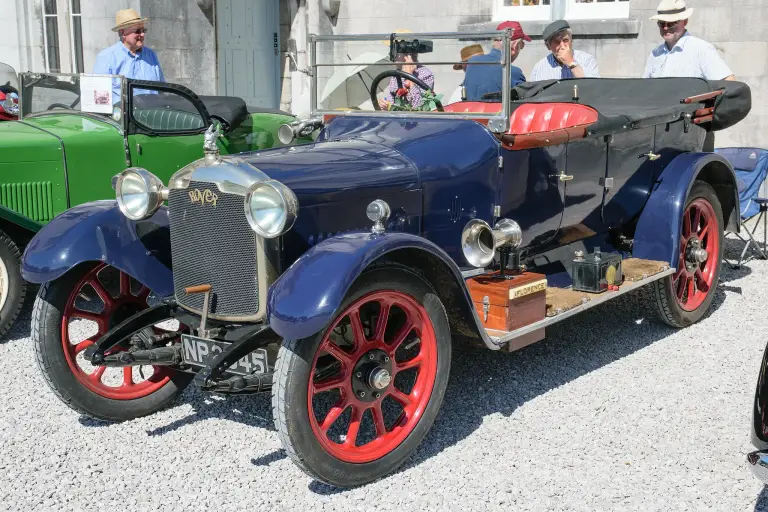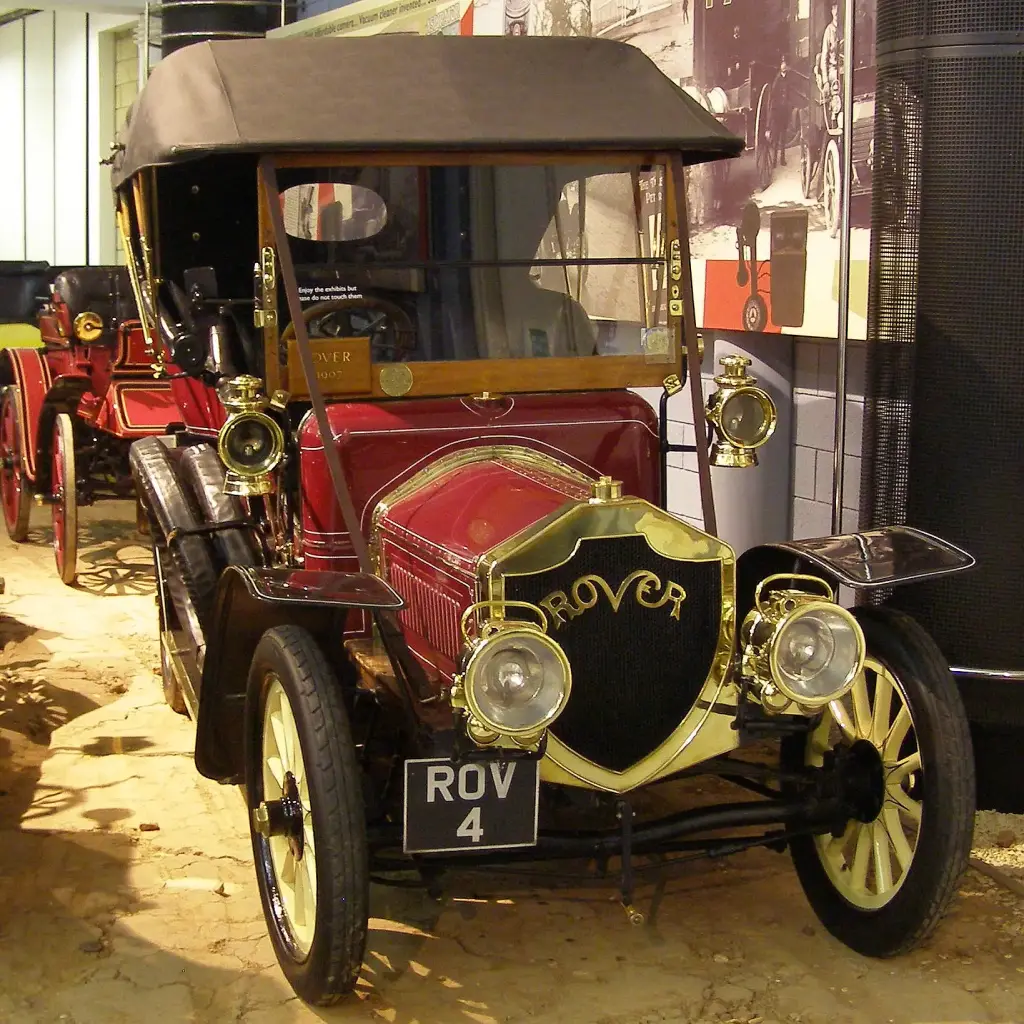
The Rover 20 was a new medium-sized car announced by Rover in June 1907. It was a production version of the car that won the Isle of Man Tourist Trophy race in 1906, and with a few breaks Rover kept a premium 20 tax horsepower car in its catalogue until the outbreak of war in 1939.
Rover 20 at a glance
| Announced | June 1907 |
|---|---|
| Based on | the car that won the 1906 Isle of Man Tourist Trophy |
| Wheels | artillery wood wheels, not the wire wheels of the race car |
| Engine | derived from the Rover 16, with the bore increased by 2 mm |
| Suspension | the whole car rested on three points, with a pivoted transverse leaf spring at the front |
| Chassis | steel flitch plates over ash |
| Engine brake | Rover’s system could close the engine’s valves |
| Controls | Autoloc levers over the steering wheel for throttle and ignition; no accelerator pedal |
| Light Twenty | 1930, with the Rover Meteor 20 hp engine |
| Speed Twenty | from 1933; 641 of the 1936 version built before 1940 |
| Back in the range | the 2.6-litre Rover 90 and later the 3-litre from the early 1950s |
Based on one source: the English Wikipedia article on the Rover 20.
History of the Rover 20
The 1907 model
The Rover 20 was announced in June 1907 as a production version of the car that had won the Isle of Man Tourist Trophy race the year before. Artillery wood wheels were fitted instead of the wire wheels used in the race, although wire wheels were still recommended, and the longer wheelbase allowed the engine to be kept out of the passenger area; on the prototype the engine had come back beneath the petrol tank. The engine was very much based on the Rover 16’s, with the bore increased by 2 mm and a number of minor improvements: the water inlet pipe moved to the other side of the engine for better access to the valves and tappets, the oil reservoir moved to the left rear so that a catcher for oil thrown up by the flywheel was no longer needed, lubrication pipes were mounted lower and a new partition between sump and clutch housing kept oil away from the clutch. Rover’s engine braking system was fitted, with the ability to close the engine’s valves. The chassis was suspended from the front axle at a single point by a pivoted transverse leaf spring that made no contribution to transverse stability, so the whole car rested on three points. Radius rods from the gearbox took up braking strains and acted as distance stays for the back axle, with buffer springs at their front ends; the rear springs attached through a spherical case clipping over a spherical part of the axle casing, allowing a little movement over bumps. The chassis was built up from steel flitch plates over ash to give strength with flexibility. A pair of Autoloc levers over the top of the steering wheel worked the throttle and ignition, a pedal controlled the engine braking system, and road tests as late as 1911 noted how Rover cars lacked accelerator pedals. The foot brake was of the contracting band type and the hand brake pulled on internal expanding shoes, both metal to metal, and the engine brake avoided much use of the conventional system.
The Twenty in the 1930s
A premium 20 hp Rover returned with the Light Twenty of 1930, which used a Rover Meteor 20 hp engine but was otherwise identical with the Rover Two-litre Sportsman’s coupé. From 1933 Rover made the Speed 20 as a Weymann saloon, a coachbuilt saloon, a sportsman’s coupé, a Hastings coupé and a four-seat tourer. Some 641 examples of the 1936 Speed Twenty were built before the production run stopped in 1940. After the war the place of the 20 was taken in the early 1950s by the 2.6-litre Rover 90 and later by Rover’s 3-litre car.
Design and features
- Race-bred: the production 20 came directly from the car that won the 1906 Isle of Man Tourist Trophy.
- Three-point suspension: a pivoted transverse leaf spring at the front left the car resting on three points.
- Engine brake: Rover’s system could close the engine’s valves, and a pedal controlled it.
- Autoloc levers: throttle and ignition were worked from levers over the steering wheel, not a pedal.
Rover 20 versions
- Rover 20 (1907): the original production model, on artillery wood wheels.
- Light Twenty (1930): a Meteor 20 hp engine in the Two-litre Sportsman’s coupé body.
- Speed Twenty (1933): offered as a Weymann saloon, coachbuilt saloon, sportsman’s coupé, Hastings coupé and tourer.
- Speed Twenty (1936): the last version, with 641 built before 1940.
The 20 was the largest Rover of its time, above the Rover 16. More cars are in the Rover collection.
Sources
- Rover 20, English Wikipedia: the 1907 model and the 1930s Light and Speed Twenty