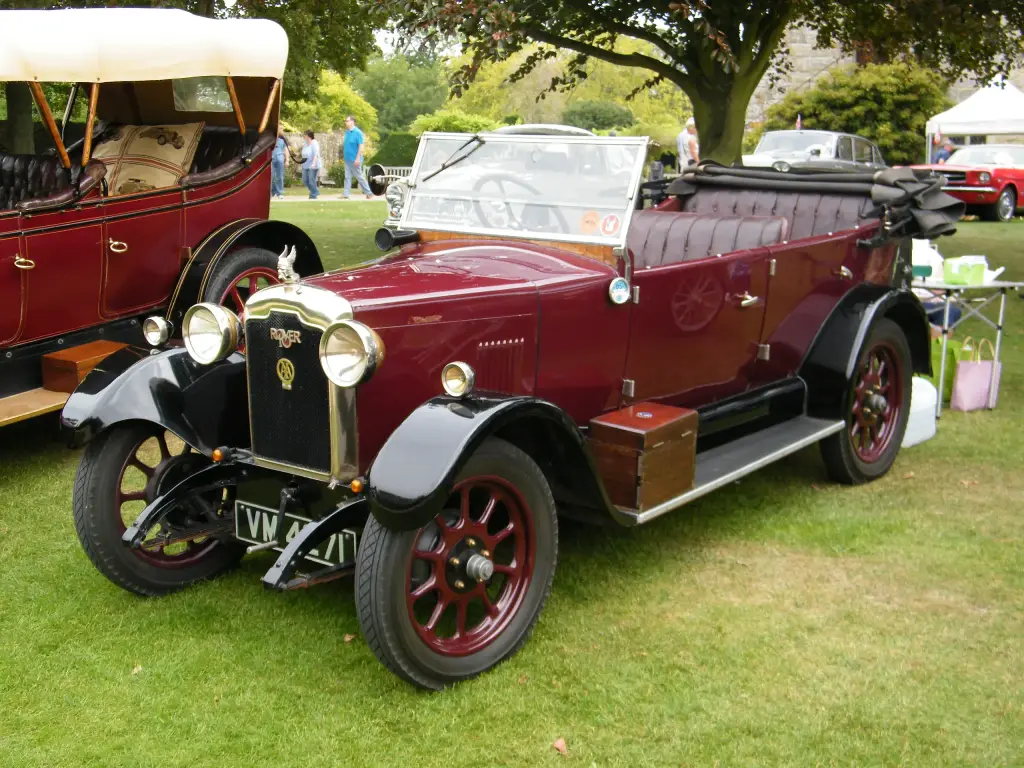
The Rover 10 was a small family car built by the Rover Company from 1927 to 1947. It started in mid-1927 as the 10/25, a Rover 9/20 whose engine had been given a larger bore, and in 1932 it became the 10 Special with a completely new chassis, a freewheel gearbox and Lockheed hydraulic brakes.
Rover 10 at a glance
| Production | 1927–1947 |
|---|---|
| First model | 10/25, mid-1927 |
| Engine | 1,185 cc four-cylinder overhead valve; ten per cent more capacity than the 9/20 |
| Claimed output | 25 per cent more than the 9/20 |
| Gearbox | Three-speed; four-speed with quiet third standard on the de luxe Family Ten from 1932, standard on the 10 Special |
| Suspension | Rigid axles and leaf springs: half-elliptic at the front, quarter-elliptic at the rear; half-elliptic all round on the steel Family Ten |
| Brakes | Internally expanding on all four wheels; Lockheed hydraulic on the 10 Special |
| Bodies | Open tourer, semi-sports tourer, saloon, Weymann saloon, Riviera, Sportsman’s Coupé |
| Regal model | 1928, sliding roof, bumpers, safety glass and vacuum servo brakes, 12 per cent premium |
| 10 Special | July 1932, 17 per cent premium over the Family Ten |
Based on one source: the English Wikipedia article on the Rover 10.
History of the Rover 10
The 10/25 of 1927
The 10/25 appeared in mid-1927. Some time between March and September that year Rover increased the bore of its 9/20 engine by 3 mm and renamed the model 10/25 hp, to advertise the ten per cent increase in capacity and the 25 per cent increase in claimed output. The drive shaft was enclosed at the same time, and the 9/20 stayed in the showrooms alongside the new car. The chassis was conventional: rigid axles, half-elliptic springs in front and quarter-elliptic behind, a 1,185 cc four-cylinder overhead-valve engine, a three-speed gearbox, rear-wheel drive and internally expanding brakes on all four wheels. The magneto ignition was replaced by coil ignition in 1929.
Weymann bodies and the Regal
Buyers could have a two- or four-seat open tourer, a semi-sports tourer or a four-seater saloon. The saloons used a Weymann fabric body built by Rover under licence at Parkside, and the windows had double sliding panels for ventilation. A standard Paris body with a folding roof was rebranded Riviera: its roof folded back like an ordinary hood over about two-thirds of its length. The Paris body came with leather upholstery, five lamps, two electric horns, an eight-day clock, an automatic screen wiper, a roof ventilator with a lamp, a rear blind worked from the driver’s seat and a folding luggage grid. In October 1928 the bonnet was lengthened and a four-seat Weymann Sportsman’s Coupé with two 40-inch doors joined the range. A high-line Regal model was offered on every body from 1928 at a 12 per cent premium, with a sliding roof, front and rear bumpers, safety glass, vacuum servo braking, two spare wheels and special mats.
Steel bodies and the Family Ten
In August 1930 the Weymann Riviera and Sportsman’s Coupé were joined by a coachbuilt model with an all-steel body from Pressed Steel, delivered to Rover painted and trimmed and made for far less than Rover’s own fabric bodies — although Rover charged the same price for the three models, fully equipped with a safety glass windscreen, an electric wiper and a luggage grid. The steel bodies were roomier and had a new shape; wire wheels cost £5 extra. The steel safety saloon was also sold as the Family Ten, still on the old Rover 8 chassis but with half-elliptic rear springs in place of quarter-elliptics. It stayed in the catalogue after July 1932 beside the new 10 Special, and both gained a sliding roof, cam steering and a new radiator stone guard. The Times found the steel saloon smooth and quiet, with light, steady steering and effective brakes, and recorded 46 mph on the straight. In February 1932 Rover strengthened the Family Ten chassis with heavier gauge material and redesigned cross members, fitted an Autovac fuel feed and made a four-speed gearbox with a quiet third standard on the de luxe car.
The 10 Special of 1932
The 10 Special of July 1932 had an all-new chassis under the same Pressed Steel body, sold beside the Family Ten at a 17 per cent premium. The engine was now carried on three rubber-insulated mountings instead of four, and the car had a four-speed gearbox with constant-mesh double-helical gears for second and third, a freewheel with its control beside the driver, an optional automatic clutch, a Startix automatic starter and a spiral bevel final drive. Rover called the arrangement Easy-free gear change: gears could be changed after a slight easing of the accelerator without using the clutch, and a knob on the instrument panel switched the freewheel off. The freewheel went on to remain a Rover feature for more than twenty years. Bigger Lockheed hydraulic brakes with self-compensating drums were fitted to match. The Rover 10 remained in production until 1947.
Design and features
- Weymann fabric saloon: a coachbuilt body made under licence at Parkside, with sliding ventilation panels in the windows.
- Riviera folding roof: the Paris saloon body with a roof that folded back over two-thirds of its length.
- Regal trim: the 1928 high-line model added a sliding roof, bumpers, safety glass and vacuum servo brakes.
- Freewheel transmission: the 10 Special could change gear without the clutch, and the freewheel stayed a Rover feature for over twenty years.
Rover 10 versions
- 10/25 (1927): the original car, with a 1,185 cc engine and a three-speed gearbox.
- Riviera: the Paris saloon body with a folding roof.
- Sportsman’s Coupé (October 1928): a four-seat Weymann coupé with two 40-inch doors.
- Regal (1928): the high-line specification available on all bodies at a 12 per cent premium.
- Family Ten (1930): the all-steel Pressed Steel saloon with half-elliptic rear springs.
- 10 Special (1932): new chassis, four-speed gearbox, freewheel, Startix starter and Lockheed hydraulic brakes.
The 10 was the smallest Rover of its day, sitting below the Rover 12 and Rover 14. More cars are in the Rover collection.
Video: A Grand Day Out with a Rover 10
Video by Mike Grillage on YouTube.
Sources
- Rover 10, English Wikipedia: the 10/25, bodies, the Family Ten and the 10 Special