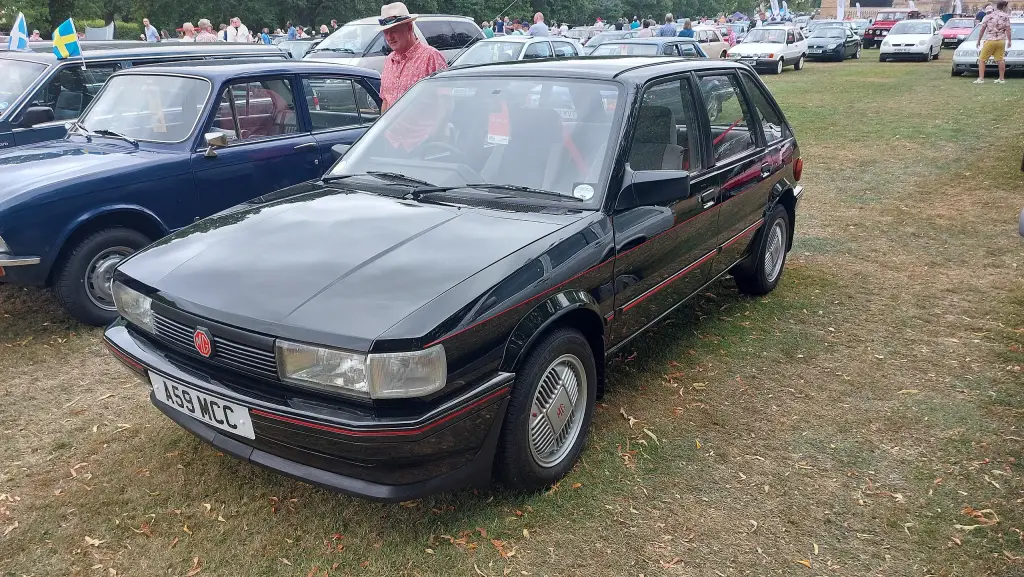
The Maestro was a small family car produced in Oxford from November 1982 to December 1994. It was introduced by British Leyland under the Austin marque, sold simply as the Maestro by the Rover Group from 1988, and sometimes informally called the Rover Maestro, although the car never wore the Rover badge.
Rover Maestro at a glance
| Production | November 1982–December 1994, at Cowley, Oxford |
|---|---|
| Launched | 1 March 1983 |
| Project code | LC10, with the hatchback as LM10 |
| Bodies | five-door hatchback and two-door van |
| Marques | Austin from launch, then simply Maestro from 1988; never a Rover badge |
| Sporting version | MG Maestro, 1983–1991 |
| Wheelbase and length | 2,510 mm and 4,050 mm |
| Drag coefficient | 0.38, or 0.36 for the HLE and MG models |
| Total built | 605,000 in Britain |
| Built elsewhere | knock-down kits in Varna, Bulgaria, 1995–1996; derivatives in China 1998–2017 |
The car was never badged as a Rover; this page uses the English Wikipedia article on the Austin Maestro, which also covers the later Maestro models.
History of the Rover Maestro
The LC10 project
British Leyland was created in 1975 when the bankrupt British Leyland Motor Corporation was nationalised, and in 1977 Michael Edwardes was recruited as chairman to sort out the firm. Part of his plan was a completely new range of mass-market models, and the first of these was the Austin Metro of 1980. The cars for the lower and upper medium segments were to share a platform with different trim and styling: the Maestro would replace both the Austin Allegro and Maxi, while the Montego replaced the Austin Ambassador and Morris Ital. The common platform was project LC10, including the LM10 hatchback that became the Maestro, and preliminary design work began in 1977 with production scheduled for around 1980. LC10 was styled by Ian Beech under David Bache. It dropped the Issigonis transmission-in-sump layout in favour of an end-on transmission bought from Volkswagen, and replaced Hydragas suspension with MacPherson struts in front and a Volkswagen Golf-style torsion beam at the rear, with long-travel rising-rate springs.
Novel features
The Maestro brought many features new to its class: a bonded laminated windscreen, homofocal headlamps, body-coloured plastic bumpers, electronic engine management, adjustable front seat belt upper anchorages, an asymmetrically split rear seat and a 12,000-mile service interval. It also used white lamp indicators instead of the traditional orange, which later became the norm. The MG and Vanden Plas versions had solid-state instrumentation with a digital speedometer, vacuum fluorescent displays for the tachometer, fuel and temperature gauges, a trip computer and a voice synthesis warning system, voiced by the New Zealand actress Nicolette McKenzie. The analogue instrument pod of the cheaper models was later used in the Range Rover from 1985. Production began in November 1982 and the car was launched on 1 March 1983.
A twelve-year life
The Maestro was produced for twelve years with little change to its basic design at Morris’s former Oxford plant at Cowley, and 605,000 were sold in total. It was replaced in the market by newer Rover models, but the name outlived British production: after UK assembly ended, knock-down kits were assembled in Varna, Bulgaria, from 1995 to 1996 under the Rodacar joint venture, and various derivatives were made in China from 1998 to 2017. The Montego saloon was a variant of the Maestro, and the MG Maestro remained the sporting version until 1991.
Design and features
- Modern equipment: bonded windscreen, body-coloured bumpers, electronic engine management and a 12,000-mile service interval.
- Digital dash: MG and Vanden Plas cars had solid-state instruments and a voice warning system.
- White indicators: unusual in 1983 and standard on most cars today.
- End-on transmission: a Volkswagen-sourced gearbox instead of the old transmission-in-sump layout.
Rover Maestro versions
- Austin Maestro (1983–1988): the original hatchback range.
- Maestro (1988–1994): the same car sold without the Austin marque.
- MG Maestro (1983–1991): the sporting version with digital instruments, including a turbo from 1990.
- Maestro van: a two-door commercial version.
- Montego: the four-door saloon variant, launched in 1984.
The Maestro shared its platform with the Rover Montego, and the smaller car of the same family was the Rover Metro. More cars are in the Rover collection.
Video: The history Of The Austin Maestro
Video by Men and Motors on YouTube.
Sources
- Austin Maestro, English Wikipedia: the LC10 project, features, production and later assembly