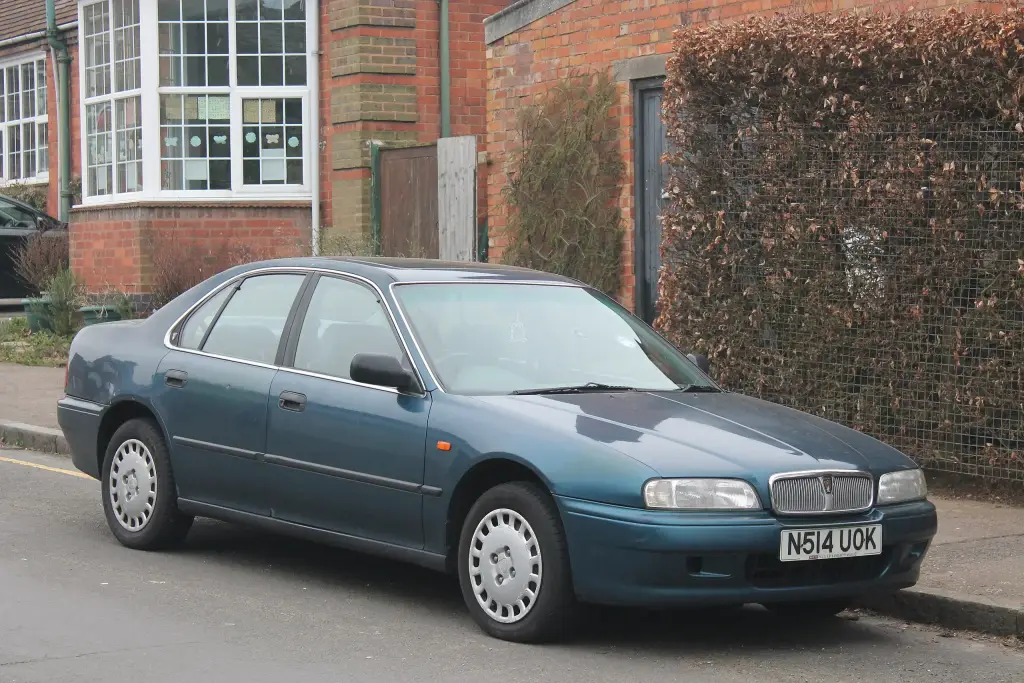
The Rover 600 Series was a compact executive car built by Rover from 1993 to 1999. Its exterior was designed by Rover as a reskin of the European Honda Accord, built alongside it at Swindon, and the range ran from the 1.8-litre 618 to the 620ti with Rover’s turbocharged T-series engine.
Rover 600 at a glance
| Production | 1993–1999 |
|---|---|
| Launched | 19 April 1993, two months before the new Honda Accord |
| Basis | European Honda Accord, itself derived from the Japanese Ascot Innova |
| Petrol engines | 1.8, 2.0 and 2.3-litre four-cylinders, all supplied by Honda |
| Rover engines | 2.0-litre L-series turbodiesel and the T-series, including the 620ti |
| Badging | 618 for 1.8, 620 for 2.0, 623 for 2.3 litres |
| Trims | i, Si, SLi, GSi and the 620ti, plus SDi diesel models |
| Standard equipment | power steering, electric front windows, remote central locking with alarm and immobiliser |
| Driver’s airbag | standard from 1994 |
| Recall | 21,634 cars built between December 1994 and December 1995, checked for a steering rack fault |
| Replaced by | Rover 75 at the start of 1999 |
Based on one source: the English Wikipedia article on the Rover 600 Series.
History of the Rover 600
Development with Honda
Austin Rover had originally intended to replace the Montego with the AR16 and AR17 concepts, essentially the Montego underpinnings reskinned to mimic the Rover 800 design language and to be called the Rover 400 Series. AR16 was a saloon and AR17 a hatchback aimed at the Ford Sierra and Vauxhall Cavalier, but the plan was cancelled for lack of funds after the restructuring of the company into the Rover Group, and a facelifted Montego was released instead for 1989. In June 1989 Rover reached an agreement with Honda, its partner since 1980, to produce a new model sharing its base with the next Honda Accord and using Honda engines, aimed further upmarket than the Montego and more directly at the BMW 3 Series. The car was shown to the motoring press late in 1992 and went on sale on 19 April 1993, two months before the new Accord on which it was based; both were derived from the Japanese-market Ascot Innova, launched in March 1992, so the engineering and interior design were public knowledge almost a year before the European launch. The Montego saloon was withdrawn after nine years, although the estate continued until the end of the following year.
The car and its engines
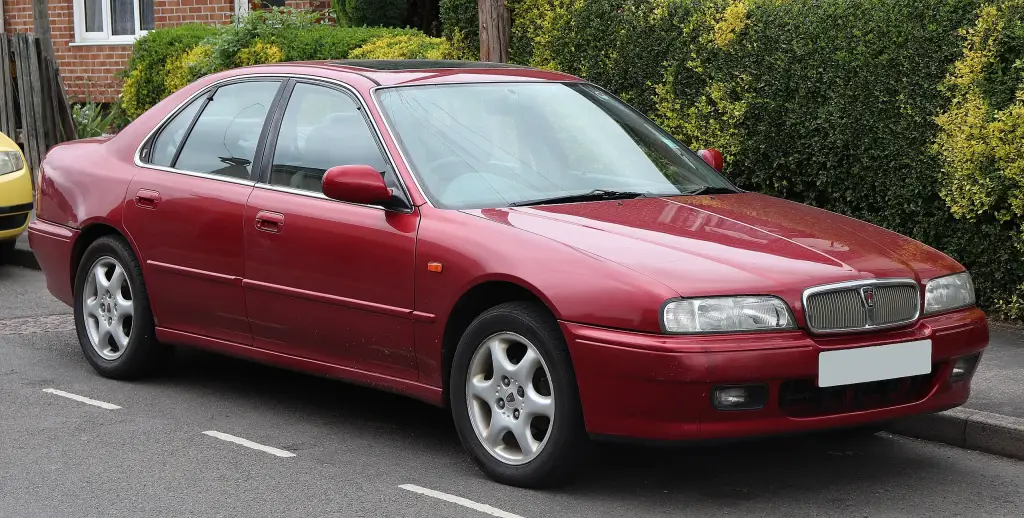
The exterior of the Rover 600 was designed by Rover as a reskin of the European Honda Accord, with the core structure and most of the engineering sourced from Honda; the cars were designed at the same time with a small Rover team on site in Japan, and colour and trim derivatives helped separate the Rover from the Honda in the market. The 1.8, 2.0 and 2.3-litre inline-four petrol engines were all provided by Honda, while the 2.0-litre turbodiesel L-series and the turbocharged T-series engines were Rover’s own, evolutions of units used elsewhere in the range. The interior had wood and chrome trim and relatively high equipment levels, although rear legroom was criticised as rather constrained, and the interior was similar to the Japanese-built Honda Ascot Innova apart from a few cosmetic changes. The Honda-derived chassis was reported to give a comfortable but unsporting ride. Given the equipment, prices were competitive in the large family car segment and well below compact executive rivals such as the BMW 3 Series and Audi A4. There was never an estate version of the 600, so no direct replacement appeared for the Montego estate when it was discontinued at the end of 1994; an estate returned only with the Rover 75 Tourer in July 2001. Production continued until the beginning of 1999, when the 600 was replaced by the Rover 75, developed under BMW’s stewardship.
Versions and trims
Badging indicated engine size: 618 models had 1.8-litre engines, 620 had 2.0 and 623 had 2.3 litres. Apart from the T-series 620ti, all petrol engines came from Honda, and the diesel used the Rover L-series; the K-series was never fitted to the 600. All models had power steering, electric front windows, remote central locking with alarm and immobiliser and tinted windows. The Si had split rear seats, and Si Auto and above got a sunroof; SLi trim added electric rear windows and wooden door trim, while GSi models received 15-inch multispoke alloys and full leather trim. From 1994 all cars had a driver’s airbag. The 623iS had half leather trim and a small lip spoiler, and the ti featured 16-inch six-spoke alloys, uprated suspension, a Torsen gearbox and a dark half-leather interior. Run-out models included the 618iL, 618iS, 620iSD and 620iLD. Rover recalled 21,634 cars built between December 1994 and December 1995 in May 1996 to check a potential steering rack fault.
Design and features
- Honda engineering: the 600 shared its structure with the European Accord, built at Swindon.
- Rover engines at the top: the 620ti used the turbocharged T-series, and the diesel was Rover’s L-series.
- High equipment: remote central locking, alarm and immobiliser were standard across the range.
- No estate: the 600 was saloon-only, leaving the Montego estate in production until the end of 1994.
Rover 600 versions
- 618: the 1.8-litre entry model, with i, Si and run-out iL and iS trims.
- 620: the 2.0-litre car, from the 620i to the GSi and the SDi and SLDi diesels.
- 620ti: the turbocharged T-series model with 16-inch alloys and uprated suspension.
- 623: the 2.3-litre model, including the 623iS with half leather and a boot lip spoiler.
The 600 was replaced by the Rover 75 and sat below the Rover 800. More cars are in the Rover collection.
Sources
- Rover 600 Series, English Wikipedia: development, engines, trims and the recall