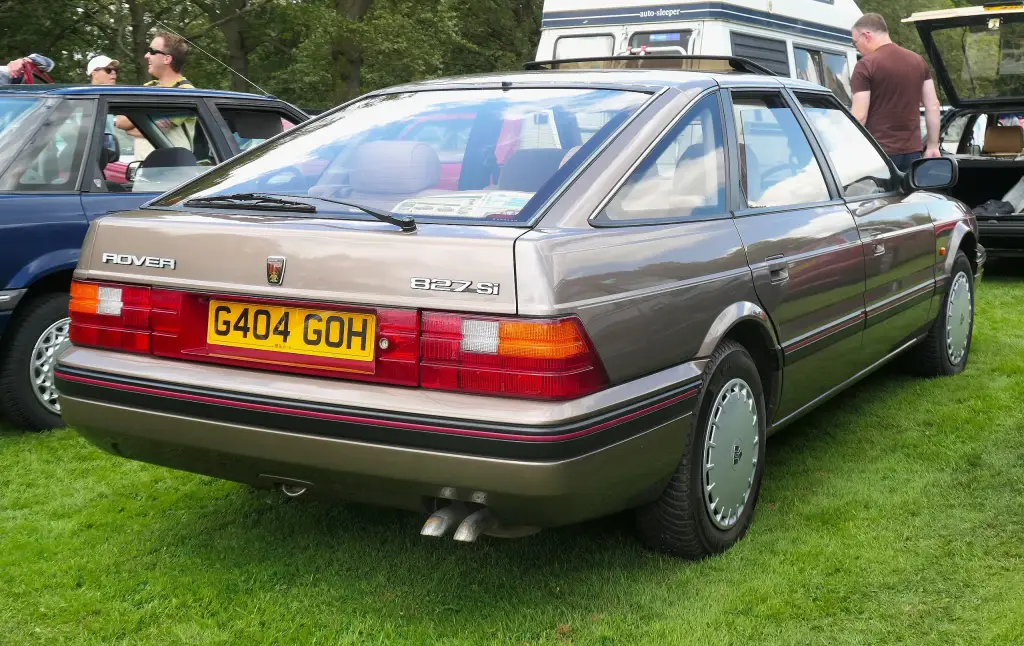
The Rover 800 series was an executive car range built by the Austin Rover Group and then the Rover Group from 1986 to 1999. It was co-developed with Honda, closely related to the Honda Legend and the successor to the Rover SD1, and it was marketed in the United States as the Sterling.
Rover 800 at a glance
| Production | 1986–1999, two marks |
|---|---|
| Launched | 10 July 1986, replacing the Rover SD1 |
| Partner | Honda; the Honda version was the Legend |
| Development codes | XX for the Rover, HX for the Honda |
| Mark I | 1986–1991 |
| 2.0-litre engines | M-series 16-valve developments of the O-series, in M16e and M16i forms |
| V6 | 2.5-litre Honda V6 in the 825i and Sterling, enlarged to 2.7 litres in February 1988 |
| Diesel | 2,498 cc VM Motori unit from 1990 |
| Bodies | four-door saloon from 1986, five-door fastback from 1988 |
| Badges | Sterling for the luxury saloon, Vitesse for the sporting fastback |
| 820 Turbo | just over 500 built with a Tickford-developed 180 bhp turbo engine |
| Successor | Rover 75, which replaced both the 600 and the 800 in 1999 |
Based on one source: the English Wikipedia article on the Rover 800 series, which covers the Mark I in detail.
History of the Rover 800
Working with Honda
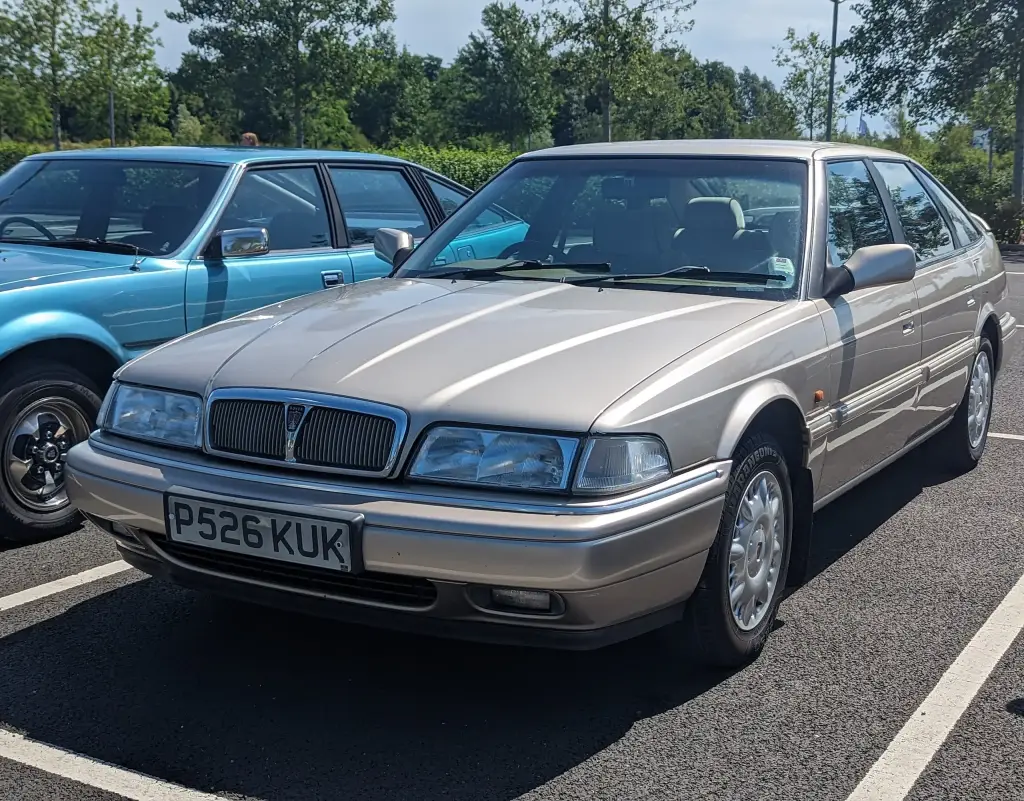
The first product of the BL-Honda alliance was the Triumph Acclaim, and shortly after its launch the two companies mapped out future projects. Plans for a mid-size car were dropped because BL already had the Austin Maestro and Montego in the final stages of development, but both companies needed a full-size executive car: BL had to plan a successor to the Rover SD1, and Honda wanted a luxury saloon to expand in North America, where its largest model was the Accord. Joint development began in 1981 under the XX codename, with the Honda version known as the Legend and codenamed HX, and the work was carried out at Rover’s Cowley plant and Honda’s Tochigi development centre. Both cars shared the core structure and floorpan but had their own exterior bodywork and interior, and under the agreement Honda supplied the V6 petrol engine, the automatic and manual transmissions and the chassis design, while BL provided the four-cylinder petrol engine and much of the electrical system. Honda and Austin Rover agreed that Legends for the British market would also be built at Cowley, while American Acura Legends were built in Japan. The 800 was launched on 10 July 1986 in place of the decade-old SD1.
Mark I, 1986–1991
At launch the two-litre 800s used two naturally aspirated 2.0-litre 16-valve developments of British Leyland’s O-series engine, called the M series. In 1988 an 820 Fastback with a single-carburettor O-series engine was added for the fleet market. The M series came in two forms: the M16e with single-point injection in the 820e and se, and the M16i with multi-point injection and four injectors in the 820i and si, using engine management derived from the MG Maestro and MG Montego. The top 2.5-litre versions, the 825i and Sterling, used a Honda-designed 2.5-litre V6. At first only a four-door saloon was offered, and a five-door liftback, called a fastback, arrived in 1988. There were no V8 versions, unlike earlier Rover saloons including the SD1, and unlike its rear-wheel-drive predecessor the 800 had front-wheel drive. A diesel followed in 1990 with a 2,498 cc engine from the Italian company VM Motori, related to the smaller unit used in the SD Turbo of the Rover SD1 and the Range Rover Turbo D. The Sterling badge marked the top luxury saloon and the Vitesse badge the top sporting fastback, the Vitesse arriving with the 2,675 cc Honda V6; both were initially available in Britain only with the V6. In some markets, Italy in particular, the 2.0-litre petrol was badged Sterling and later offered in turbo form as Vitesse to avoid duties that made engines over two litres unviable. At launch the Sterling caused controversy by overlapping in price with entry-level Jaguar XJ40 versions. Towards the end of Mark 1 production the Vitesse had nearly as many luxury features as the Sterling, and there was a brief run of just over 500 820 Turbo 16v cars using a turbocharged M-series engine developed with Tickford, with sodium-filled exhaust valves and Mahle forged pistons, producing 180 bhp. In the United States the car was branded Sterling rather than Rover and sold only with Honda V6 engines; sales started strongly but build quality and reliability problems with trim, electrics, paintwork and corrosion damaged its reputation, especially as the Acura Legend was doing well at the same time. Despite that, the 800 was Britain’s best-selling executive car for eight years. In February 1988 the 2.5-litre engine was enlarged to 2.7 litres and the Maestro-derived instrumentation was replaced by proper gauges.
Design and features
- Honda partnership: the same core structure as the Honda and Acura Legend, with Honda V6 power.
- Sterling and Vitesse: distinct badges for the luxury saloon and the sporting fastback.
- 820 Turbo: a Tickford-developed 180 bhp turbo model, built in a run of just over 500.
- Front-wheel drive: a break from the rear-wheel-drive SD1 it replaced.
Rover 800 versions
- 820 (1986–1991): the two-litre M-series models, from the 820e to the 820i and si.
- 825i and Sterling: the 2.5-litre Honda V6 cars, enlarged to 2.7 litres in 1988.
- Vitesse: the sporting fastback, with the 2,675 cc Honda V6.
- 820 Turbo 16v: the Tickford-developed turbo, just over 500 built.
- 820 diesel (1990): the 2,498 cc VM Motori engine.
The 800 was replaced by the Rover 75 and sat above the Rover 600. More cars are in the Rover collection.
Video: Rover 800 – Used Car Overview & Buying Advice
Video by Men and Motors on YouTube.
Sources
- Rover 800 series, English Wikipedia: development with Honda, the Mark I range, engines and the Sterling