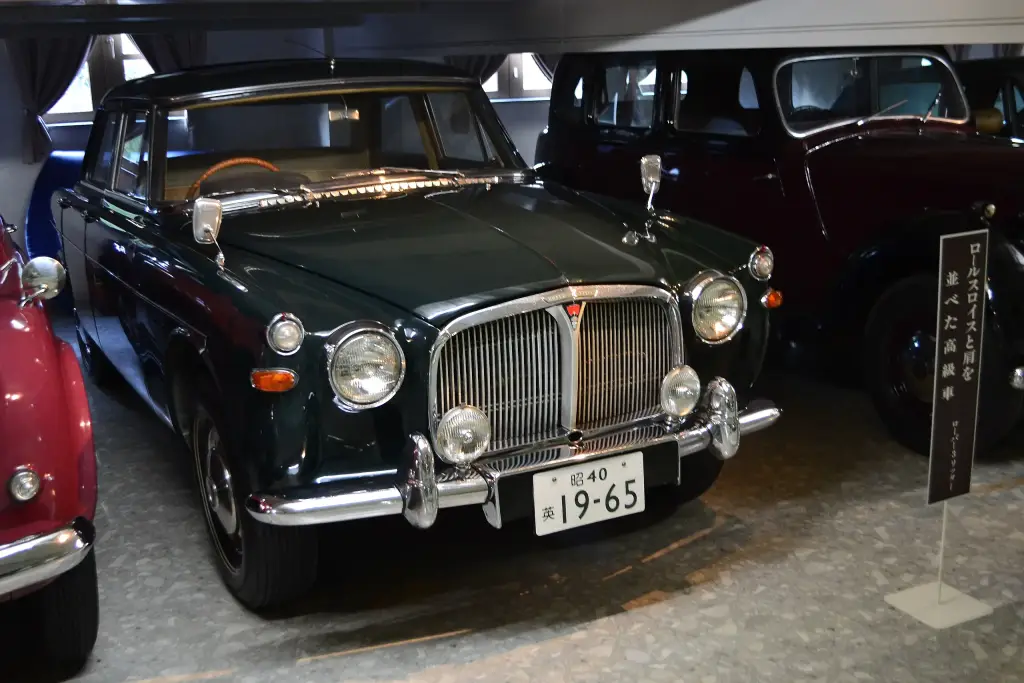
The Rover P5 was a series of large saloons and coupés produced from 1958 until 1973 under the names Rover 3 Litre, Rover 3.5 Litre and Rover 3½ Litre. It was a larger car than the P4 it partly replaced, and a total of 69,141 examples were built.
Rover P5 at a glance
| Production | 1958–1973 |
|---|---|
| Total built | 69,141 |
| Mark I | September 1958, 2,995 cc straight-six, 115 bhp |
| Mark I-A | September 1961, front quarter windows and a revised transmission |
| Mark II | 1962, 129 bhp and the four-door coupé body with a roof 2.5 inches lower |
| Mark III | October 1965, 134 bhp |
| P5B | September 1967, 3,528 cc Rover V8, 160 PS |
| Transmission | automatic or overdrive; Borg-Warner Type 35 automatic standard on the P5B |
| Suspension | front wishbones and torsion bars, rear live axle on semi-elliptic springs |
| Brakes | 11-inch drums at first, Girling front power discs from October 1959 |
| Bodywork | the first Rover with unitary construction, styled by David Bache |
| The Motor test (1960) | 95 mph, 0–60 mph in 17.1 s, £1,864 |
Based on one source: the English Wikipedia article on the Rover P5.
History of the Rover P5
Mark I and the 3-litre
The P5 appeared in September 1958, badged as the 3-litre. It was powered by a 2,995 cc straight-six of Rover’s inlet-over-exhaust type, with an overhead intake valve and a side exhaust valve inherited from the P4, and in this form it claimed 115 bhp. Automatic transmission, overdrive on the manual and Burman power steering were optional, and overdrive became standard in May 1960. Stopping power came originally from a Girling system with 11-inch drums all round, but the car was heavy and by the London Motor Show of October 1959 it had Girling front power disc brakes. The suspension was independent at the front on wishbones and torsion bars, with a live axle and semi-elliptic leaf springs at the rear. A Mark I-A line introduced in September 1961 brought a minor restyle with front quarter windows intended to help dashboard ventilation, plus modifications to the engine mountings and automatic transmission and optional Hydrosteer variable-ratio power steering. By 1962, when production of the original Mark I series ended, 20,963 had been built. The Motor tested an automatic car in 1960 and recorded 95.0 mph, 0–60 mph in 17.1 seconds, 20.5 miles per imperial gallon and a price of £1,864.
Mark II and the coupé
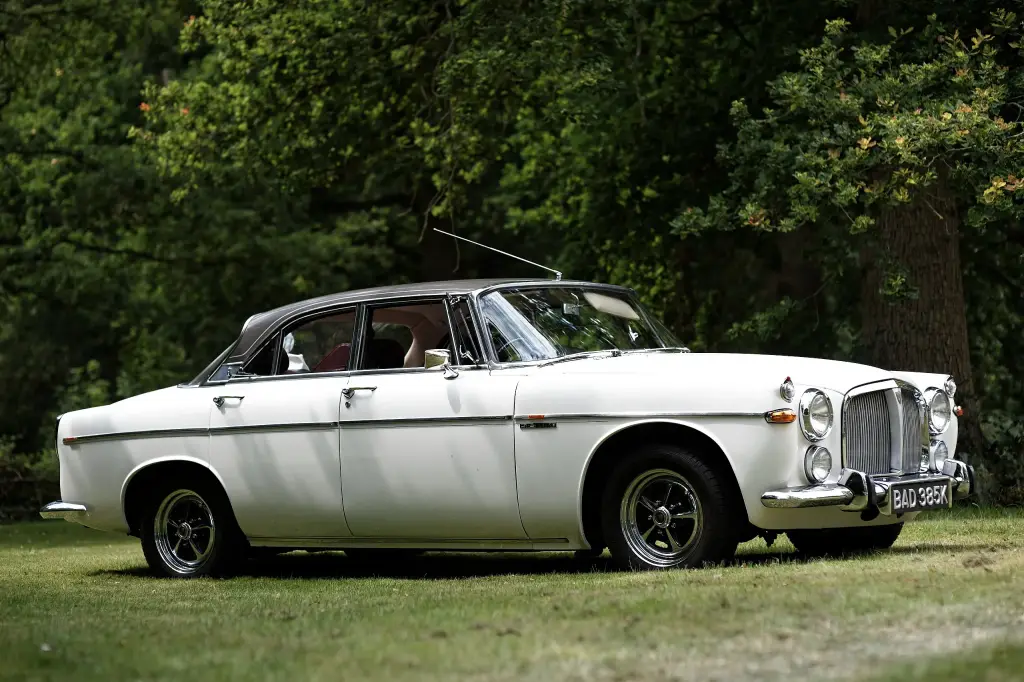
The Mark II of 1962 brought more power, 129 bhp from the same 3-litre engine, an improved suspension and the loss of the glass wind deflectors from the top of the window openings, while the front doors gained quarterlights. The most notable addition was the Coupé body launched in autumn 1962. Unlike most coupés, which are two-door versions of four-door saloons, this kept the four doors and was the same width and length as the saloon, but had a roofline lowered by two and a half inches and thinner B-pillars, giving it the look of a hardtop. Hydrosteer power-assisted steering was standard on the coupé and optional on the saloon. Production of the Mark II ended in 1965, by which time 5,482 coupés and 15,676 saloons had been built.
Mark III and the P5B
The Mark III was presented at the London Motor Show in October 1965, described as even more luxuriously trimmed and furnished. It was again available as a four-door saloon or coupé, used the same engine now producing 134 bhp, and could be told by its full-length body trim strip and Mark III badging; inside it replaced the rear bench with two individually moulded rear seats, more comfortable for four occupants but less so for five. A total of 3,919 saloons and 2,501 coupés had been sold when production ended in 1967. The final iteration appeared in September 1967 with the 3,528 cc Rover V8 also used in the 3500, badged 3.5 Litre and commonly known as the 3½ Litre. The B in P5B came from Buick, the engine’s originator; Rover did not have the budget for a new engine and instead developed the lightweight aluminium Buick unit, making it considerably stronger. The Borg-Warner Type 35 automatic transmission, Hydrosteer power steering and front Lucas fog lamps were now standard. Output was 160 PS at 5,200 rpm with 210 lb·ft of torque at 2,600 rpm, and the greater power and lower weight gave better performance and economy. Outside, the changes were bold 3.5 Litre badging, a pair of fog lights below the headlamps forming a four-light array and chrome Rostyle wheels with black painted inserts. Production ended in 1973 with 9,099 coupés and 11,501 saloons built, and the 3½ Litre saloon served as prime ministerial transport for Harold Wilson, Edward Heath, James Callaghan and Margaret Thatcher.
Design and features
- IOE six: the 3-litre engine carried over from the P4, with an overhead inlet valve and side exhaust valve.
- Four-door coupé: a lower roofline and thinner pillars without losing the rear doors.
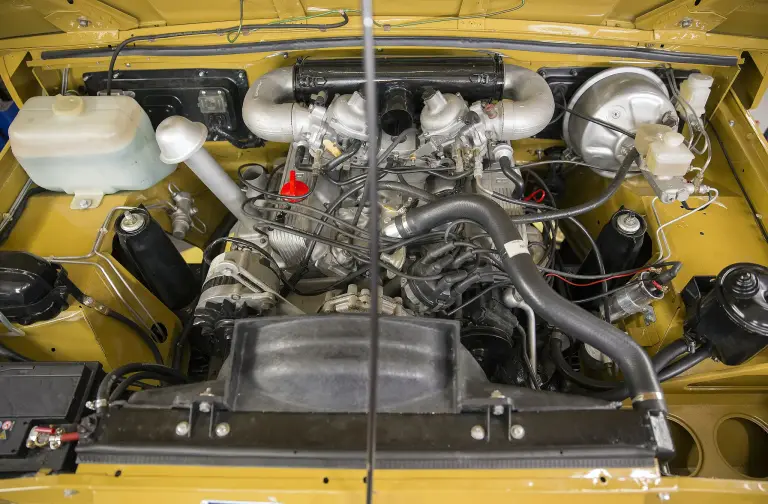
- Buick-derived V8: the 3.5 Litre of 1967 brought 160 PS and a standard automatic gearbox.
- Unitary bodywork: the first Rover with a one-piece body, styled by David Bache.
Rover P5 versions
- 3 Litre Mark I (1958–1962): 115 bhp, 20,963 built.
- Mark I-A (1961): quarter windows and revised engine mountings.
- Mark II saloon and coupé (1962–1965): 129 bhp; 15,676 saloons and 5,482 coupés.
- Mark III (1965–1967): 134 bhp; 3,919 saloons and 2,501 coupés.
- P5B 3.5 Litre (1967–1973): the V8 model, 11,501 saloons and 9,099 coupés.
The P5 sat above the Rover P4 and was joined in the range by the smaller Rover P6. More cars are in the Rover collection.
Video: Rover P5B – 1971 V8 goes for a drive
Video by furiousdriving on YouTube.
Sources
- Rover P5, English Wikipedia: the Mark I to Mark III and the P5B V8